The agreement could unlock a multibillion-dollar Saudi nuclear programme, but questions surrounding uranium enrichment, safeguards and non-proliferation are likely to attract international scrutiny.
By Nuclear Africa
27 July 2026
The United States and Saudi Arabia have signed a major peaceful nuclear cooperation agreement establishing the legal foundation for American companies to participate in the Kingdom’s emerging civil nuclear energy programme.
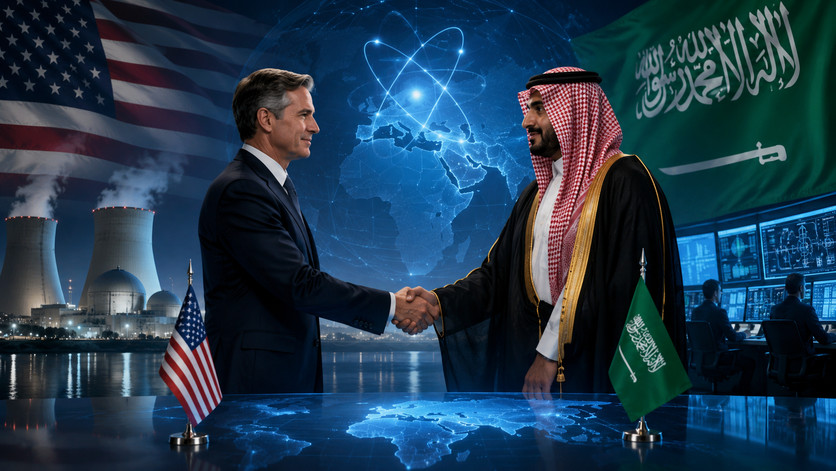
The agreement, commonly known as a Section 123 Agreement, was signed on 22 July 2026 by US Secretary of Energy Chris Wright and Saudi Arabia’s Minister of Energy, Prince Abdulaziz bin Salman. An accompanying bilateral safeguards agreement was also signed by the two countries.
The US Department of Energy described the arrangement as the basis for a “decades-long, multi-billion-dollar partnership” intended to facilitate nuclear technology exports, strengthen bilateral commercial relations and support Saudi Arabia’s efforts to diversify its energy system. The agreement will now be transmitted to the United States Congress for review before it can enter into force.
What is a Section 123 Agreement?
Under Section 123 of the United States Atomic Energy Act, a peaceful nuclear cooperation agreement is generally required before significant American nuclear materials, equipment or reactor components can be transferred to another country.
These agreements establish the legal conditions under which nuclear trade and technical cooperation may occur. They can cover reactor technology, nuclear materials, scientific research, workforce development, technical exchanges and safeguards cooperation.
For Saudi Arabia, the agreement could provide access to American nuclear technology and expertise as the country seeks to introduce nuclear power into its energy mix.
The programme could also create significant commercial opportunities for US nuclear companies. Reports indicate that Westinghouse’s AP1000 reactor technology is among the designs that could be considered for Saudi Arabia’s proposed nuclear power programme, although the final reactor technology, financing structure and implementation schedule remain subject to further decisions.
Saudi Arabia’s nuclear ambitions
Saudi Arabia has for several years explored the introduction of nuclear power as part of a broader strategy to diversify its electricity generation system, conserve hydrocarbons for export and support growing industrial and domestic electricity demand.
The country also possesses uranium resources and has expressed interest in developing parts of the nuclear fuel cycle. This has made the conditions governing any prospective enrichment or reprocessing activities a central issue in negotiations with international nuclear suppliers.
The US Department of Energy’s public announcement does not provide the complete text or detailed provisions of the new agreement. It states that the agreement upholds high standards of nuclear safety, security and non-proliferation and reinforces global non-proliferation objectives.
However, reporting by the Associated Press and Reuters indicates that the agreement could permit Saudi Arabia to pursue domestic uranium enrichment and possibly the reprocessing of nuclear material under specified arrangements. The reports also state that the agreement does not presently require Saudi Arabia to implement the International Atomic Energy Agency’s Additional Protocol.
The precise legal conditions governing these activities will require careful examination when the full agreement and accompanying safeguards provisions become publicly available.
The safeguards question
Saudi Arabia is a party to the Treaty on the Non-Proliferation of Nuclear Weapons and has a comprehensive safeguards agreement with the IAEA.
The Kingdom has also moved away from the original Small Quantities Protocol safeguards arrangement designed for states with little or no significant nuclear material or nuclear activity. Regular safeguards arrangements provide for greater verification of declared nuclear materials and facilities as a country’s nuclear programme expands.
An Additional Protocol would provide the IAEA with expanded access to information and locations, strengthening its capacity to detect possible undeclared nuclear materials and activities.
Reports that the US–Saudi agreement may not require the Additional Protocol have therefore generated concern among some non-proliferation specialists and legislators. Critics argue that a country considering domestic enrichment should accept the strongest available international verification arrangements.
Supporters of the agreement maintain that engaging Saudi Arabia through a formal US cooperation framework would provide stronger safety, security and non-proliferation controls than leaving the Kingdom to pursue partnerships under less restrictive supplier arrangements.
The debate is consequently not only about whether Saudi Arabia should develop nuclear energy. It is also about the safeguards, fuel-cycle and verification conditions under which that programme should proceed.
Comparison with the UAE model
The agreement is likely to be compared with the 2009 US–United Arab Emirates peaceful nuclear cooperation agreement.
Under that arrangement, the UAE committed not to enrich uranium or reprocess spent nuclear fuel within its territory. This commitment, together with the UAE’s implementation of the IAEA Additional Protocol, led the agreement to be widely described as a high-standard or “gold-standard” model for nuclear cooperation with newcomer countries.
Saudi Arabia has taken a different position, maintaining that it should retain the right to develop nuclear fuel-cycle capabilities available to other countries under the Nuclear Non-Proliferation Treaty.
The contrast between the Saudi and UAE approaches raises broader questions about whether nuclear supplier countries can maintain a uniform non-proliferation standard or whether future agreements will increasingly reflect country-specific political, strategic and commercial considerations.
Congressional review remains important
The agreement has not yet completed the US domestic approval process.
According to the US Department of Energy, it will be transmitted to Congress for review. Reuters reports that Congress will have 90 days of continuous session to examine the agreement and may seek to approve, reject or modify the terms through the applicable legislative process.
The review is expected to focus on uranium enrichment, spent-fuel reprocessing, IAEA verification, the bilateral safeguards agreement and the wider security implications of introducing sensitive nuclear technologies into the Middle East.
The agreement could therefore face extensive debate before it becomes operational.
Why the agreement matters for Africa
The US–Saudi agreement has important implications beyond the Middle East.
Several African countries are exploring nuclear power, small modular reactors, research reactors and other peaceful nuclear applications. Many will eventually need to negotiate nuclear cooperation agreements with technology-supplying countries.
The Saudi experience demonstrates that such agreements are not simply commercial arrangements for purchasing reactors. They can determine:
- access to nuclear technology and materials;
- nuclear fuel-supply conditions;
- rights and restrictions concerning enrichment and reprocessing;
- safeguards and verification obligations;
- spent-fuel and radioactive-waste arrangements;
- technology-transfer and localisation opportunities;
- workforce-development commitments;
- long-term dependence on foreign suppliers; and
- the geopolitical orientation of a national nuclear programme.
African nuclear-newcomer countries should therefore develop clear negotiating positions before entering supplier agreements. These positions should be grounded in national nuclear policy, energy planning, non-proliferation commitments, financing assessments and long-term fuel-cycle strategies.
Countries should also ensure that commercial negotiations do not move ahead of the development of an independent regulator, comprehensive nuclear legislation, a competent owner-operator organisation and credible arrangements for nuclear safety, security, safeguards and radioactive-waste management.
A wider shift in global nuclear diplomacy
The agreement reflects the growing strategic competition among the United States, Russia, China, South Korea and other nuclear suppliers seeking access to emerging nuclear markets.
Supplier states increasingly offer packages combining reactor technology, financing, fuel supply, workforce training, infrastructure development and broader diplomatic cooperation.
For nuclear-newcomer countries, this competition may create opportunities to negotiate better financing and localisation terms. It may also create risks where geopolitical considerations overshadow technical readiness, regulatory independence, economic sustainability or non-proliferation responsibilities.
The US–Saudi agreement should therefore be watched closely by African policymakers, regulators and nuclear institutions.
Its final provisions—and the outcome of the congressional review—could influence how future nuclear cooperation agreements balance national development priorities, commercial interests, sovereign fuel-cycle rights and the international community’s non-proliferation expectations.
Conclusion
The signing of the US–Saudi peaceful nuclear cooperation agreement represents a major milestone in Saudi Arabia’s nuclear energy ambitions and the United States’ renewed effort to expand its presence in the global civil nuclear market.
It may unlock significant investment, reactor construction and technical cooperation. At the same time, unresolved questions concerning uranium enrichment, reprocessing and the Additional Protocol mean that the agreement will remain under close international scrutiny.
For Africa’s emerging nuclear-energy programmes, the central lesson is clear: nuclear cooperation agreements must be treated as long-term instruments of national policy and international responsibility—not merely as reactor-purchasing contracts.
Their provisions can shape a country’s nuclear programme, strategic relationships, safeguards obligations and energy sovereignty for several decades.
Related

Modernising Radioactive-Material Transport Rules: What Africa Can Learn from the US Proposal
By Nuclear Africa• July 27, 2026

Nuclear Africa Opportunities Roundup
By Nuclear Africa• July 27, 2026Rwanda Completes IAEA Review of Research-Reactor Infrastructure
By Nuclear Africa• July 27, 2026