
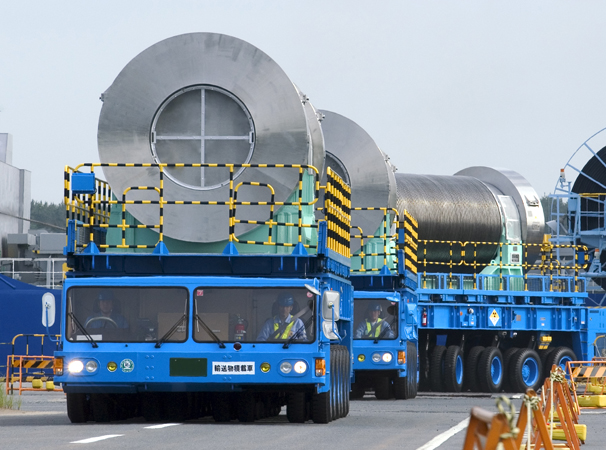
The United States Nuclear Regulatory Commission has proposed changes to its regulations governing the certification of packages used to transport radioactive materials, including packages that could carry transportable microreactors and other advanced nuclear systems.
The proposed amendments form part of a broader effort by the NRC to modernise its regulations and reduce unnecessary administrative requirements while maintaining protection of workers, the public and the environment.
The main regulations concerned are contained in Part 71 of Title 10 of the United States Code of Federal Regulations, which establishes requirements for the packaging, preparation and transportation of licensed radioactive materials.
The NRC’s rulemaking schedule identifies the initiative as “Modernizing Package Certification Requirements” and associates it with Docket NRC-2025-1667.
The proposal is particularly relevant to emerging reactors that may be manufactured, fuelled or tested in factories and later transported to deployment sites.
For Africa, however, the significance extends beyond microreactors. The continent already depends on the frequent movement of medical isotopes, industrial sources, research materials and radioactive waste across national borders.
Why radioactive-material transport matters
Radioactive materials are transported safely around the world every day.
They are used in:
- cancer diagnosis and treatment;
- sterilisation of medical equipment;
- industrial radiography;
- mining and mineral processing;
- agricultural research;
- scientific laboratories;
- oil and gas operations;
- nuclear-power generation; and
- radioactive-waste management.
Many of these materials must travel by road, air, rail or sea between producers, users, storage facilities and disposal sites.
The safe-transport system is based primarily on the package.
Packaging requirements are designed so that radioactive material remains contained and adequately shielded during routine transport conditions and, for higher-risk materials, under specified accident conditions.
Transport regulations also address labelling, documentation, radiation levels, quality assurance, security, emergency arrangements and notifications to relevant authorities.
Different packages for different risks
Radioactive materials are not all transported in the same type of container.
The package depends on the amount, physical form and potential hazard of the material.
Common categories include:
Excepted packages
These are used for very small quantities of radioactive material presenting limited hazards.
Industrial packages
These may be used for materials with relatively low concentrations of radioactivity, including certain ores, contaminated equipment and low-specific-activity materials.
Type A packages
Type A packages are used for limited quantities of radioactive material. They are designed to withstand normal transport conditions such as rainfall, handling impacts and stacking loads.
Many medical and industrial radioactive materials are transported in Type A packages.
Type B packages
Type B packages are intended for larger quantities or more hazardous radioactive material.
They must be capable of maintaining containment and shielding following severe test conditions representing credible transport accidents, including impact, fire and water immersion.
Spent nuclear fuel and significant quantities of certain radioactive materials generally require Type B packages.
Fissile-material packages
Packages containing fissile materials must also demonstrate that criticality will be prevented during normal and accident conditions.
This requirement is particularly important for nuclear fuel and transportable reactor systems.
What the US proposal seeks to change
The proposed American reforms are intended to modernise how transport packages are certified.
The NRC has indicated that the initiative is connected partly to the development of transportable microreactors and other advanced technologies.
Microreactor developers are considering factory-based manufacturing models in which reactor modules could be assembled, fuelled, tested and then transported to remote or industrial sites.
Existing transport regulations were largely developed around conventional shipments such as radioactive sources, fresh nuclear fuel, spent fuel and radioactive waste.
A complete or partly assembled reactor module may present different issues.
Regulators may need to determine:
- whether the reactor is transported with fuel installed;
- how criticality is prevented;
- whether coolant or other radioactive material remains inside;
- how decay heat is managed;
- how the package is secured;
- what accident tests apply;
- how repeated transportation is authorised;
- what inspections are required before shipment; and
- how responsibilities are divided between reactor and transport regulators.
The NRC’s rulemaking seeks to make certification more efficient and better suited to emerging technologies without abandoning the performance requirements that protect the public.
Package certification is not permission to transport anything anywhere
A certified package design is only one part of a safe shipment.
Transporting radioactive material may also require:
- possession or material licences;
- shipment approvals;
- carrier qualifications;
- security plans;
- route assessments;
- advance notifications;
- emergency arrangements;
- customs documentation;
- transit-state permissions; and
- compliance with national and international transport rules.
The shipper must also ensure that the package is correctly loaded, closed, surveyed, labelled and documented.
A strong regulatory system therefore combines package design approval with operational controls over each shipment.
The international regulatory framework
The IAEA develops international safety standards for the transport of radioactive material.
These standards provide the technical foundation for many national and international transport regulations covering road, rail, air, inland waterway and maritime shipments.
Other international organisations apply related requirements within their respective transport sectors.
For example, air shipments must comply with aviation requirements, while maritime shipments are subject to international shipping rules.
Countries incorporate these standards into national legislation and regulatory systems.
However, differences in implementation can still create delays, duplication and uncertainty—particularly where a shipment passes through several jurisdictions.
Why the issue matters to Africa now
Africa’s most immediate radioactive-transport challenge is not the movement of complete microreactors.
It is the routine transport of medical isotopes, radiopharmaceuticals and industrial radioactive sources.
Many African hospitals depend on materials produced abroad or in a small number of regional facilities.
Some medical isotopes have short half-lives, meaning their radioactivity decreases rapidly. Delays at airports, borders or customs posts can therefore make a shipment medically unusable before it reaches the patient.
Transport disruptions can arise from:
- inconsistent documentation;
- limited airline acceptance;
- customs delays;
- lack of trained cargo handlers;
- duplicate regulatory approvals;
- uncertainty over package certificates;
- poor coordination among authorities;
- limited emergency arrangements; and
- refusal by carriers or transit countries.
These challenges can affect cancer diagnosis and treatment even where the radioactive material has been packaged safely.
Transport regulation is therefore both a safety issue and a healthcare-access issue.
Recognition of foreign package certificates
One of the central questions for African regulators is how to recognise package approvals issued by another competent authority.
It would be inefficient for every African country to repeat a complete technical assessment of an internationally certified package.
At the same time, regulators cannot simply accept every foreign certificate without confirming its validity and applicability.
A practical recognition system should establish:
- which foreign competent authorities are accepted;
- which package types require national validation;
- what supporting documentation must be submitted;
- how design modifications are treated;
- how certificate expiry is monitored;
- how quality-assurance problems are communicated; and
- when the national regulator may impose additional conditions.
Regional guidance could reduce duplication while preserving national regulatory authority.
The African medical-isotope supply chain
The expansion of nuclear medicine across Africa will increase the number of radioactive shipments moving between countries.
South Africa remains a major regional isotope producer, but many other African states are developing cyclotrons, radiopharmaceutical facilities and nuclear-medicine centres.
A reliable continental supply chain requires cooperation among:
- nuclear regulators;
- medicines authorities;
- civil-aviation bodies;
- airport operators;
- customs agencies;
- health ministries;
- transport companies;
- police and security agencies;
- isotope producers; and
- hospitals.
Each institution has a legitimate role, but fragmented processes can create avoidable delays.
Governments should establish dedicated procedures for urgent medical-isotope consignments without weakening safety or security controls.
Electronic pre-clearance, shared documentation systems and designated points of contact could significantly improve delivery times.
Transport security
Safety and security are related but distinct.
Transport safety focuses on preventing exposure, contamination, criticality and releases during normal and accident conditions.
Transport security focuses on preventing theft, sabotage, unauthorised access and malicious use.
High-activity radioactive sources can be attractive to criminals or other malicious actors because they may be used to cause harm or public fear.
Security arrangements may include:
- background checks;
- shipment tracking;
- secure communication;
- route planning;
- escorts;
- vehicle security;
- response arrangements; and
- confidentiality of sensitive shipment information.
Requirements should follow a graded approach based on the material’s potential consequences.
Applying the highest security level to every low-risk shipment would be impractical. Applying weak controls to high-activity sources would be irresponsible.
The microreactor question for Africa
Microreactors are being promoted for mines, remote communities, military installations, industrial facilities and isolated electricity systems.
Some African countries may eventually consider these systems for locations that are difficult to connect to national grids.
Transportability is often presented as a major advantage. A reactor could theoretically be delivered to a site and removed at the end of its operating period.
However, transportability creates additional regulatory and policy questions.
African governments would need to establish:
- who authorises the reactor package;
- whether it may cross national borders while fuelled;
- which country retains safeguards responsibility;
- how nuclear material is tracked;
- who provides physical protection;
- how transport accidents are managed;
- where spent fuel is returned;
- who accepts radioactive waste;
- whether transit states can refuse passage; and
- how nuclear liability applies during transport.
These issues should be resolved before procurement contracts are signed.
A vendor’s statement that a reactor is “transportable” does not by itself establish that transport is legally, technically or politically feasible.
Cross-border regulatory cooperation
Africa’s regional economic communities could play a greater role in radioactive-material transport.
Organisations such as the Economic Community of West African States, the East African Community, the Southern African Development Community and the African Union could support:
- harmonised documentation;
- common training programmes;
- emergency-response exercises;
- compatible package-validation procedures;
- information-sharing among regulators;
- designated transport corridors;
- regional guidance for medical isotopes; and
- mutual assistance following an accident or security event.
Regional cooperation would not remove national sovereignty.
Instead, it would create predictable procedures for shipments that already cross borders.
The African Commission on Nuclear Energy and regional regulatory networks could help coordinate such work with the IAEA.
Ghana and other nuclear-newcomer countries
Ghana and other countries preparing nuclear-power programmes must develop transport capability as part of their broader nuclear infrastructure.
Even before a power reactor is constructed, a newcomer programme may need to transport:
- environmental samples;
- calibration sources;
- research materials;
- fresh fuel for a research reactor;
- radioactive waste;
- nuclear instrumentation; and
- medical or industrial sources.
Later stages may involve heavy reactor components, fresh nuclear fuel, spent fuel and potentially modular reactor systems.
Transport responsibilities should therefore be clearly allocated among the nuclear regulator, customs authorities, transport ministries, national security institutions, emergency services and the future plant operator.
Regulations should also address international transit, port handling, carrier approval, package certification and liability.
Lessons from the US proposal
Regulations must evolve with technology
Rules written for conventional shipments may not adequately address fuelled microreactors or other transportable nuclear systems.
African regulators should review whether existing laws are sufficiently technology-neutral.
Efficiency and safety can be pursued together
Removing duplicate paperwork or creating clearer certification pathways does not necessarily weaken safety.
Well-designed reforms can allow regulators to focus resources on higher-risk activities.
Package approval should be risk-informed
Regulatory effort should correspond to the radioactive inventory, fissile content, heat generation and potential consequences of a shipment.
Cross-agency coordination is essential
Nuclear regulators cannot manage transport alone.
Customs, aviation, maritime, road-safety, health and security institutions must understand their roles.
Regional recognition can reduce delays
Compatible procedures for recognising foreign package certificates could improve both trade and healthcare access.
Emergency arrangements must be practical
Countries should have trained responders capable of recognising radioactive-material packages and taking appropriate action without unnecessary public alarm.
Public communication following transport events
Transport incidents involving radioactive materials can generate disproportionate public concern.
A traffic collision involving a properly secured radioactive package does not necessarily mean that radiation has been released.
Authorities should communicate:
- what material was being transported;
- what type of package was used;
- whether the package was damaged;
- whether radiation levels changed;
- whether anyone was exposed;
- what protective actions were taken; and
- whether the shipment remained secure.
Accurate communication protects the public from both real hazards and unnecessary fear.
Conclusion
The US proposal to modernise radioactive-material package certification responds partly to the emergence of transportable microreactors and new nuclear technologies.
Its relevance to Africa is broader.
African countries already rely on the safe and timely movement of medical isotopes, industrial sources and research materials. Yet inconsistent regulations, border delays, limited carrier capacity and fragmented institutional responsibilities continue to affect the system.
As advanced reactors emerge, the transport challenge will become more complex.
African governments and regulators should therefore modernise national rules, strengthen package-recognition systems, improve customs coordination and develop regional arrangements before transportable reactors and larger nuclear-material shipments arrive.
Safe transport regulation is not an administrative detail.
It is an essential link connecting nuclear technology to hospitals, industries, research institutions and, eventually, nuclear-power programmes across the continent.
Related

Morocco Nuclear Regulator Says No Radioactive Leak at Maâmora Research Centre
By Nuclear Africa• October 7, 2026
Amazon’s 20-Year Nuclear Deal Shows How Large Corporate Buyers Can Help Finance Nuclear Investment
By Nuclear Africa• October 7, 2026Beyond the Resolutions: GC70 and the Emerging Global Nuclear Order
By Nuclear Africa• October 6, 2026
US Nuclear Regulator’s Workforce Warning Carries a Clear Lesson for African Nuclear Newcomers
By Nuclear Africa• October 5, 2026