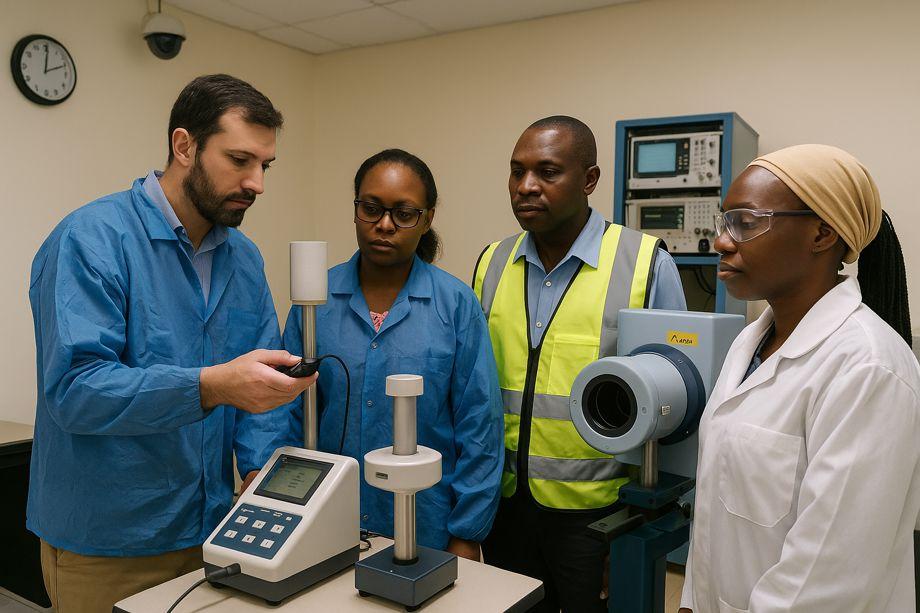
Kenya’s nuclear energy ambitions received an important examination in October 2026, but not of the kind most often featured in headlines about new reactors. From 11 to 19 October, an International Atomic Energy Agency (IAEA) team conducted an Integrated Review Service for Radioactive Waste and Spent Fuel Management, Decommissioning and Remediation (ARTEMIS) mission in Nairobi at the Kenyan government’s request. The review, the IAEA said, was the first ARTEMIS mission held in Africa.
In its 22 October statement, the Agency recognised Kenya’s commitment and progress in managing radioactive waste. It also urged the country to strengthen the independence of regulatory activities, complete key national policies and draw together the findings of the 2026 ARTEMIS mission and a separate 2025 regulatory peer review into one coordinated action plan. The final ARTEMIS report is expected to be provided to Kenyan authorities within three months of the mission.
This is neither an international certificate approving a nuclear power station nor a finding that Kenya’s waste-management challenge has been solved. It is a peer review designed to identify strengths and improvements. The real test is whether Kenya can translate the recommendations into accountable institutional action, sustained budgets and independently verifiable safety outcomes.
Why examine radioactive waste before the first nuclear power plant?
The public discussion about African nuclear power often begins with electricity shortages, reactor vendors, financing, sites and dates. Radioactive waste enters the debate later, sometimes framed as an objection rather than a core infrastructure requirement. That sequence is backward. Even countries without nuclear power plants already rely on radioactive materials in hospitals, cancer treatment, industry, education and research. Those activities generate disused sealed sources and other radioactive waste that require controlled handling, storage, transport and eventual disposal.
Kenya is an instructive example. The IAEA noted that the country’s existing waste-management programme is served by the Central Radioactive Waste Processing Facility at Oloolua in Kajiado County. The facility addresses responsibilities that exist independently of any future electricity-generation reactor. In other words, nuclear waste governance is not a speculative obligation arising only if a new nuclear plant is built; it is part of the current national radiation-safety system.
As programmes grow, the categories and timescales of responsibility become more complex. Disused industrial or medical sources, operational waste from a research reactor, spent research-reactor fuel, and eventual waste and spent fuel from a commercial power plant are not interchangeable. They differ in physical properties, radionuclide inventories, heat output, shielding requirements, security needs, conditioning techniques and long-term management strategies. A national programme must specify which institution is responsible for each category at every stage.
What the IAEA actually found
The ARTEMIS team included four external experts from Lithuania, Morocco, Slovakia and South Africa, supported by four IAEA staff. Hosted by the Kenya Nuclear Regulatory Authority (KNRA), it examined national arrangements against IAEA safety standards and relevant international practices. Its discussions addressed the existing management of disused sources and the future demands associated with proposed research and power reactors. The reviewers also considered the October 2025 IAEA regulatory review.
The public findings can be grouped into three practical priorities. First, Kenya should protect the independence of regulatory activities, ensuring that safety oversight can be exercised without improper influence from institutions promoting nuclear technologies or operating facilities. Second, it should finalise its national policies on nuclear energy, the nuclear fuel cycle and radioactive waste management. Third, it should strengthen human and institutional capacity and implement a consolidated action plan spanning the earlier and current review findings.
These recommendations are complementary. A regulator cannot consistently enforce requirements if institutional mandates are unclear. A waste-management operator cannot plan facilities and funding effectively if there is no agreed national policy for ownership, waste classification, long-term storage and disposal. A government cannot demonstrate progress simply by completing studies unless action points are assigned to authorities, deadlines, funding and measurable evidence.
The IAEA’s press release does not publish a full site-by-site technical appraisal or assert that a particular future repository has been approved. It also does not confer a nuclear construction or operating licence. Pending publication of the final mission report, external analysts should avoid attributing detailed technical findings beyond the Agency’s released recommendations.
A research reactor and a power programme are different tracks
Kenya is simultaneously developing plans for its first nuclear research reactor and the longer-term possibility of nuclear electricity generation. These two projects should be kept distinct in public communication. A research reactor can support scientific training, neutron applications, analysis, isotope-related research and the development of national competence. A commercial nuclear power plant is a much larger electricity-sector undertaking with different economic, grid and construction requirements.
In October, the Nuclear Power and Energy Agency (NuPEA) reported that Kenya had designated it the operating organisation for a proposed 10-megawatt thermal research reactor at Konza Technopolis. That proposed facility is not a 10 MW electricity station: thermal power is not the same as electrical output. The research-reactor initiative also had a separate IAEA infrastructure review activity, which should not be confused with the ARTEMIS mission on waste and spent fuel.
Both pathways require radioactive-waste management, but the nature and scale of their responsibilities differ. For a research reactor, questions include fuel procurement, potential return or transfer arrangements for spent fuel, interim storage, radioactive experiments, activated components and eventual decommissioning. For a future power reactor, Kenya would need to account for a much larger long-term spent-fuel inventory and operational waste streams, in addition to fuel-cycle contractual arrangements and the eventual end of the plant’s operating life.
Thus, the ARTEMIS review touches an enabling system that cuts across research, health, industry and future energy generation. Building a capable waste-management system now could improve safety irrespective of when, or whether, a commercial reactor is ultimately commissioned.
Five governance decisions that cannot be deferred
A comprehensive national inventory. Kenya needs an authoritative and frequently updated picture of sources and waste already in use, in storage or awaiting disposition. Inventory quality influences both radiological safety and nuclear security. It informs facility capacity, transport routes, contingency planning and the liabilities that must be funded.
Clear ownership and institutional roles. Waste generators, the central facility operator, implementing institutions, regulatory authorities and relevant ministries must have defined duties. Policies should distinguish who sets strategy, who manages waste, who owns liabilities and who independently inspects compliance. Responsibility should not disappear when a private operator closes or a source becomes disused.
A technically justified waste pathway. Processing and interim storage facilities are important but are not necessarily permanent disposal solutions. Strategies should be suited to different waste classes and should address treatment, conditioning, package acceptance, engineered barriers, monitoring, records preservation and eventual disposal options. A programme should explain which decisions are required today and which can be staged as inventories and technologies mature.
Financing across generations. Safe waste management imposes obligations long after equipment generates revenue or a facility closes. Funding approaches may include generator charges, ring-fenced provisions and government responsibilities for legacy waste. The principle should be that foreseeable liabilities are recognised in the full cost of nuclear technologies, not moved off the books until a future government inherits them.
Public consent supported by transparent information. Communities around existing or proposed facilities should know what materials are present, the nature of credible risks, the protections in place, how incidents are reported and whom to contact. Engagement must be accessible and two-way. Technical compliance is essential, but trust also depends on the quality of information and the responsiveness of institutions to concerns.
Why regulatory independence matters
The IAEA recommendation on independent regulatory activities deserves particular attention. Nuclear institutions have different mandates: an agency may promote nuclear power, an operator may construct or manage facilities, and a regulator must decide independently whether standards are met. When these responsibilities are blurred, pressure to achieve political deadlines may undermine safety decisions or weaken public confidence that the regulator can say no.
Independence is not only a clause in legislation. It requires a transparent appointment process, skilled personnel, stable resources, the authority to inspect and enforce, freedom from operational conflicts of interest, and access to technical support. The regulator must be able to challenge both a small medical source user and an important state-sponsored nuclear project. Maintaining that separation also helps establish credibility with potential international partners and financiers.
A continental precedent worth using carefully
Kenya’s hosting of Africa’s first ARTEMIS mission is valuable beyond its borders because nuclear infrastructure in Africa is at different stages of maturity. South Africa manages an existing commercial nuclear programme; Egypt has reactors under construction; other countries have research reactors or use radioactive sources extensively but do not yet generate nuclear electricity. These programmes have different waste inventories, but all need national systems that work throughout a facility’s life cycle.
The regional lesson is that readiness should not be judged solely by reactor-site selection, vendor discussions or grid studies. It should also be demonstrated through a national waste policy, a credible inventory, a capable implementing organisation, a properly empowered regulator, trained staff, transparent funds and a programme for implementing peer-review recommendations.
There is a potential role for African technical cooperation, including regional training, laboratory support, source-security expertise, waste characterisation and peer exchanges. However, regional cooperation cannot substitute for clear national legal responsibility. Nor should shared arrangements be assumed to permit cross-border movement or disposal of radioactive waste without specific national and international legal requirements being met.
What comes next for Kenya
The next milestones are practical rather than ceremonial. The government and KNRA should publish, where appropriate, a clear account of the ARTEMIS action items once the final report is available; identify the authority responsible for each item; set realistic implementation dates; and establish periodic progress reporting. Important measures include progress on the national policy framework, a verified waste inventory, competency assessments, sustainable funding and oversight arrangements at the Oloolua facility.
Future IAEA reviews can help validate improvement, but national institutions must own the work between missions. Parliamentary oversight and public reporting would make that accountability more durable. For research-reactor and nuclear-power planners, waste and spent-fuel obligations should become explicit project-development criteria, with costs and responsibilities defined before major commitments are signed.
Related

Ghana Commits US$200 Million to Nuclear Power Readiness, Sets 2028 Deadline for Construction Contract
By Nuclear Africa• November 13, 2026
South Africa’s 5,200 MW Nuclear Expansion Faces Its Real Test: From Policy to Procurement
By Nuclear Africa• November 11, 2026Zambia Completes IAEA Phase 1 INIR Mission: What the Review Means for Its Nuclear Power Ambitions
By Nuclear Africa• November 11, 2026COP31 in Türkiye: Can Nuclear Energy Move From Climate Pledges to Bankable Projects and What Will Africa Gain?
By Nuclear Africa• November 11, 2026