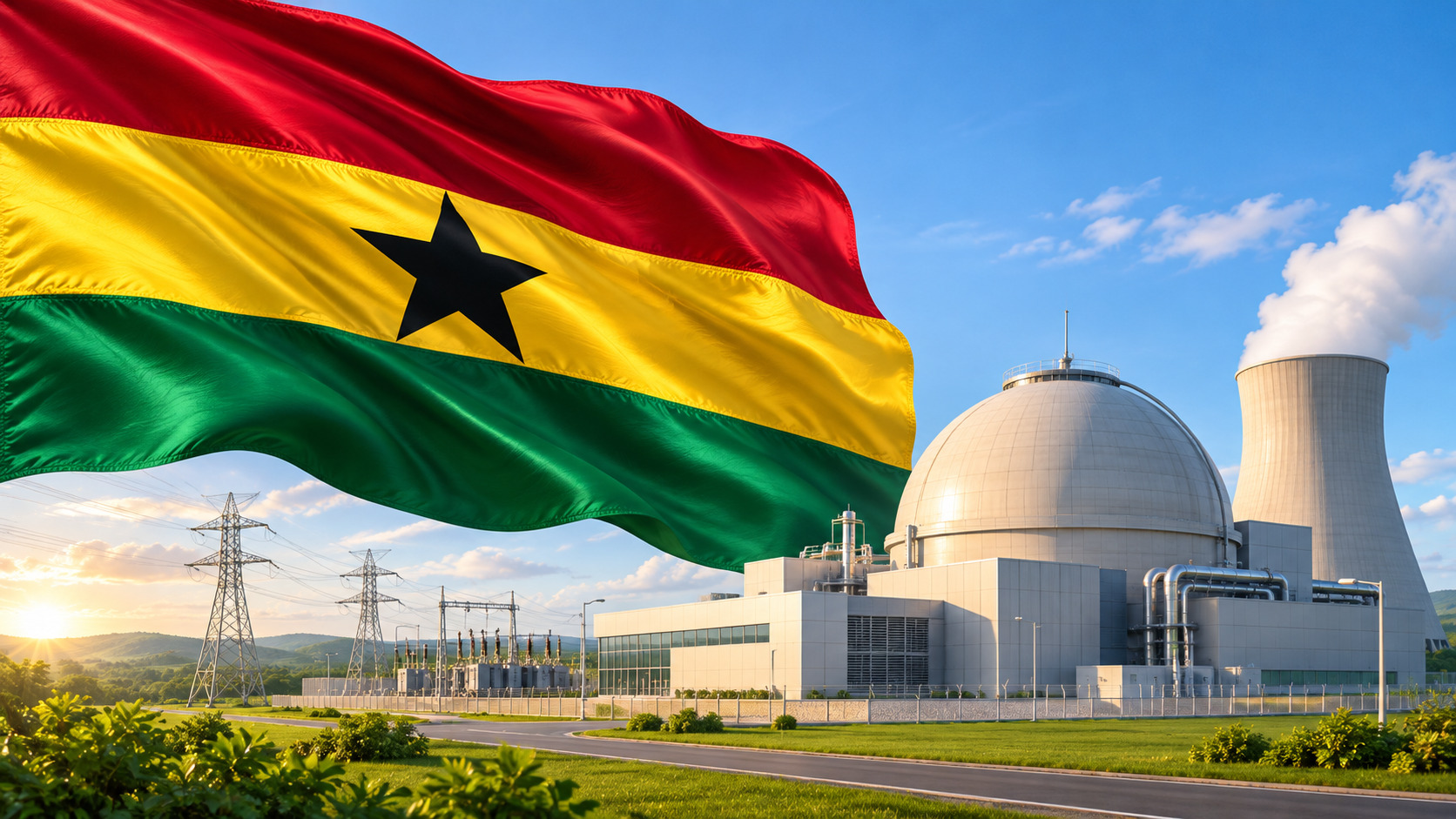
Ghana’s 2027 Budget marks a significant shift from decades of nuclear energy planning towards investment preparation, with a US$200 million commitment to strengthen national readiness, establish a state-owned nuclear power plant and position the country for a major construction and financing agreement by December 2028.
By NuclearAfrica
Ghana has taken a significant step towards realising its longstanding ambition of introducing nuclear electricity generation, announcing a US$200 million commitment to accelerate preparations for the country’s first nuclear power plant. The announcement, contained in the 2027 Budget Statement and Economic Policy presented to Parliament on 12 November 2026 by Finance Minister Dr. Cassiel Ato Forson, establishes a 24-month nuclear power readiness programme scheduled to run from January 2027 to December 2028.
The commitment signals an important transition in Ghana’s nuclear energy development, moving the programme beyond policy declarations and institutional preparations towards a more clearly defined investment and implementation phase. Under the programme, the government intends to complete essential technical, institutional, financial and regulatory preparations and sign an engineering, procurement, construction and financing (EPCF) contract by December 2028.
The proposed nuclear power plant will be fully state-owned, reflecting the government’s wider objective of strengthening national control over strategic energy infrastructure. International partners are expected to provide technology, financing, engineering expertise and specialised services, while the plant itself will remain a strategic national asset.
The significance of the announcement extends beyond the headline financial commitment. It represents an opportunity to consolidate decades of nuclear infrastructure development and establish a clearer pathway towards commercial nuclear electricity generation. Nevertheless, the US$200 million commitment is intended to support nuclear readiness rather than finance the entire construction of a nuclear power plant, and the announcement does not establish that the full amount has already been appropriated or disbursed.
A New Chapter in Ghana’s Nuclear Energy Ambition
Ghana’s pursuit of nuclear power is rooted in a longstanding national ambition to diversify electricity generation, strengthen energy security and support industrial development. Since the early years of independence, nuclear science and technology have featured in the country’s broader scientific and technological aspirations. Over subsequent decades, Ghana has established research capabilities, developed technical expertise, strengthened international cooperation and created institutions to support the peaceful applications of nuclear technology.
The decision to commit US$200 million to nuclear readiness introduces a more specific financial and implementation horizon for this ambition. Unlike general policy declarations, the 2027 Budget identifies a defined implementation period, an intended investment milestone and several technical activities required to advance the country’s nuclear power programme.
This development comes at a time when Ghana is pursuing a broader economic transformation agenda centred on industrialisation, domestic value addition, modern infrastructure and greater energy sovereignty. Reliable electricity supply remains essential for expanding manufacturing, mineral processing, commercial activity and other energy-intensive sectors of the economy.
Nuclear power is being positioned as a potential long-term source of reliable, low-carbon electricity that could complement Ghana’s existing hydropower, natural gas and renewable energy resources. Its eventual contribution will depend on the economics of the selected technology, the country’s future electricity demand, grid readiness and the successful implementation of the nuclear power programme.
US$200 Million to Accelerate Nuclear Infrastructure Readiness
The government’s proposed investment will finance a 24-month readiness programme encompassing several essential components of nuclear power development. According to the Budget, these include site studies, technology selection, environmental assessment, financing preparations, licensing activities, safeguards, emergency planning and development of the nuclear power plant’s safety case.
These activities represent important prerequisites for advancing a nuclear power project towards a credible investment decision. Nuclear power development requires substantially more preparation than conventional electricity infrastructure because of its technical complexity, financial scale, regulatory requirements and long-term safety and security obligations.
Site investigations, for example, must assess geological, seismic, environmental and other characteristics that could affect the safe construction and operation of a nuclear facility. Technology selection must consider reactor safety, operational performance, grid compatibility, financing requirements and long-term technical support. Regulatory preparation requires appropriate legal instruments, qualified personnel, technical review capabilities and effective institutional arrangements.
The programme must also address nuclear security, safeguards implementation, emergency preparedness, human resource development and financial planning. Each of these responsibilities requires specialised expertise, adequate resources and coordination among several national institutions.
The Budget provides an overall financial commitment but does not present a detailed breakdown of the US$200 million by activity, implementing institution or annual allocation within its nuclear programme narrative. Consequently, the adequacy of the commitment will depend on how the funds are allocated, the progress already achieved and the resources required to complete outstanding activities.
A comprehensive implementation plan, supported by clear institutional responsibilities, measurable milestones and transparent financial reporting, would provide an important basis for evaluating the programme’s performance.
Ghana Targets Completion of Nuclear Investment Readiness by December 2028
One of the most significant elements of the announcement is the government’s target of completing nuclear investment readiness and signing an EPCF contract by December 2028.
The deadline introduces a defined commercial objective that could strengthen institutional coordination, improve planning discipline and accelerate the completion of outstanding nuclear infrastructure requirements.
However, the government has explicitly distinguished nuclear investment readiness from actual electricity generation. The Budget acknowledges that achieving readiness in 2028 does not mean Ghana will begin producing nuclear electricity in that year.
Instead, the target concerns reaching a stage at which the necessary technical studies, regulatory preparations, financing arrangements and institutional capabilities provide a credible foundation for investment and implementation decisions.
This distinction is particularly important because nuclear power plant construction and commissioning require additional years of work after major commercial agreements have been concluded. Construction authorisation, detailed engineering, procurement, civil works, equipment installation, testing and commissioning will remain subject to their respective requirements.
The December 2028 target must therefore be understood as a milestone in the nuclear development process rather than the date on which Ghana expects its first nuclear power plant to become operational.
For the deadline to be meaningful, progress should be assessed against verified readiness criteria rather than contract signature alone.
Advancing Ghana’s Nuclear Power Programme Through the IAEA Milestones Approach
Ghana is currently progressing through Phase Two of the International Atomic Energy Agency’s Milestones Approach, which provides a structured framework for countries considering or developing their first nuclear power plants.
The framework identifies 19 nuclear infrastructure issues that must be addressed to establish the conditions for a safe, secure and sustainable nuclear power programme. These include national position, nuclear safety, nuclear security, safeguards, management, financing, legal and regulatory arrangements, human resources, site and environmental considerations, emergency preparedness, electricity grid development and radioactive waste management.
Phase Two focuses on developing the national infrastructure necessary for a country to be ready to invite bids or negotiate a contract for its first nuclear power plant. Ghana’s readiness programme therefore aligns with an important stage in its nuclear development pathway.
Over the years, the country has made progress in establishing institutional arrangements, developing nuclear research and technical capabilities, strengthening regulatory structures and engaging international partners.
Nevertheless, the transition from institutional preparation to investment readiness requires evidence that relevant organisations possess the technical competence, operational capacity, financial resources and management systems necessary to fulfil their responsibilities.
The US$200 million programme provides an opportunity to accelerate the completion of outstanding requirements while strengthening the institutions responsible for implementing the programme.
Successful completion of Phase Two infrastructure requirements would represent an important achievement, but it would not automatically constitute construction authorisation or financial closure. These are distinct processes that must satisfy their respective technical, commercial and regulatory conditions.
Government Opts for a Fully State-Owned Nuclear Power Plant
The government’s decision to pursue a fully state-owned nuclear power plant represents one of the most consequential policy directions contained in the Budget.
By declaring that the plant will remain a strategic national asset rather than operate under an independent power producer arrangement, Ghana has signalled its intention to maintain sovereign ownership and control over an important component of its future electricity infrastructure.
State ownership could provide greater national influence over energy planning, electricity supply strategy, long-term asset governance and the management of strategic infrastructure. It could also create opportunities for domestic participation, technology transfer and the development of specialised national industries.
However, the proposed model will place substantial responsibilities on the Ghanaian state. Nuclear power projects require significant upfront capital investment, long construction schedules, specialised maintenance arrangements and financial commitments extending over several decades.
As the ultimate owner, the government will need to establish arrangements for financing, project governance, risk management, operational accountability and long-term asset sustainability.
International partners may provide technology, engineering expertise, construction services, equipment, financing and fuel-related services, but these arrangements will still require careful negotiation and evaluation.
The financial structure must address construction risks, cost escalation, foreign exchange exposure, debt servicing, electricity demand and the long-term affordability of nuclear-generated electricity.
The state-ownership decision therefore creates an opportunity for greater national control while reinforcing the need for strong corporate governance, transparent financing and professional project management.
Site Selection, Technology Procurement and International Partnerships
The 2027 Budget reports that land acquisition activities are ongoing for two prospective nuclear power plant sites, while public sensitisation and international vendor engagement continue.
These activities represent important components of the nuclear development process, although they should not be interpreted as evidence that final site approval or technology selection has already been completed.
Nuclear site selection requires detailed evaluation of natural hazards, geological and seismic conditions, cooling-water availability, environmental characteristics, population distribution, transport infrastructure and other technical considerations.
The process must also take account of social and economic conditions within prospective host communities, including land acquisition, public consultation, local development expectations and emergency preparedness arrangements.
Technology selection will be equally important. Ghana must evaluate prospective nuclear technologies against its electricity system requirements, financing capacity, regulatory infrastructure, technical workforce and long-term development priorities.
Considerations such as reactor licensing maturity, reference operating experience, safety performance, construction requirements, fuel supply arrangements and lifecycle costs will influence the suitability of available technologies.
International cooperation will remain central to the programme. Ghana’s engagement with prospective technology suppliers, including discussions involving Russia’s Rosatom, reflects growing international interest in the country’s nuclear energy ambitions.
However, preliminary cooperation arrangements and vendor discussions are not substitutes for transparent technology evaluation, comprehensive contractual negotiations and regulatory processes.
A credible procurement framework will be necessary to ensure that the eventual technology choice is technically appropriate, financially sustainable and aligned with Ghana’s long-term national interests.
Training More Than 2,000 Scientists to Build National Nuclear Expertise
The government’s announcement that more than 2,000 scientists will be trained as part of the nuclear readiness programme highlights the importance of human capital development.
A sustainable nuclear power programme requires a highly specialised workforce capable of supporting project development, construction, operation, regulation, maintenance, emergency preparedness and eventual decommissioning.
Ghana will require nuclear engineers, physicists, reactor specialists, safety analysts, electrical and mechanical engineers, nuclear security professionals, safeguards experts, radiation protection personnel, environmental scientists and qualified regulatory inspectors.
The wider programme will also depend on technicians, project managers, procurement specialists, financial analysts, emergency response personnel and other professional groups.
The proposed training initiative could strengthen national scientific institutions, create opportunities for advanced education and technical cooperation, and support the development of specialised employment within Ghana’s emerging nuclear industry.
However, training outcomes should be evaluated not only by the number of participants but also by the relevance of the competencies acquired, practical experience, professional qualifications, institutional placement and long-term retention.
A national nuclear workforce strategy should identify the specific personnel requirements of the programme at each stage and establish coordinated training pathways involving universities, research institutions, regulatory bodies and international nuclear organisations.
The development of domestic expertise will be essential to ensuring that Ghana becomes not merely a purchaser of nuclear technology, but a country capable of governing, regulating and sustaining its nuclear power infrastructure.
Strengthening Nuclear Safety, Security and Safeguards
As Ghana approaches the next stage of nuclear power development, nuclear safety, security and safeguards must remain central to national preparations.
These responsibilities are distinct but complementary. Nuclear safety focuses on preventing accidents and protecting people and the environment from unintended radiation exposure. Nuclear security addresses the prevention, detection and response to malicious acts involving nuclear materials, radioactive materials and associated facilities. Nuclear safeguards support the verification of peaceful nuclear material use in accordance with applicable international obligations.
The introduction of commercial nuclear power will increase the scale and complexity of responsibilities across these areas, requiring stronger technical capabilities, institutional coordination and specialised personnel.
Ghana’s Nuclear Regulatory Authority will have a particularly important role in ensuring that applicable regulatory requirements are satisfied independently of commercial or political objectives.
Regulatory decisions concerning nuclear installations must be based on appropriate technical evidence, safety assessments and compliance with national requirements.
The government will also need to ensure that emergency preparedness, physical protection, safeguards arrangements, radioactive waste management and environmental monitoring are integrated into the programme from the planning stage.
Investment in these systems should not be treated as secondary to plant procurement or financing. They are fundamental requirements for establishing a credible nuclear power programme and maintaining public and international confidence.
The Proposed Nuclear Power Corporation and Institutional Coordination
The Budget further reports that legislation to establish the Nuclear Power Corporation of Ghana has been submitted to Parliament for consideration.
The proposed corporation could become an important institutional mechanism for developing and owning Ghana’s first nuclear power plant.
Its effectiveness will depend on the clarity of its legal mandate, governance arrangements, financing structure, professional management and relationships with existing institutions.
Nuclear power development involves responsibilities distributed across government ministries, project implementation organisations, research institutions, regulatory authorities, electricity transmission and distribution entities, environmental agencies and emergency response organisations.
Effective coordination among these institutions will be essential to avoid duplication, institutional uncertainty and delays in decision-making.
The establishment of the corporation should therefore be accompanied by clear institutional boundaries, transparent accountability arrangements and appropriate mechanisms for technical oversight and reporting.
Particular attention must be given to preserving the independence of nuclear regulatory decisions while ensuring that implementation institutions possess sufficient authority and resources to discharge their responsibilities.
What Ghana’s Commitment Means for Africa’s Nuclear Energy Future
Ghana’s US$200 million nuclear readiness commitment carries significance beyond the country’s national electricity sector.
Across Africa, governments are increasingly examining nuclear energy as an option for addressing rising electricity demand, strengthening energy security, supporting industrial development and diversifying low-carbon electricity generation.
However, one of the principal challenges facing emerging nuclear power programmes is the gap between political ambition and the financial, technical and institutional capabilities required to progress towards construction.
Nuclear power programmes demand sustained investments long before the first reactor is constructed. Countries must establish regulatory systems, develop technical workforces, undertake site investigations, strengthen electricity grids, prepare financing frameworks and establish the necessary safety, security and safeguards arrangements.
Ghana’s announcement demonstrates the importance of recognising nuclear readiness as a substantial national investment in its own right.
The country’s proposed state-ownership model may also contribute to wider African discussions about energy sovereignty, public infrastructure ownership, international financing and the role of governments in developing capital-intensive electricity projects.
For other emerging nuclear power countries, Ghana’s experience may provide valuable lessons on how financial commitments, institutional responsibilities and technical infrastructure development can be organised within a defined implementation period.
Ultimately, however, the importance of Ghana’s approach will depend on whether its commitments produce measurable improvements in national preparedness and a credible foundation for subsequent investment.
From Political Commitment to Measurable Implementation
The announcement of US$200 million for nuclear readiness is an important political and financial signal, but the next stage of Ghana’s nuclear energy journey will be defined by implementation.
Over the 24-month programme, the government will need to demonstrate progress in completing technical studies, strengthening institutions, improving regulatory preparedness, advancing technology evaluation, establishing financing arrangements and developing national human resources.
A comprehensive implementation framework should identify the responsible institutions, funding requirements, expected outputs, major dependencies and timelines associated with each component of the programme.
Transparent monitoring and regular reporting would support accountability and make it possible to assess whether national preparations are advancing in accordance with the government’s stated objectives.
Independent policy research and evidence-based readiness assessments could also provide valuable support by identifying implementation challenges, tracking institutional progress and informing public understanding of the programme.
These efforts would help distinguish between activities that have been initiated, those completed and those independently verified against the requirements for investment readiness.
Ghana’s December 2028 target should ultimately be judged against the strength of the technical, financial, legal and institutional foundation established rather than the achievement of a commercial deadline in isolation.
Conclusion: A Defining Opportunity for Ghana’s Nuclear Future
Ghana’s decision to commit US$200 million to nuclear power readiness represents an important development in its efforts to introduce commercial nuclear electricity generation.
The announcement provides a clearer financial and implementation framework for advancing the programme and reinforces the government’s intention to position nuclear energy as part of the country’s long-term industrial and electricity development strategy.
The proposed investment, December 2028 contracting target, state-ownership policy, institutional reforms and workforce development ambitions collectively signal a renewed determination to translate decades of nuclear planning into tangible progress.
Nevertheless, the successful development of nuclear power will require sustained political commitment, adequate financial resources, independent regulation, transparent procurement, effective institutional governance and the development of specialised national capabilities.
The coming two years will therefore be particularly important in determining whether Ghana can establish the conditions necessary for a credible nuclear power investment decision.
For Ghana and the wider African nuclear energy community, the announcement reinforces a fundamental lesson: nuclear power development begins long before reactor construction, and the strength of the institutions, systems and expertise established during the preparatory stages will determine the sustainability of the eventual investment.
The true significance of Ghana’s US$200 million commitment will not be measured by the announcement itself or the speed at which a construction contract is signed, but by whether the country emerges from the readiness programme demonstrably prepared to develop, regulate and sustain its first nuclear power plant safely, securely and economically.
Source: Republic of Ghana, 2027 Budget Statement and Economic Policy, presented to Parliament on 12 November 2026, paragraphs 370–381 and 1291.
NuclearAfrica | Independent Nuclear Energy News, Policy and Intelligence for Africa
Related

Kenya’s First ARTEMIS Review Puts Nuclear Waste Governance at the Centre of Its Energy Ambitions
By Nuclear Africa• November 11, 2026South Africa’s 5,200 MW Nuclear Expansion Faces Its Real Test: From Policy to Procurement
By Nuclear Africa• November 11, 2026Zambia Completes IAEA Phase 1 INIR Mission: What the Review Means for Its Nuclear Power Ambitions
By Nuclear Africa• November 11, 2026COP31 in Türkiye: Can Nuclear Energy Move From Climate Pledges to Bankable Projects and What Will Africa Gain?
By Nuclear Africa• November 11, 2026