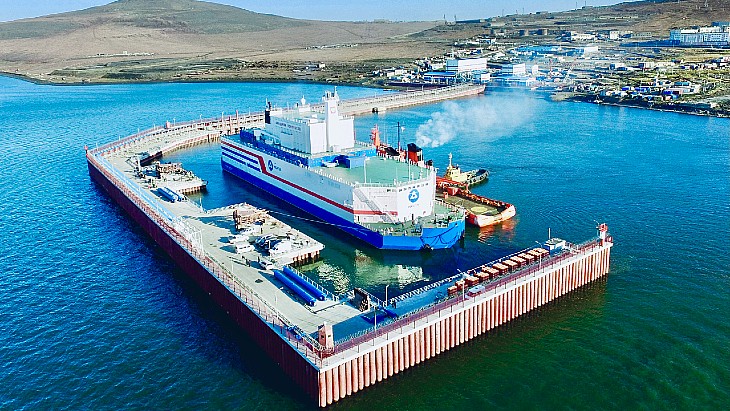
Rosatom says it is in advanced discussions with Egypt, Tanzania, Togo and Namibia over floating nuclear power units of about 100 MW. The concept could offer smaller African electricity systems a new route into nuclear generation, but questions over regulation, liability, financing, maritime security, fuel dependence and long-term sovereignty will determine whether floating reactors become a practical African solution or remain an attractive technology proposition.
By NuclearAfrica Editorial Desk
Floating nuclear power has moved rapidly from the margins of Africa’s nuclear conversation towards a potentially significant technology option after Russia’s Rosatom confirmed discussions with several African governments over the deployment of maritime nuclear generating units.
Rosatom says more developed discussions are under way with Egypt, Tanzania, Togo and Namibia, while interest has been expressed by a wider group of African countries. The company is promoting approximately 100 MW floating units using RITM-200M reactor technology adapted from the RITM reactor family already used aboard Russian nuclear-powered icebreakers. Reuters reported that Rosatom is exploring commercial models under which electricity could be sold through long-term power-purchase agreements while the company retains responsibility for major servicing and refuelling.
The discussions remain precisely that: discussions. None of the four African countries identified by Rosatom has publicly announced a final investment decision for a floating nuclear plant, and Togo’s government has explicitly stated that its new cooperation memorandum with Russia should not be interpreted as an announcement that a floating reactor will be constructed in the country.
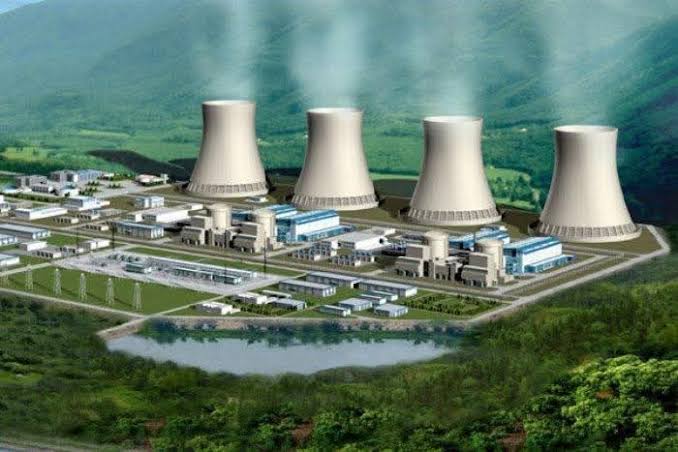
Even so, the technology deserves serious attention because it could change the parameters of the African SMR debate. Much of the discussion around small modular reactors has assumed construction on land. Floating nuclear power introduces another possibility in which the reactor and much of the generating infrastructure can be manufactured at a specialised shipyard, delivered to a coastal location and operated as a power-generating asset linked to the host electricity system.
For countries with smaller grids, constrained construction capability or large coastal industrial demand, that proposition could be attractive. But floating nuclear power does not make the institutional challenges of nuclear energy disappear. In several respects, it introduces new ones.
Why Floating Nuclear Could Appeal to African Electricity Systems
Many African newcomer countries face a difficult mismatch between their electricity needs and the size of conventional nuclear reactors. Large reactors in the 1,000–1,200 MW range can be economically attractive when deployed into sufficiently large grids, but a single unit of that size may be too large for countries whose entire national electricity systems are only a few gigawatts.
A floating plant around 100 MW changes that calculation. Capacity could potentially be added in smaller increments, reducing the consequences of losing a single unit during an outage and allowing nuclear generation to grow alongside national electricity demand. The smaller scale may also make the technology relevant for industrial loads such as mineral-processing centres, ports, desalination plants or clusters of energy-intensive businesses located near the coast.
The maritime configuration could also reduce some onshore construction requirements. Instead of building the nuclear island at the host site, major components could be manufactured and integrated in a specialised shipyard before the unit is transported to its operating location. Rosatom presents this as a way of reducing the infrastructure burden for newcomer countries and accelerating deployment.
Those advantages are potentially meaningful, especially in countries where building a conventional nuclear plant would require extensive development of local nuclear construction capability. But they should not be confused with the elimination of nuclear infrastructure requirements. The host country still needs regulation, grid integration, emergency arrangements, security, safeguards and long-term legal responsibility.
The Indonesian Agreement Is Important Because It Tests the Export Model
Rosatom’s African discussions have gained credibility from a separate development in Indonesia. On 16 October 2026, Rosatom announced an agreement with an Indonesian national company for electricity supply from two FPU-100 floating nuclear units with combined capacity of 200 MW in North Maluku. The project is described by Rosatom as the first export arrangement of its kind.
That agreement matters for Africa because it provides a possible commercial reference model. If the Indonesian project proceeds successfully, African governments will eventually be able to evaluate real project costs, licensing arrangements, construction schedules and operating experience rather than relying entirely on projections.
This is particularly important for newcomer states. Early adopters of emerging technologies assume more uncertainty because there is less evidence on which to judge performance. A technology that has been delivered, licensed and operated internationally carries a different risk profile from one that remains largely a proposal.
African countries therefore have an incentive to watch the Indonesian project closely before making irreversible commitments.
The Power-Purchase Model Could Reduce Capital Requirements — But Shift Other Risks
One of the most interesting aspects of Rosatom’s floating-nuclear proposition is the possibility that the host country would purchase electricity rather than finance and own the entire reactor asset. In theory, such a model could reduce the enormous upfront capital requirement that often makes nuclear power difficult for developing economies.
If the supplier finances, owns and operates the floating unit while the host utility purchases electricity under a long-term power agreement, the government may avoid some direct construction financing. This could make nuclear generation more accessible to countries unable to raise several billion dollars for a conventional plant.
However, risk does not disappear simply because ownership changes. It is redistributed through the contract. A long-term PPA must determine the electricity price, currency denomination, indexation formula, minimum purchase obligations, termination clauses and responsibility for interruptions. If the tariff is denominated in dollars or euros while the host utility collects revenue in local currency, exchange-rate risk could become significant over a contract lasting several decades.
The commercial attractiveness of floating nuclear power will therefore depend not only on the technical design but on the quality of the underlying power-purchase agreement.
Regulatory Jurisdiction Will Be More Complex Than for a Conventional Plant
A floating nuclear reactor creates a particularly important regulatory question: who has jurisdiction over the nuclear facility and under what legal framework?
A conventional land-based reactor is physically located within the host state and licensed by the national nuclear regulator. A floating plant could involve a foreign-owned vessel, international maritime law, host-state nuclear law and potentially continuing responsibilities for the supplier state.
African regulators considering such projects will need clear legal answers long before a unit arrives in national waters. Licensing arrangements must cover reactor safety, environmental protection, security, safeguards, emergency preparedness and eventual decommissioning. Maritime regulators and port authorities may also become involved in ways that are less common for conventional nuclear stations.
The host country cannot simply rely on the supplier’s regulatory system. Even if the reactor is licensed in Russia, the African state retains sovereign responsibility for protecting its population and environment. National regulators will therefore need sufficient expertise to evaluate the technology and supervise operations within their jurisdiction.
Nuclear Liability Must Be Resolved Before Deployment
Liability could become one of the most difficult legal issues. Nuclear liability frameworks are designed to ensure that responsibility for a nuclear incident is clearly assigned and that compensation mechanisms exist. Floating technology introduces questions about how those rules interact with maritime law and foreign ownership.
If an incident occurred while the unit was stationed in an African port, responsibility would need to be legally unambiguous. Similar questions arise during transport, refuelling or removal of the reactor from the host country.
These issues are manageable, but they cannot be resolved informally after a commercial agreement has already been signed. Countries considering floating nuclear power will need detailed legal reviews of national legislation and relevant international conventions.
Maritime and Nuclear Security Would Need to Be Integrated
Floating nuclear power also creates a security environment that differs from a conventional nuclear site. The reactor would be located in or near a maritime environment, potentially close to commercial shipping, ports and coastal populations. Security planning would therefore need to integrate conventional nuclear physical protection with maritime surveillance and port security.
Threat assessments would have to consider unauthorised vessels, sabotage, underwater approaches, drones and cyber risks alongside the physical-protection issues associated with any nuclear installation. Security responsibilities between the reactor operator, national security agencies, navy, coast guard, port authority and nuclear regulator would need to be clearly defined.
This does not mean floating reactors are inherently less secure than land-based plants. It means their security architecture is different and must be evaluated accordingly.
Supplier Dependence Could Be Both an Advantage and a Vulnerability
Rosatom argues that floating units could reduce some burdens on newcomer countries because major servicing and refuelling could remain the responsibility of the supplier. The unit could potentially be removed for refuelling or significant maintenance, limiting the host state’s need to develop certain specialised capabilities.
For a small newcomer programme, this could be an advantage. Developing a complete domestic nuclear fuel-cycle and heavy-maintenance capability for one small reactor may be economically inefficient.
But the same model creates long-term dependence. If the supplier controls fuel, specialised maintenance and major technical support, the host state becomes reliant on the continuation of that commercial and political relationship. A nuclear power contract may last several decades, far longer than most governments or diplomatic cycles.
African countries therefore need to evaluate supplier dependence as a strategic issue, not merely an operational convenience.
Togo and Namibia Illustrate Why the Technology Is Attracting Attention
Togo and Namibia demonstrate two different reasons why floating reactors could appeal to African governments. Togo is developing nuclear interest from a relatively early institutional base and is looking at nuclear technology as part of a broader energy-security and development strategy. A smaller unit could appear more appropriate than a conventional gigawatt-scale reactor.
Namibia, by contrast, is one of the world’s largest uranium producers and is now taking formal steps to assess nuclear power domestically. Its electricity system remains comparatively small, making smaller reactor concepts potentially relevant. Namibia also has major coastal mining and industrial activity that could theoretically support concentrated electricity demand.
Neither country has committed to floating nuclear construction. Their interest nevertheless shows how the technology is being positioned: not primarily as a competitor to large reactors in large nuclear systems, but as a possible entry route for smaller grids and specialised industrial markets.
Africa Should Demand Evidence From Early Export Projects
Floating nuclear power should neither be dismissed as unrealistic nor embraced simply because it appears innovative. African countries now have an opportunity to observe how the first export projects develop and demand evidence before committing public resources.
Governments should examine actual capital costs, PPA tariffs, licensing duration, construction schedules, maintenance arrangements, capacity factors and security requirements. They should also understand how long the unit may be unavailable during major servicing and how the electricity system would compensate during those periods.
The more evidence available from early deployments, the less technological and contractual risk African adopters will need to assume.
Conclusion
Floating nuclear power could become an important addition to Africa’s nuclear technology options. Smaller unit sizes, factory fabrication and alternative ownership models may address some of the problems that make conventional large reactors difficult for smaller electricity systems.
But floating reactors do not eliminate the complexity of nuclear power. They change where that complexity sits.
Financing may shift from construction loans into long-term PPAs. Heavy maintenance may shift from the host country to the supplier. Conventional site construction may decline, while maritime security and international liability become more important. Domestic fuel-cycle responsibilities may be reduced, but long-term supplier dependence may increase.
For Africa, the right question is therefore not whether floating nuclear power is inherently good or bad. The question is whether its specific risk allocation, cost structure and institutional requirements fit the needs of the country considering it.
Related

Who Will Finance Ghana’s Proposed 2,000 MW Nuclear Power Programme with Russia?
By Nuclear Africa• November 2, 2026
Finland Grants World’s First Operating Licence for Spent Nuclear Fuel Repository: What Onkalo Means for Africa
By Nuclear Africa• November 2, 2026
From Summit Diplomacy to Nuclear Delivery: What Moscow’s 2026 Russia–Africa Summit Means for Africa’s Nuclear Future
By Nuclear Africa• November 1, 2026
Ethiopia Begins Defining a 2.4 GW Nuclear Power Programme as Three Potential Sites Emerge
By Nuclear Africa• November 1, 2026