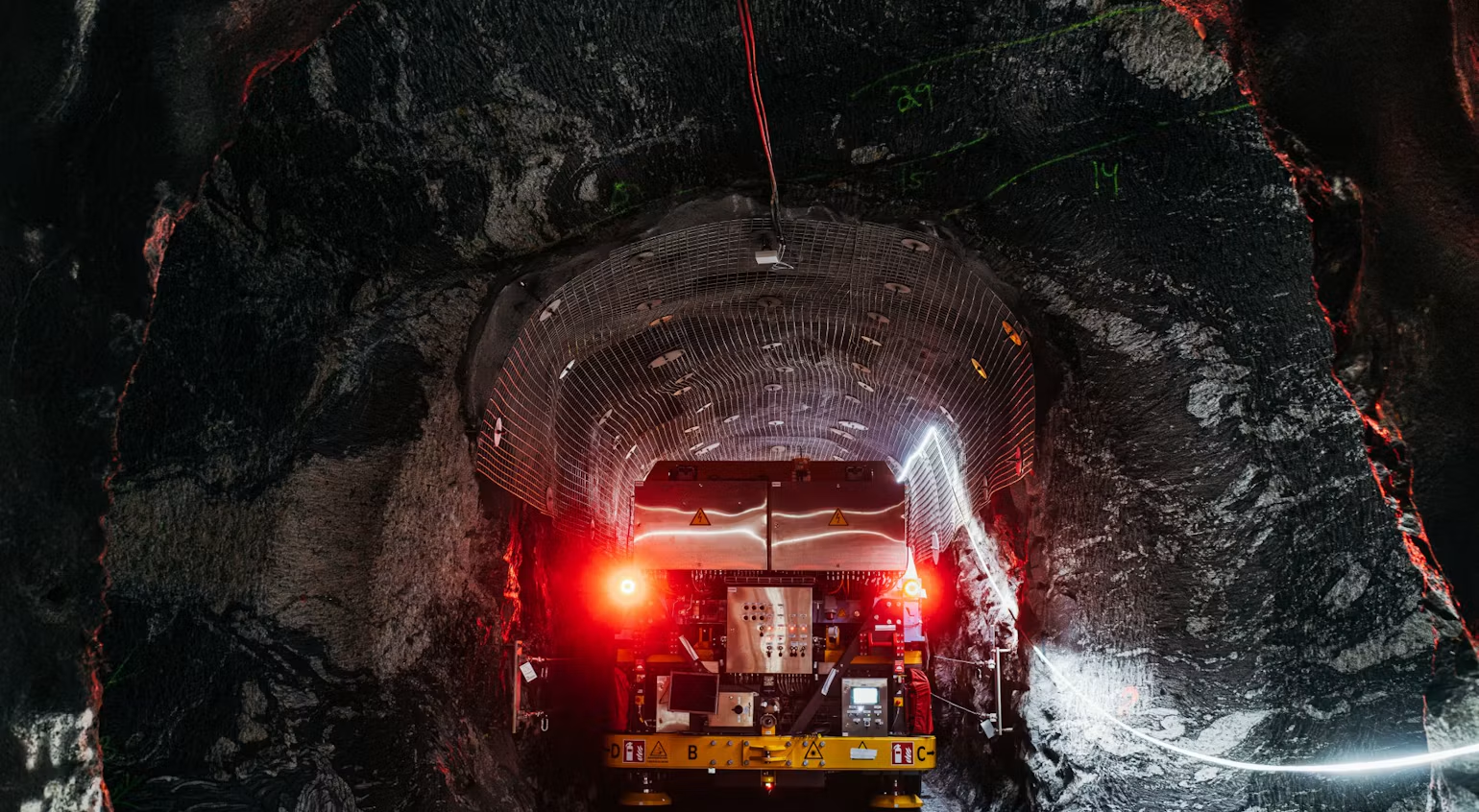
Finland has granted Posiva an operating licence for the Onkalo spent nuclear fuel repository at Olkiluoto, marking the first time anywhere in the world that a geological disposal facility for spent nuclear fuel has received an operating licence. For African nuclear newcomers, the significance extends far beyond Finland: Onkalo demonstrates that radioactive waste policy, financing, institutional responsibility and public engagement must begin decades before a reactor reaches the end of its operating life.
By NuclearAfrica Editorial Desk
Finland has reached one of the most consequential milestones in the history of commercial nuclear waste management after its government granted Posiva an operating licence for the encapsulation and final disposal facility for spent nuclear fuel at Olkiluoto. The decision, issued on 22 October 2026, is the first operating licence anywhere in the world for a facility designed to dispose permanently of spent nuclear fuel in a deep geological repository.
The licence represents the culmination of more than four decades of research, regulation, site investigation, engineering and public engagement. Posiva now intends to complete the remaining commissioning activities required before actual disposal operations can begin. Finland’s Radiation and Nuclear Safety Authority, STUK, must still conduct the final inspection required before operation, meaning the licence itself does not automatically authorise Posiva to begin receiving spent fuel immediately.
The significance of the milestone extends far beyond Finland because management of spent nuclear fuel remains one of the most politically difficult issues associated with nuclear energy. Many countries have operated reactors for decades while relying on interim storage arrangements because permanent disposal programmes have remained technically, politically or institutionally unresolved. Finland has now moved further than any other country in turning geological disposal from a long-term policy concept into a licensed operating facility.
For Africa, where several countries are considering their first nuclear power plants, Onkalo provides an important reminder that nuclear infrastructure planning cannot end with the reactor. A commercial nuclear programme must also address what happens to spent fuel, how those obligations will be financed, which institution will remain responsible over many decades and how future generations will be protected from liabilities created today.
A Repository Developed Over More Than Four Decades
Onkalo’s achievement is particularly important because it illustrates the length of time required to develop a credible disposal programme. Finland did not wait until its reactors were approaching retirement before beginning to address spent fuel. The foundations for the programme were established more than forty years ago through national policy decisions that defined responsibilities for nuclear waste and required the operators benefiting from nuclear power to provide for eventual disposal.
Posiva was created by Finnish nuclear utilities specifically to implement final disposal. Over decades, the organisation developed site-screening programmes, geological studies, repository designs, safety assessments and public-engagement mechanisms. The Olkiluoto site was selected after extensive geological investigation and political processes involving both national and local authorities. The result is not simply an underground facility but an institutional system linking the waste-management company, reactor operators, government, regulator and host community.
That institutional continuity may be one of the most important lessons for newcomer countries. Geological disposal is not a project that can be improvised when reactor operation is nearing its end. It requires long-term scientific knowledge, financial provision and public confidence that may take decades to develop. Countries planning reactors today should therefore begin waste governance today, even if the eventual repository will not be required for many years.
How Onkalo Will Isolate Spent Nuclear Fuel
The Onkalo system is based on the principle of deep geological disposal. Spent fuel from Finland’s Olkiluoto and Loviisa nuclear power plants will first be taken to an above-ground encapsulation facility, where fuel assemblies that have already spent decades cooling in interim storage will be dried and sealed inside engineered disposal canisters. The canisters contain a cast-iron insert surrounded by a copper shell designed to resist corrosion and mechanical stress over extremely long periods.
Those canisters will then be transported to the underground repository approximately 430 metres below the surface. Each canister will be placed into a deposition hole surrounded by bentonite clay, which swells in contact with water and provides an additional protective barrier. Stable bedrock forms another natural barrier around the repository. Finland’s safety concept therefore does not depend on any single component remaining perfect indefinitely; it relies on several independent and complementary barriers that collectively isolate radioactive material from people and the environment.
The Finnish government’s licence allows Posiva to dispose of up to 6,500 tonnes of uranium contained in spent fuel from Finland’s operating nuclear plants, corresponding to approximately 3,300 disposal canisters. Once operations are fully established, the facility is expected to dispose of up to about 60 canisters annually, with final disposal activities continuing into the 2120s before the repository is eventually backfilled and closed.
This timescale underscores an important point for newcomer countries: radioactive waste management is not a short-term activity attached to a power plant project. It can become a national institutional responsibility extending well beyond the operating life of the reactors that created the waste.
Regulatory Oversight Continues After the Licence
The operating licence is historically important, but Finland’s regulatory process also demonstrates that licensing does not end oversight. STUK completed a favourable safety assessment in August 2026, concluding that the statutory conditions for granting the licence had been satisfied. The Finnish government subsequently relied on that assessment when issuing the operating licence.
Even after the government decision, however, Posiva cannot begin operation until STUK conducts the required commissioning inspection and verifies that all conditions for safe operation have been met. The regulator will continue supervising the facility during operation and can require corrective measures where necessary. Posiva will also be required to submit periodic safety assessments and updated long-term safety justifications as operational experience accumulates.
That continuing oversight is relevant for African programmes because nuclear waste responsibility cannot be reduced to a one-time approval. Waste facilities require regulation over extremely long periods, while technical knowledge must be preserved as generations of personnel change. Institutional continuity is therefore as important as engineering.
Waste Financing Must Begin While Electricity Is Being Generated
Another important Finnish lesson concerns financial responsibility. Nuclear waste management has to be funded even though many of its most expensive activities occur decades after electricity is sold. If governments postpone this issue, future taxpayers can inherit liabilities created by earlier generations of electricity consumers.
Finland has addressed this through legal arrangements requiring nuclear operators to make financial provisions for waste-management obligations. The Ministry of Economic Affairs and Employment has already integrated Posiva into the financial provision system associated with Finland’s National Nuclear Waste Management Fund.
For African newcomer programmes, this issue deserves attention before the first reactor contract is signed. Governments need to decide whether waste-management costs will be recovered through electricity tariffs, operator contributions, dedicated funds or other mechanisms. The institutional structure should protect those resources from being diverted to unrelated government expenditure.
The principle should be straightforward: the generation that benefits economically from nuclear electricity should contribute to the cost of managing the resulting waste.
Africa Should Avoid Treating Spent Fuel as a Problem for the Distant Future
Several African countries considering nuclear power have understandably concentrated on technology selection, project financing, grid development and workforce preparation. Those are immediate challenges, but Onkalo demonstrates why spent fuel should not be postponed simply because final disposal may be decades away.
Countries need early policies covering ownership of spent fuel, interim storage, transport, safeguards, physical protection and eventual disposal. They also need clarity on whether fuel-supply agreements include provisions for spent fuel to be returned to the vendor country or whether the host state will retain long-term responsibility. These commercial decisions can have consequences stretching far beyond the initial fuel contract.
The correct strategy does not necessarily require a newcomer country to construct a geological repository before its first reactor begins operation. What is required is a credible national policy showing how the waste will be managed safely over time, how the necessary institutions will develop and how future obligations will be financed.
Regional Cooperation May Become Relevant for Smaller African Programmes
The economics of geological disposal also raise questions about regional cooperation. A repository requires substantial investment in geology, engineering, regulation and long-term monitoring. For countries that may operate only one or two reactors, developing a complete national disposal system could be expensive relative to the quantity of waste generated.
International law, national politics and public acceptance would make any multinational repository arrangement difficult, but the issue deserves long-term consideration. African countries could at least cooperate initially on research, spent-fuel policy, transport regulation, safeguards, geological expertise and human-resource development even if each state ultimately retains responsibility for its own waste.
Regional bodies such as AFCONE and the Forum of Nuclear Regulatory Bodies in Africa could potentially support shared technical capacity. Cooperation would not eliminate national responsibility, but it could reduce duplication and help newcomer states learn from both mature nuclear countries and one another.
Ghana, Egypt and South Africa Should Watch Onkalo Closely
The Finnish development is relevant to African nuclear programmes at several different stages. South Africa already has decades of spent fuel arising from Koeberg and research activities and therefore faces long-term decisions about geological disposal. Egypt, where four VVER-1200 reactors are under construction at El Dabaa, will eventually accumulate substantial quantities of spent fuel requiring long-term management. Ghana and other newcomers have the advantage of being able to incorporate waste strategy more explicitly before commercial nuclear operation begins.
This is where newcomers can learn from the difficulties faced by earlier nuclear countries. Mature programmes often developed reactors before permanent disposal policy had fully matured, leaving governments to resolve the issue decades later. African countries do not have to repeat that sequencing.
A first nuclear project should therefore be accompanied by a lifecycle strategy covering fuel procurement, interim storage, radioactive waste, spent fuel, decommissioning and final disposal. Even when the exact repository location is unknown, the responsibilities and financing mechanisms should already be understood.
Public Trust Was a Technical Requirement, Not a Communications Add-On
Finland’s experience also demonstrates that public engagement cannot be separated from technical programme development. Geological repositories involve extremely long time horizons and can generate strong community concerns. Finland’s progress was supported by a process in which national institutions, regulators, technical organisations and prospective host communities engaged over many years.
STUK has itself emphasised that the foundations for implementation were created by clear responsibilities, long-term expertise and sustained public engagement built on transparency.
For African programmes, this suggests that waste policy should not appear suddenly when government identifies a potential repository site. Public understanding of the nuclear fuel cycle should begin much earlier. Communities need to understand why spent fuel exists, how it is initially stored, what geological disposal means and which institutions will remain accountable.
Trust built before controversy emerges is generally stronger than communication introduced only after opposition has already developed.
Conclusion
Finland’s decision to grant the world’s first operating licence for a spent nuclear fuel geological repository is one of the most important nuclear milestones of 2026. It moves a challenge that has existed since the beginning of commercial nuclear power from long-term policy aspiration towards actual industrial implementation.
The technical achievement is significant, but the institutional lesson may be even more important. Finland succeeded because responsibilities were established early, the programme was maintained over decades, the regulator remained deeply involved, financial provision was created and host-community engagement accompanied technical development.
African nuclear newcomers should pay close attention.
The lesson from Onkalo is not that every country considering nuclear power needs to begin digging a repository immediately. The lesson is that the back end of the nuclear fuel cycle cannot be left to a future government simply because the first reactor has not yet been built.
A credible nuclear programme should know not only how electricity will be generated, but how the responsibilities created by that electricity will be managed long after the reactor stops producing it.
Related

Who Will Finance Ghana’s Proposed 2,000 MW Nuclear Power Programme with Russia?
By Nuclear Africa• November 2, 2026
Floating Nuclear Power Is Moving Onto Africa’s Energy Agenda — But the Model Needs Much Deeper Scrutiny
By Nuclear Africa• November 2, 2026
From Summit Diplomacy to Nuclear Delivery: What Moscow’s 2026 Russia–Africa Summit Means for Africa’s Nuclear Future
By Nuclear Africa• November 1, 2026
Ethiopia Begins Defining a 2.4 GW Nuclear Power Programme as Three Potential Sites Emerge
By Nuclear Africa• November 1, 2026