
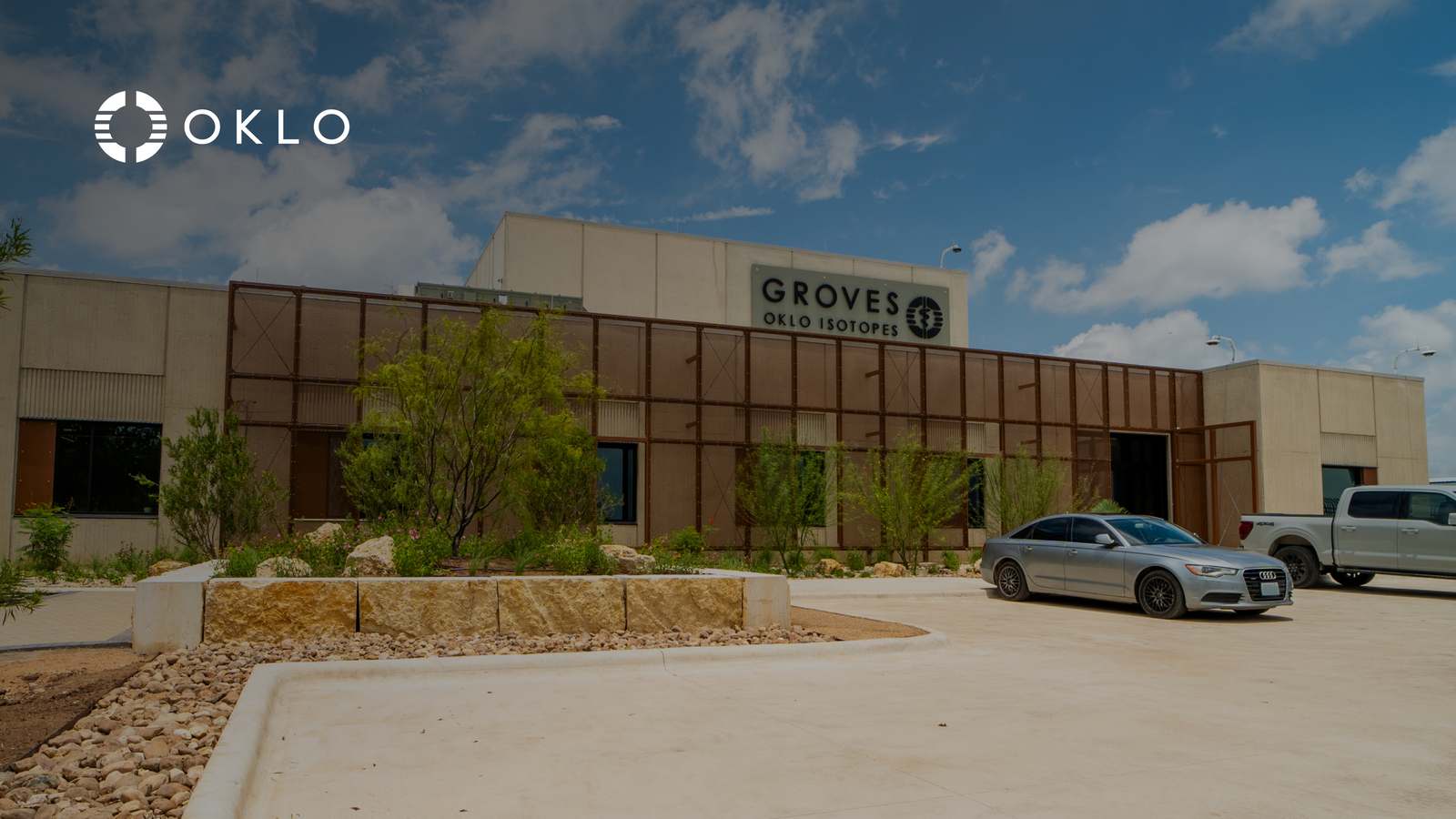
US nuclear technology company Oklo has received startup authorisation from the United States Department of Energy for its Groves Isotope Test Reactor in Texas.
The authorisation allows the company to load nuclear fuel, conduct startup testing and proceed towards first criticality—the point at which the reactor achieves a controlled, self-sustaining nuclear chain reaction.
Oklo announced the regulatory milestone on 23 July 2026. World Nuclear News subsequently reported that the reactor is located near Lockhart in Caldwell County, Texas.
The company says it progressed from groundbreaking to startup authorisation in just over ten months.
The project is intended to demonstrate reactor operations and isotope production before the development of larger commercial isotope-production capacity.
What is the Groves reactor?
The Groves Isotope Test Reactor is being developed through Atomic Alchemy, an Oklo subsidiary focused on radioisotope production.
The facility forms part of Oklo’s broader business platform, which includes advanced reactors, nuclear fuel, fuel recycling and isotope production.
According to the company, the test reactor will help validate operating systems and isotope-production processes before commercial-scale deployment.
The facility has been developed under the US Department of Energy’s Reactor Pilot Program, which was established to support accelerated testing of advanced reactor technologies outside the traditional national-laboratory setting.
Unlike a commercial nuclear-power reactor licensed principally to supply electricity to the grid, the Groves facility is designed to generate operational data and support isotope-production development.
Why isotopes matter
Radioisotopes are used across medicine, agriculture, scientific research, industry and space exploration.
In healthcare, radioactive isotopes support:
- diagnostic imaging;
- cancer treatment;
- sterilisation of medical products;
- cardiovascular investigations;
- neurological examinations;
- targeted radionuclide therapy; and
- medical research.
Industrial applications include equipment inspection, material testing, process control, leak detection and measurement of thickness, density and moisture.
Radioisotopes are also used in agriculture for crop research, food preservation, pest control and soil-management studies.
However, many medically important isotopes have short half-lives. They cannot be stockpiled indefinitely and must be transported quickly from production facilities to hospitals and treatment centres.
This makes reliable regional production and distribution systems essential.
Africa’s isotope dependence
Much of Africa remains dependent on imported medical isotopes and radiopharmaceutical products.
South Africa is the continent’s principal producer and exporter through facilities including the SAFARI-1 research reactor and associated isotope-production infrastructure.
However, ageing facilities, transport distances, limited processing capacity and dependence on international aviation expose African health systems to supply disruptions.
A delay in reactor production, processing, certification or air transport can affect patient diagnosis and treatment.
Several African countries are therefore considering new research reactors, cyclotrons and radiopharmaceutical facilities.
South Africa is planning a new multipurpose research reactor to succeed SAFARI-1. Other countries are expanding accelerator and nuclear-medicine capacity.
The Groves project provides a useful case study in how a relatively small reactor could be designed around specialised isotope-production objectives.
A different model of reactor deployment
Oklo’s project is notable not only because of its isotope mission, but also because of the speed of its development.
The company states that the reactor moved from groundbreaking to startup authorisation in slightly more than ten months.
This timetable is unusually short compared with conventional nuclear projects.
However, the comparison must be treated carefully.
Groves is a test reactor, not a large commercial nuclear-power station. Its scale, licensing pathway, intended use, site arrangements and safety case differ considerably from those of a gigawatt-scale power reactor.
The project therefore does not prove that all reactors can be built within one year. It demonstrates that specialised reactor projects may be delivered more rapidly when their scope, design, regulatory pathway, supply chain and institutional responsibilities are clearly defined.
The role of the Department of Energy
The US Department of Energy authorisation process used for Groves is distinct from the licensing process normally applied by the US Nuclear Regulatory Commission to commercial reactors.
The project underwent safety-document reviews and a readiness assessment before receiving startup approval.
Earlier in July, Oklo announced that the Department of Energy had approved the reactor’s final safety analysis, allowing it to move towards the final pre-startup review.
The completed readiness review considered whether the organisation, personnel, equipment, procedures and safety-management systems were prepared for startup.
This distinction is important for African readers.
The Groves timetable should not be interpreted as evidence that independent regulatory assessment can be removed. Rather, it illustrates an alternative government authorisation pathway created for a defined pilot programme.
Any African country considering a similar demonstration project would still need clear legal authority, an independent safety assessment and transparent responsibilities between the promoter, operator and regulator.
Lessons for African isotope programmes
1. Begin with a defined national need
A reactor should not be developed simply because the technology is available.
Countries must first identify which isotopes are required, expected patient demand, existing supply vulnerabilities and the realistic regional market.
2. Consider regional rather than purely national supply
Not every African country needs its own isotope reactor.
Regional hubs could serve several countries where aviation links, customs procedures, quality controls and radiopharmaceutical distribution systems are reliable.
3. Build the full value chain
Producing an isotope inside a reactor is only the first step.
A viable programme also requires:
- target manufacturing;
- irradiation facilities;
- hot cells;
- chemical processing;
- quality assurance;
- radiopharmaceutical preparation;
- regulatory approval;
- specialised packaging;
- secure transportation;
- trained pharmacists and clinicians; and
- hospital infrastructure.
Without these capabilities, reactor production may not translate into improved patient access.
4. Strengthen regulatory coordination
Isotope programmes involve nuclear regulators, medicines authorities, health ministries, transport agencies, customs institutions and hospital regulators.
These organisations must coordinate their requirements without creating unnecessary delays.
5. Develop a sustainable business model
Research reactors are expensive to construct, operate, maintain and decommission.
African countries should assess whether isotope revenues, research services, training, industrial irradiation and government support can sustain a facility over its full lifecycle.
Private-sector participation
The Groves project also raises the question of private investment in nuclear science infrastructure.
Historically, most research reactors and isotope facilities have been developed by governments, universities or national nuclear organisations.
Oklo’s model introduces a stronger private-sector role in reactor construction and isotope commercialisation.
African governments may wish to explore public-private partnerships, but nuclear safety and public accountability cannot be transferred entirely to commercial developers.
The state must retain strong oversight of licensing, security, safeguards, radioactive-waste management, emergency preparedness and decommissioning funding.
Implications for nuclear workforce development
An isotope reactor can support more than product supply.
It can provide practical training for:
- reactor operators;
- nuclear engineers;
- radiochemists;
- radiation-protection specialists;
- medical physicists;
- nuclear pharmacists;
- maintenance personnel;
- safeguards professionals; and
- nuclear regulators.
For nuclear-newcomer countries, a research or isotope reactor could therefore contribute to the workforce required for a future power programme.
The training value will depend on whether the project is integrated into national universities, technical institutions and professional-development programmes.
Conclusion
The startup authorisation for Oklo’s Groves Isotope Test Reactor represents an important milestone in the development of specialised advanced reactors and commercial isotope production.
The project is not directly comparable to a large nuclear-power station, and its accelerated schedule should not be used to justify reducing regulatory scrutiny.
Its significance lies elsewhere.
Groves shows how a clearly defined reactor mission, specialised regulatory pathway, private investment and integrated isotope strategy can be combined within one project.
For Africa, the central question is not whether the Groves model should be copied exactly. It is whether African countries can develop reliable regional systems linking nuclear research infrastructure to healthcare, industrial development, workforce training and scientific capacity.
A reactor becomes valuable when it solves a clearly defined development problem. Medical-isotope security is one such problem that deserves greater attention across the continent.
Related


Africa Deepens Nuclear Safeguards Capacity as AFCONE Convene Hands-On Training in Nairobi
By Nuclear Africa• August 24, 2026
A 300 MW SMR Could Support More Than 12,500 Construction Jobs in Ghana: New Study Tests Nuclear’s Economic Case
By Nuclear Africa• August 24, 2026
Ghana Targets 1,000 MW of Nuclear Power by the Mid-2030s: What Must Happen Before Construction Can Begin?
By Nuclear Africa• August 24, 2026