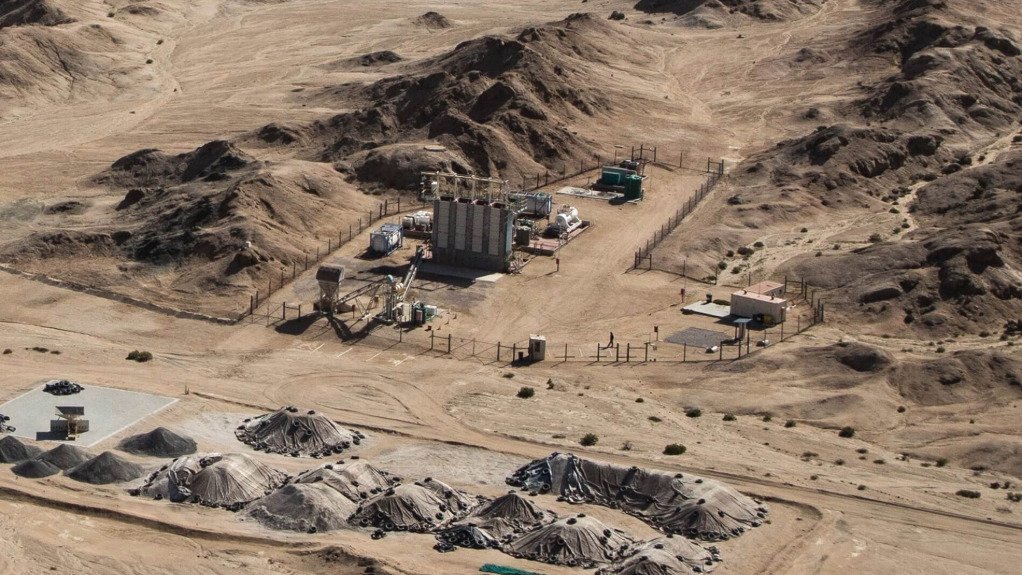
Bannerman Energy and CNNC Overseas have formally committed to developing the Etango uranium project, with first yellowcake targeted for 2028. The decision strengthens Namibia’s position in the international nuclear fuel market, gives China greater long-term uranium security and provides a useful example of how a major African energy project moves from feasibility into investment and construction.
By NuclearAfrica Editorial Desk
Namibia’s uranium industry has entered another significant phase following a positive Final Investment Decision for the Etango uranium project, clearing the way for full-scale construction. The project is expected to produce approximately 3.5 million pounds of U3O8 annually, with commissioning and first yellowcake production targeted for 2028.
The decision is particularly important because it represents a genuine project-execution milestone rather than another preliminary nuclear announcement. Etango has completed years of resource definition, engineering studies, environmental assessment, licensing and early construction activity. Financing has been assembled and a strategic partner has committed substantial capital. The project is therefore moving from development into physical execution.
This makes Etango one of the most concrete nuclear-sector investments currently progressing in Africa and reinforces Namibia’s already important role in the global uranium industry.
Etango Has Crossed the Boundary From Development Into Execution
The significance of Final Investment Decision is that the project sponsors have reached the point at which they are prepared to commit the capital required for construction. This follows a long period during which geological, technical, regulatory and commercial uncertainties had to be reduced sufficiently to justify the investment.
Etango therefore illustrates how large resource and energy projects mature over time. The uranium resource first had to be defined. Engineering studies had to determine how the ore could be mined and processed economically. Environmental approvals and a mining licence were required. Infrastructure planning had to advance, potential customers had to be identified and financing had to be secured.
Only after these pieces came together could the developers move confidently into full construction. The principal risks now shift from whether the project can be financed towards whether it can be delivered on schedule, within budget and at the production levels assumed in the investment case.
China Has Become Central to Etango’s Financial Structure
China’s involvement is one of the defining features of the project. CNNC Overseas, part of the China National Nuclear Corporation group, has taken a substantial equity interest and provided strategic capital supporting development. This connects Etango directly with one of the world’s fastest-growing commercial nuclear fleets.
China’s nuclear expansion creates an enormous long-term requirement for secure uranium supply. Nuclear fuel procurement is generally planned years in advance, and utilities place a high value on diversified sources because disruption in mining, conversion or enrichment can affect reactor fuel availability long after the original event.
For Namibia, Chinese investment provides the capital required to bring another major uranium resource into production. For China, the investment provides both equity participation and a long-term connection to uranium supply from an established producer. The relationship therefore combines African resource development with Asian nuclear energy security.
Long-Term Offtake Converts Investment Into Fuel Security
CNNC’s strategic position extends beyond ownership. The company has rights to acquire a substantial share of Etango’s future uranium production, giving it a direct supply channel over the life of the mine. This illustrates how nuclear fuel security increasingly shapes investment decisions in the uranium sector.
For uranium producers, long-term offtake can improve project bankability because it reduces uncertainty over future sales. For buyers, it reduces exposure to sudden changes in the spot market and provides greater confidence that fuel will be available when required.
The structure therefore aligns the interests of both partners. Bannerman gains access to capital and a major customer, while CNNC strengthens its long-term fuel supply. Namibia, meanwhile, becomes even more deeply integrated into the global nuclear fuel chain.
Namibia’s Importance to the Global Uranium Market Is Increasing
Namibia has been a major uranium producer for decades and already hosts several internationally significant mining operations. Its established mining sector, large resource base and experience regulating uranium extraction make it one of the most important nuclear-resource jurisdictions in Africa.
Etango will strengthen that position at a time when uranium demand expectations are rising. Existing nuclear plants are receiving life extensions, new reactors are being constructed in Asia and elsewhere, and many countries are reconsidering nuclear energy as part of their energy-security and decarbonisation strategies.
Utilities are also paying greater attention to the geographical concentration of the nuclear fuel supply chain. Political disruptions and concerns over dependence on a limited number of suppliers have made diversification increasingly valuable. Namibia’s relatively established uranium sector therefore gives the country an important strategic advantage.
Namibia Could Eventually Build a Wider Nuclear Economy
The Etango decision is occurring at the same time that Namibia is beginning to consider a broader nuclear role. The country has strengthened the institutional arrangements surrounding possible nuclear power development and has appeared in discussions involving new reactor concepts, including floating nuclear technology.
These initiatives remain far less mature than uranium mining, but they raise an important long-term question about whether Namibia should remain primarily a supplier of raw uranium or use its resource position as the foundation for a wider nuclear economy.
The answer does not necessarily require the country to develop every part of the nuclear fuel cycle. However, uranium production can support specialised engineering, environmental services, research, technical education, transport and radiation-protection capability. These activities could increase the amount of economic value retained domestically and create a stronger industrial base around the country’s natural-resource advantage.
Domestic Value Creation Should Be Central to the Development Model
The success of Etango should ultimately be evaluated not only according to production volumes and export revenue but also according to the value created within Namibia. Large resource projects can contribute through employment, local procurement, infrastructure, technical training, taxes and the development of domestic suppliers.
For uranium, this question is particularly important because the commodity sits at the beginning of a highly sophisticated international value chain. The value of the final nuclear fuel and electricity produced from that uranium is many times greater than the value of the mined material itself.
Namibia cannot realistically capture every stage of that chain, but it can use its position as a major producer to negotiate stronger domestic participation and invest in the skills required for more advanced nuclear-related activities. The long-term objective should therefore be to ensure that uranium mining contributes to structural economic development rather than functioning only as an export activity.
Environmental Performance Will Remain Essential
The strategic importance of uranium also brings substantial environmental and occupational responsibilities. Uranium mining requires careful management of water, tailings, dust, radiation exposure, land disturbance and eventual mine rehabilitation. The long operating life of a mine means these responsibilities continue well beyond the construction phase.
Etango has obtained the approvals required to proceed, but regulatory oversight will remain important throughout construction and operation. Transparent monitoring and credible environmental management will be essential to maintaining public confidence and the project’s international reputation.
This is particularly important as global nuclear growth increases scrutiny of the environmental performance of the entire fuel cycle. The argument that nuclear power provides low-carbon electricity will be strengthened when the uranium supply chain also demonstrates high standards of environmental and occupational protection.
Etango Provides a Useful Model of Investment Readiness
Etango also offers a wider lesson for African infrastructure development. Large projects do not become investment-ready because governments or companies announce that they are priorities. They become investment-ready through the systematic reduction of risk.
In Etango’s case, geological uncertainty was reduced through exploration, technical uncertainty through engineering studies, regulatory uncertainty through licensing, market uncertainty through offtake arrangements and financing uncertainty through strategic investment. Early works then provided additional evidence that the project could move into execution.
This sequence is relevant to nuclear power projects, renewable energy, mines and other major infrastructure across Africa. Investors commit capital when project risks are clearly understood, allocated and progressively reduced. Etango demonstrates what that process looks like in practice.
Conclusion
Etango’s Final Investment Decision represents one of the most concrete African nuclear-sector developments of 2026. The project is financed, licensed and moving into full construction, with first uranium production targeted for 2028.
For Namibia, the project strengthens an already important uranium industry and creates another opportunity to deepen local economic participation. For China, it provides a strategic long-term source of uranium supporting an expanding reactor fleet. For the wider nuclear industry, it adds prospective supply at a time when fuel security is becoming increasingly important.
Most importantly, Etango reinforces the fact that Africa is already a significant participant in the global nuclear economy. The continent is not waiting for new reactors to be built before becoming strategically relevant. Its uranium resources already sit at the beginning of the fuel cycle that powers nuclear plants around the world.
Related

From Summit Diplomacy to Nuclear Delivery: What Moscow’s 2026 Russia–Africa Summit Means for Africa’s Nuclear Future
By Nuclear Africa• November 1, 2026
Ethiopia Begins Defining a 2.4 GW Nuclear Power Programme as Three Potential Sites Emerge
By Nuclear Africa• November 1, 2026
South Africa Could Become a Major HALEU Supplier Under New Pelindaba Nuclear Fuel Venture
By Nuclear Africa• November 1, 2026
Russia’s African Nuclear Strategy Is Expanding — But the Continent Must Distinguish Projects From Promises
By Nuclear Africa• November 1, 2026