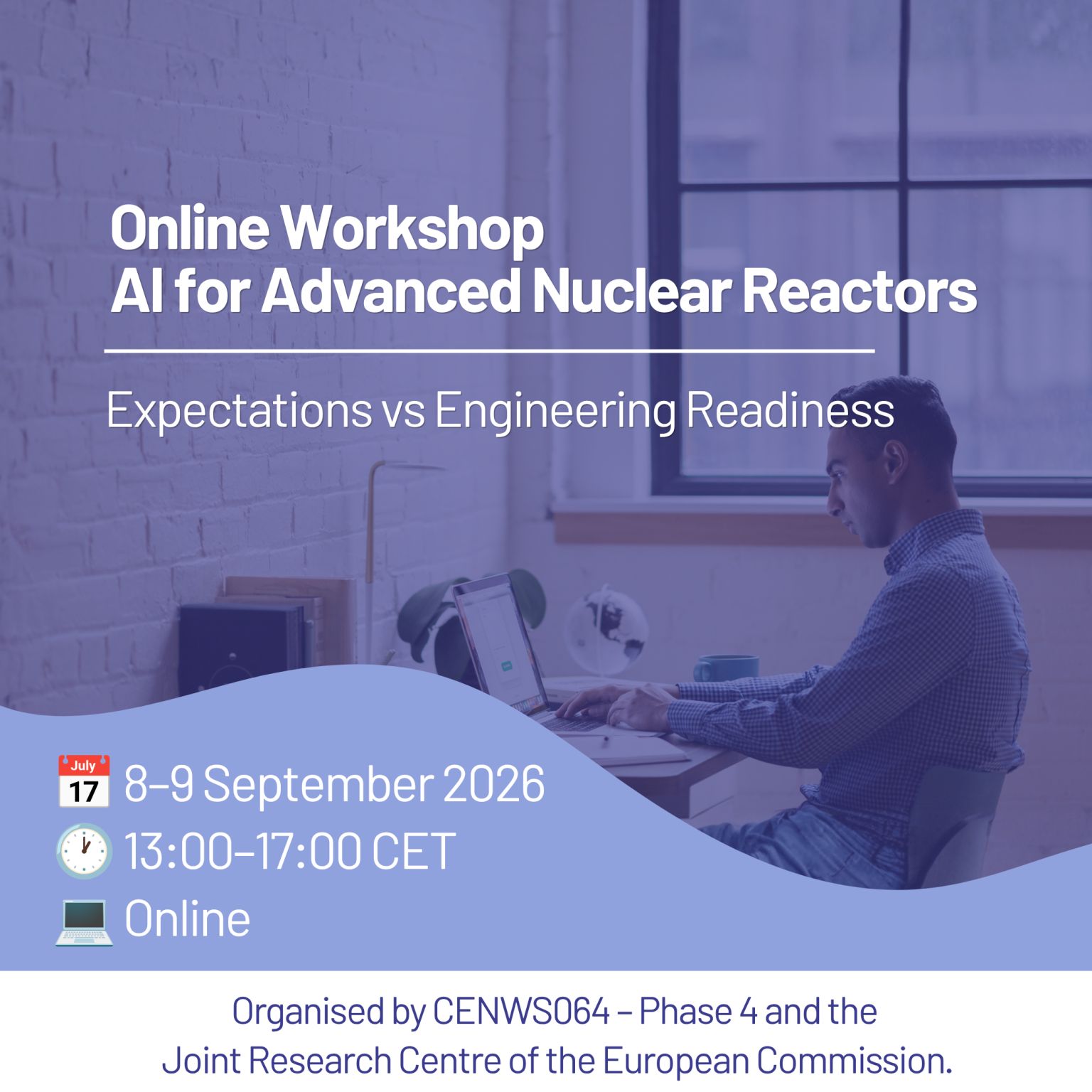
The Joint Research Centre of the European Commission, in collaboration with CEN WS064 Phase 4, will organise an online workshop on the engineering and regulatory readiness of artificial intelligence for advanced nuclear reactors.
Scheduled for 8–9 September 2026, the workshop is titled:
“Expectations vs Engineering Readiness for the Implementation of AI for the Design and Operation of Advanced Nuclear Reactors in the Next 20 Years.”
The event comes amid growing interest in using artificial intelligence and machine learning to accelerate the development and deployment of Advanced Modular Reactors. Potential applications include materials qualification, in-service inspection, predictive maintenance, component lifetime assessment and support for reactor design and operational decision-making.
Moving from AI expectations to engineering evidence
Although AI offers significant opportunities for improving the efficiency of nuclear engineering processes, its use in safety-critical systems raises important technical and regulatory questions.
Nuclear structures and components must perform reliably under demanding conditions involving high temperatures, mechanical loads, irradiation and exposure to corrosive coolants. Their performance must also be demonstrated over operational periods that may extend for several decades.
The workshop will therefore examine whether AI and machine-learning models can reliably predict long-term degradation mechanisms such as:
- Creep and creep-fatigue interaction
- Corrosion and environmentally assisted degradation
- Irradiation damage
- Material ageing and component failure
- Fatigue under changing operational conditions
A central challenge is the limited availability of long-term experimental data, particularly for novel materials and advanced manufacturing methods. Machine-learning models may consequently be required to extrapolate beyond available datasets, creating questions about uncertainty, validation and the reliability of their predictions.
Regulatory acceptance of AI-informed nuclear engineering
The workshop will also consider what regulators would require before accepting engineering decisions or safety justifications supported by machine-learning models.
Among the questions expected to guide the discussions are whether developers should prioritise increasingly sophisticated predictive models or improve the quantification of uncertainty around established physics-based models. Participants will also consider the minimum evidence regulators may require before accepting AI-informed material properties, component life predictions or inspection results.
Another issue will be how research and testing resources should be allocated. Experts will discuss whether scarce experimental budgets should be used primarily to generate data for training AI models or to validate the ability of those models to make reliable predictions under conditions not represented in their training datasets.
Technical presentations and expert panels
The tentative programme includes invited presentations from experts associated with the Joint Research Centre, the French Alternative Energies and Atomic Energy Commission, Fusion for Energy, Argonne National Laboratory, Pacific Northwest National Laboratory, the University of Wisconsin and other organisations.
Topics expected to be covered include:
- Physics-informed machine learning for creep, fatigue and irradiation life assessment
- Combining physics-based models and machine learning to extrapolate creep properties
- AI tools for advanced nuclear-materials research
- High-throughput corrosion and irradiation testing
- Machine-learning workflows for advanced-alloy development
- AI applications in nuclear power plant in-service inspections
- Regulatory-grade data and model governance
- Validation, uncertainty quantification and long-term prediction
The programme will combine technical presentations with expert-panel discussions. Participants will be able to engage with speakers through the online chat function. Following the workshop, proceedings, available presentations and conclusions are expected to be compiled and published as an official JRC report.
Why the workshop matters for Africa
The workshop is particularly relevant to African countries exploring nuclear power, Small Modular Reactors and other advanced nuclear technologies.
As newcomer countries develop nuclear infrastructure, they will increasingly encounter reactor designs that incorporate digital technologies, automated monitoring systems, predictive analytics and AI-supported engineering tools. Understanding the capabilities and limitations of these systems will be important for regulators, owner-operators, technical support organisations and nuclear research institutions.
African participation can help national institutions anticipate emerging requirements relating to:
- Nuclear data management and quality assurance
- Independent verification of AI-generated results
- Regulatory review of machine-learning applications
- Cybersecurity and protection of digital engineering systems
- Development of interdisciplinary expertise in nuclear engineering, materials science and AI
- Collaboration with reactor designers and international research organisations
The central policy lesson is that AI should not be treated merely as a tool for reducing costs or accelerating reactor deployment. Its introduction into nuclear engineering must be supported by reliable data, transparent validation methods, strong regulatory oversight and qualified human experts capable of challenging its outputs.
Event details
Event: Expectations vs Engineering Readiness for the Implementation of AI for the Design and Operation of Advanced Nuclear Reactors in the Next 20 Years
Dates: 8–9 September 2026
Time: 13:00–17:00 CET on both days
Format: Online
Participation fee: Free
Organisers: Joint Research Centre and CEN WS064 Phase 4
Advance registration is compulsory, and participation may be limited if the event receives a large number of applications. Registration through the JRC platform requires an EU Login account.
Related


Africa Deepens Nuclear Safeguards Capacity as AFCONE Convene Hands-On Training in Nairobi
By Nuclear Africa• August 24, 2026
A 300 MW SMR Could Support More Than 12,500 Construction Jobs in Ghana: New Study Tests Nuclear’s Economic Case
By Nuclear Africa• August 24, 2026
Ghana Targets 1,000 MW of Nuclear Power by the Mid-2030s: What Must Happen Before Construction Can Begin?
By Nuclear Africa• August 24, 2026