Across Africa, radioactive materials are used every day in hospitals, mining operations, industrial facilities, research institutions and laboratories. These materials support cancer treatment, medical diagnosis, mineral processing, industrial radiography, scientific research and many other peaceful applications.
Yet the wider use of radioactive sources also increases the possibility of accidents, loss of regulatory control, improper disposal, theft, illicit trafficking or the discovery of radioactive material in unexpected places.
Africa’s long land borders, growing scrap-metal trade, informal mining activities and uneven detection capabilities add another layer of complexity. Radioactive material may be misplaced, abandoned, stolen or transported across borders without the knowledge of national authorities.
Against this background, the effectiveness of a country’s emergency arrangements may depend heavily on what happens during the first few minutes after an incident is reported.
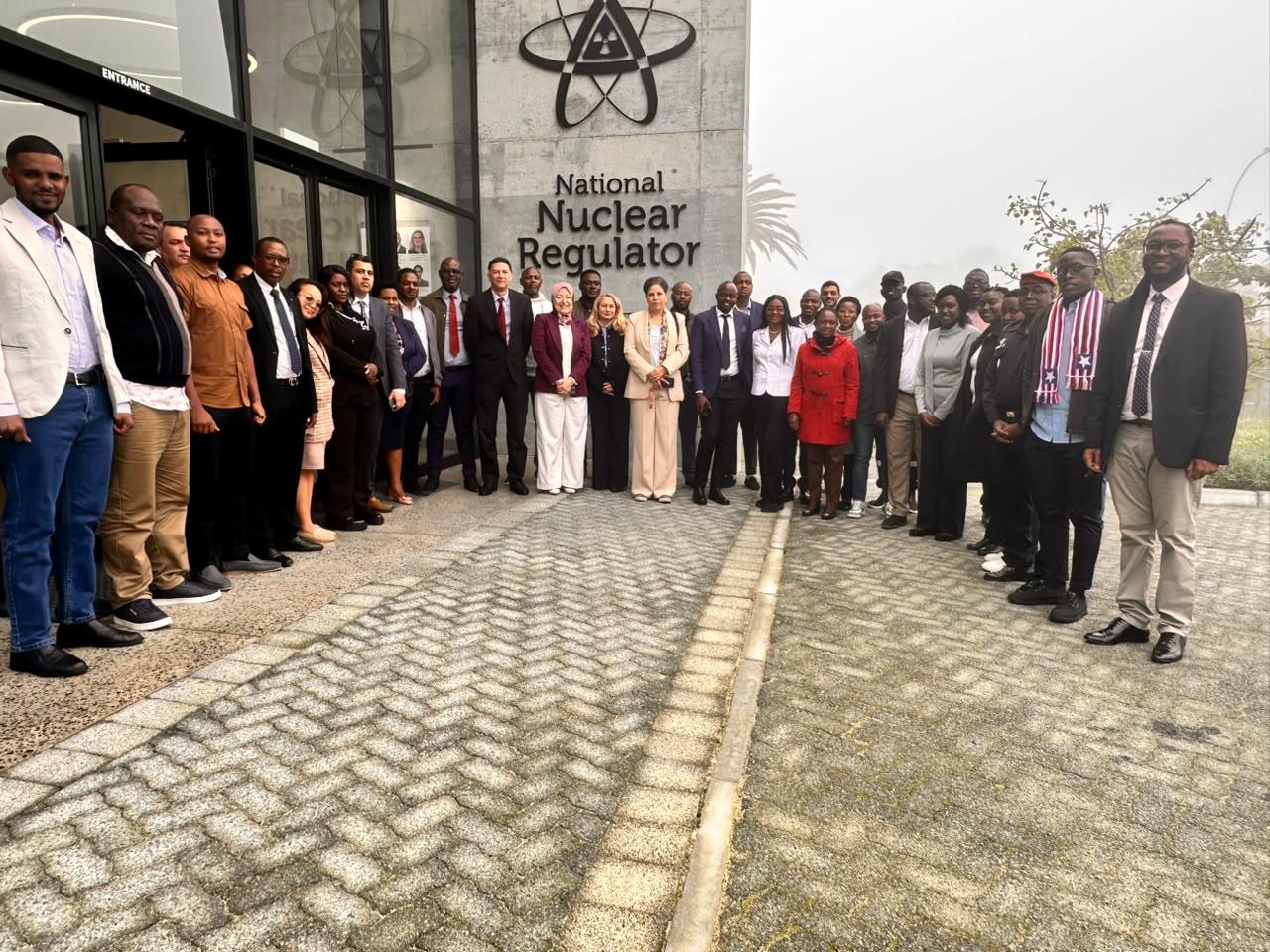
From 13 to 17 July 2026, the International Atomic Energy Agency held a Regional Training Course for First Responders to Radiological and Nuclear Emergencies in Cape Town, South Africa. The five-day programme brought together law-enforcement officers, fire and rescue personnel, emergency medical responders and nuclear regulatory staff from across the African region.
The course addressed a practical question that every country using radioactive material must eventually confront: does the first person arriving at the scene know how to recognise the hazard, protect the public and avoid making the situation worse?
Training designed for the first minutes of an emergency
Radiological and nuclear emergencies are not always large-scale reactor accidents.
They may involve a damaged industrial radiography source, a transport accident, contamination at a medical facility, an abandoned radioactive device, a fire involving radioactive material or the discovery of an unknown object emitting radiation.
In such situations, the first people arriving are unlikely to be nuclear scientists or radiation-protection specialists. They are more likely to be police officers, firefighters, ambulance crews, hospital personnel or local disaster-management officials.
Their early decisions can determine whether contamination spreads, whether responders receive unnecessary exposure, whether the public panics and whether important evidence is preserved.
The Cape Town course therefore concentrated on operational response rather than purely theoretical instruction.
Participants worked through the assessment of radiological hazards, the establishment of an inner cordoned area and the identification of exposure pathways. They also examined protective actions for responders and members of the public.
The course covered the use of a Unified Command and Control System, intended to coordinate multiple agencies responding to the same emergency.
Later sessions addressed:
- personal protective measures;
- radiation-detection and monitoring instruments;
- contamination control and decontamination;
- crime-scene and evidence management;
- response to incidents with a possible nuclear-security dimension; and
- public communication during a radiological emergency.
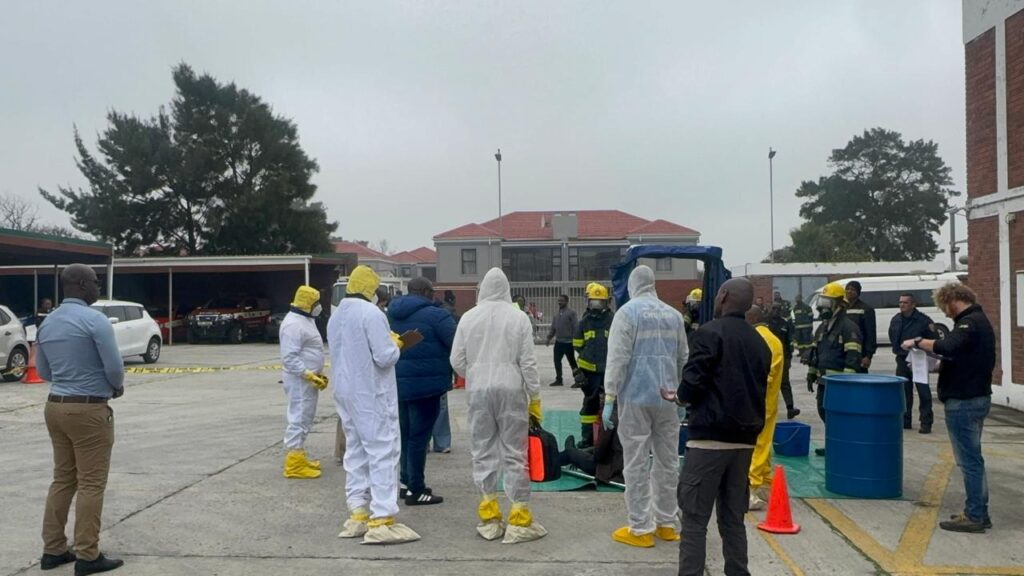
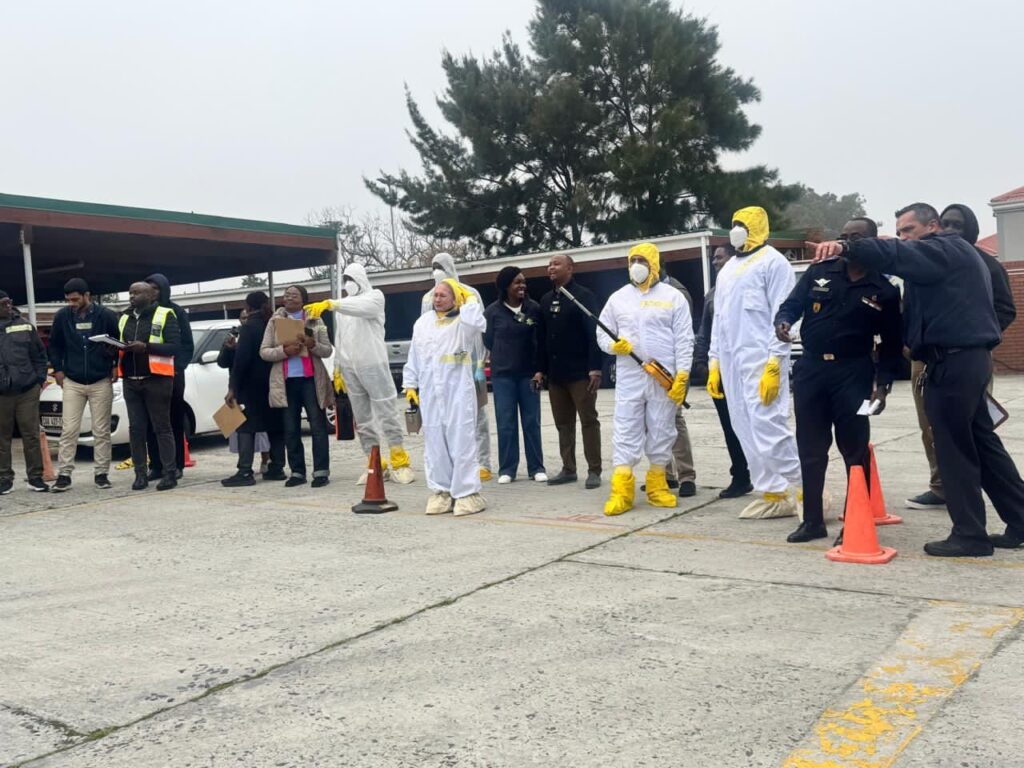
The programme combined classroom lectures, working sessions, a visit to the City of Cape Town Fire and Rescue Service and a field exercise simulating a radioactive spill at a hospital.
This practical component was particularly important. Responders cannot develop confidence in radiation instruments, protective equipment, command structures and contamination-control procedures through lectures alone.
Why the first ten minutes matter
The earliest stage of a radiological emergency is often characterised by uncertainty.
Responders may not immediately know:
- whether radioactive material is present;
- what type of source is involved;
- whether the source is damaged;
- whether contamination has spread;
- whether people have been exposed;
- whether the event is accidental or deliberate; or
- whether additional hazards are present.
In the absence of basic radiological-response training, emergency personnel may enter a hazardous area without appropriate protection. They may move contaminated objects, transport exposed individuals without controlling contamination or allow members of the public to approach the scene.
They may also establish a cordon that is either too small to provide adequate protection or unnecessarily large, causing avoidable disruption and public anxiety.
The objective of first-responder training is not to turn every firefighter or police officer into a radiation specialist.
It is to ensure that the first person at the scene can:
- recognise warning signs;
- avoid unnecessary exposure;
- isolate the immediate area;
- call for specialist support;
- protect injured people and the public;
- maintain control of the scene; and
- communicate clearly until technical experts arrive.
These actions can significantly reduce the consequences of an incident.
Africa’s response arrangements remain uneven
The need for this training is particularly important in Africa because national emergency-response systems differ considerably in their maturity and resources.
Some countries have well-established nuclear regulatory authorities, national emergency plans, specialist response teams and radiation-monitoring capabilities.
Others are still developing the legal, institutional and technical arrangements needed to respond effectively to a radiological emergency.
Even where national plans exist, practical coordination between agencies may remain weak.
A regulator may have radiation-protection expertise, while the police control access to the scene. Fire services may lead rescue operations, health authorities may manage exposed patients and disaster-management agencies may coordinate national resources.
Unless these organisations have trained and exercised together, confusion may arise over who is in command, who is authorised to enter the affected area and who communicates with the public.
A Unified Command and Control System is therefore more than an organisational chart.
It represents an agreement among police, fire, medical, regulatory and disaster-management institutions to operate under a shared structure before an emergency occurs.
Trying to create that structure for the first time during a real incident is unlikely to produce an effective response.
The security dimension cannot be ignored
Radiological incidents may also involve nuclear-security concerns.
A source may be lost or stolen. Radioactive material may be discovered at a border crossing, scrapyard, industrial facility or transport hub. An incident initially treated as an accident may later require a criminal investigation.
This means first responders may be entering both a hazardous area and a potential crime scene.
Their actions must protect life and control the radiological hazard while preserving evidence that may be needed to determine:
- where the material came from;
- whether it was intentionally removed;
- who handled it;
- whether a crime was committed; and
- whether additional material remains missing.
Training in evidence management and scene control is therefore essential.
An officer who moves, handles or disposes of an object without documenting its position may unintentionally damage the investigation. Similarly, contaminated evidence cannot be treated in the same way as ordinary material.
The Cape Town course’s inclusion of crime-scene and evidence-management procedures reflects the increasingly important connection between nuclear safety, security and law enforcement.
Material out of regulatory control is a regional concern
Radioactive sources are normally subject to licensing, tracking and regulatory oversight.
However, material can fall outside this system through theft, loss, abandonment, illegal disposal, institutional collapse or weaknesses in source inventories.
This is often described as material out of regulatory control.
Such material does not respect national borders.
A source lost in one country may be transported through another, sold as scrap or discovered only after it has entered a recycling facility. Long borders and busy regional trade routes make cross-border coordination especially important.
Customs officials, border-security officers, police and transport authorities must therefore understand how to respond when radiation is detected.
They should know how to secure the area, avoid contact, protect nearby workers and notify the appropriate national authority.
Regional training helps participating countries develop a more consistent understanding of these responsibilities.
It also supports cooperation between states that may confront the same material at different stages of its movement.
Hospitals and industrial facilities require special attention
The field exercise in Cape Town simulated a radioactive spill at a hospital.
This was a relevant choice because medical institutions are among the most common users of radioactive material in Africa.
Hospitals use radiation and radioactive sources for cancer treatment, medical imaging, diagnosis and therapy. Staff working directly with these materials are normally trained, but an emergency may quickly involve people outside the radiology or nuclear-medicine department.
Security personnel, cleaners, nurses, ambulance staff, firefighters and police may all become part of the response.
Emergency plans should therefore extend beyond specialist departments.
Hospitals need procedures for:
- isolating affected areas;
- protecting patients and staff;
- controlling contamination;
- handling exposed or injured individuals;
- informing emergency services;
- maintaining essential medical operations; and
- communicating with patients and families.
Industrial facilities face similar challenges.
Radioactive sources used for radiography, measurement or process control may be small enough to transport but powerful enough to cause serious exposure if mishandled.
Routine exercises can help ensure that the response is not improvised when a source is damaged, missing or discovered outside its authorised location.
Communication is a safety measure
Radiological emergencies create particular communication challenges because radiation cannot be seen, smelled or felt.
People may therefore assume that every radiological incident is catastrophic, even where the actual exposure risk is limited.
Poor communication can produce panic, rumours, distrust and unnecessary disruption. It can also cause members of the public to ignore instructions if official statements are delayed, contradictory or overly technical.
First responders are often the first visible representatives of the state at an emergency scene.
Their words, behaviour and confidence can shape public perceptions before a regulator, minister or technical expert issues a formal statement.
Responders should be able to explain clearly:
- why an area has been cordoned off;
- what members of the public should do;
- whether evacuation is necessary;
- where affected people should report;
- how contamination differs from exposure; and
- when additional information will be provided.
Authorities should also prepare communication arrangements before an emergency.
This includes identifying official spokespersons, approving basic public messages and coordinating information among the regulator, emergency services, health authorities and local government.
Communication should not be treated as an activity that begins after the technical response. It is part of the response itself.
Training must become institutional practice
A single regional course can improve the competence of the participants, but its national impact will remain limited unless the knowledge is transferred into institutional practice.
The officials who attended the Cape Town programme should not become the only people in their organisations who understand radiological-response procedures.
Participating countries should use the training as a foundation for:
- national first-responder courses;
- inter-agency operating procedures;
- routine radiation-awareness training;
- joint police, fire and medical exercises;
- hospital and industrial-facility drills;
- border and transport-response exercises;
- equipment testing and maintenance;
- public-communication planning; and
- periodic evaluation of national emergency arrangements.
Training materials should be adapted to national laws, institutions, languages and response structures.
Countries should also maintain a trained pool of instructors capable of continuing the programme domestically.
Without this institutionalisation, expertise may be lost when trained personnel are transferred, promoted or leave public service.
Equipment must accompany training
Training alone is insufficient if first responders do not have access to functioning equipment.
Depending on their roles, emergency teams may require:
- personal dosimeters;
- portable radiation-survey meters;
- contamination monitors;
- protective clothing;
- respiratory protection;
- communication equipment;
- barriers and warning signs;
- decontamination materials; and
- appropriate transport and storage containers.
The equipment must be available, calibrated and maintained.
A radiation detector stored in a central office but unavailable to responders at night or outside the capital provides little practical value.
Countries should therefore assess where radioactive sources are used, transported or stored and position response equipment accordingly.
They should also establish arrangements for rapidly deploying specialist teams where local responders have limited capability.
Exercises reveal weaknesses that plans conceal
Emergency-response documents may appear comprehensive on paper but fail under operational pressure.
Exercises reveal practical problems that may not be visible during planning meetings.
These can include:
- incompatible communication systems;
- unclear authority between agencies;
- delays in obtaining radiation instruments;
- uncertainty over hospital reception procedures;
- lack of transport for specialist teams;
- poorly defined public-information responsibilities; and
- confusion over contamination control.
Exercises should therefore be treated as diagnostic tools rather than ceremonial demonstrations.
After each drill, participating institutions should document weaknesses, assign corrective actions and verify that improvements have been implemented.
Scenarios should also vary.
Countries should test responses to incidents involving hospitals, industrial sources, transport accidents, scrap-metal facilities, border crossings and possible criminal activity.
This creates a broader and more realistic national capability.
The role of regulators
Nuclear and radiation regulators have an important role in strengthening first-responder readiness.
They normally possess the technical knowledge needed to assess radiation hazards and advise emergency agencies.
However, regulators should not assume that specialist expertise will always reach the scene immediately.
Their responsibility should include helping police, fire, medical and disaster-management institutions develop enough basic competence to act safely before regulatory experts arrive.
Regulators can support this by:
- developing national guidance;
- identifying likely radiological scenarios;
- maintaining emergency contact arrangements;
- participating in joint exercises;
- supporting responder training;
- inspecting emergency arrangements at licensed facilities; and
- providing technical advice during actual events.
They should also ensure that operators using radioactive material maintain appropriate onsite emergency plans and communicate effectively with local response organisations.
Regional cooperation remains indispensable
Many African countries face similar challenges: limited specialist personnel, constrained budgets, growing use of radioactive sources and uneven emergency infrastructure.
Regional training allows countries to share experience, instructors, equipment knowledge and practical lessons.
It can also help establish common approaches to cross-border incidents.
The IAEA and host countries have an important role in sustaining these programmes, but national governments must ensure that participation produces domestic change.
The lasting value of a regional course is not measured only by the number of certificates awarded.
It is measured by whether participating states develop stronger command structures, better-trained responders, more realistic exercises and faster, safer action during an actual emergency.
Conclusion
The July 2026 regional training course in Cape Town addressed one of the most practical questions in nuclear and radiation safety: what happens before the specialists arrive?
Across Africa, radioactive material is supporting medicine, industry, mining and research. Its benefits are substantial, but those benefits must be accompanied by systems capable of responding when something goes wrong.
First responders do not need to become nuclear scientists. They need to recognise the hazard, protect themselves, isolate the scene, assist the injured, preserve evidence and call for appropriate technical support.
Those actions must be rehearsed before an emergency.
The next radiological incident in Africa may occur at a hospital, on a highway, at a mine, inside an industrial facility or in a scrapyard. Whether it remains a controlled event or develops into a wider emergency may depend on the decisions taken in the first ten minutes.
Africa must therefore move beyond one-off training and make radiological first-response readiness a permanent part of police, fire, medical and disaster-management practice.
The strongest emergency plan is not the one that looks most complete on paper.
It is the one that responders have practised often enough to use correctly when the alarm is real.
About the Author
Lennox Assan, CNSsP, is a Regulatory Officer at Ghana’s Nuclear Regulatory Authority, specialising in nuclear and radiological emergency preparedness and response. His expertise spans regulatory inspections, emergency-plan authorisation, multi-agency exercises, hazard assessment, dispersion modelling, incident management, and the application of GIS and remote sensing to radiological risk analysis and emergency planning.
Related


Africa Deepens Nuclear Safeguards Capacity as AFCONE Convene Hands-On Training in Nairobi
By Nuclear Africa• August 24, 2026
A 300 MW SMR Could Support More Than 12,500 Construction Jobs in Ghana: New Study Tests Nuclear’s Economic Case
By Nuclear Africa• August 24, 2026
Ghana Targets 1,000 MW of Nuclear Power by the Mid-2030s: What Must Happen Before Construction Can Begin?
By Nuclear Africa• August 24, 2026