Egypt has announced another 2,300 employment opportunities linked to construction of the El Dabaa Nuclear Power Plant, providing one of Africa’s clearest demonstrations yet that nuclear localisation extends far beyond nuclear engineers and reactor operators.
Egypt’s Ministry of Labour announced the recruitment drive on 27 July, saying vacancies were available for skilled trades including welders, steel workers and concrete workers, with salaries for some positions reaching EGP 40,000, depending on the role and applicable requirements.
The latest recruitment follows a separate Ministry announcement on 5 July of 4,210 employment opportunities for companies working at El Dabaa. Those vacancies covered a wider range of professions, including engineers, translators, surveyors, reinforcing-steel workers, carpenters, argon technicians, installation technicians, electric welders, painters and supporting workers.
The announcements should not automatically be interpreted as completed hiring or added together as a definitive number of new workers because recruitment rounds may involve different contractors and potentially overlapping workforce requirements. But taken together, they reveal something increasingly important about Egypt’s nuclear programme: construction of a nuclear power plant is becoming a major industrial workforce undertaking.
Africa’s Largest Nuclear Construction Project
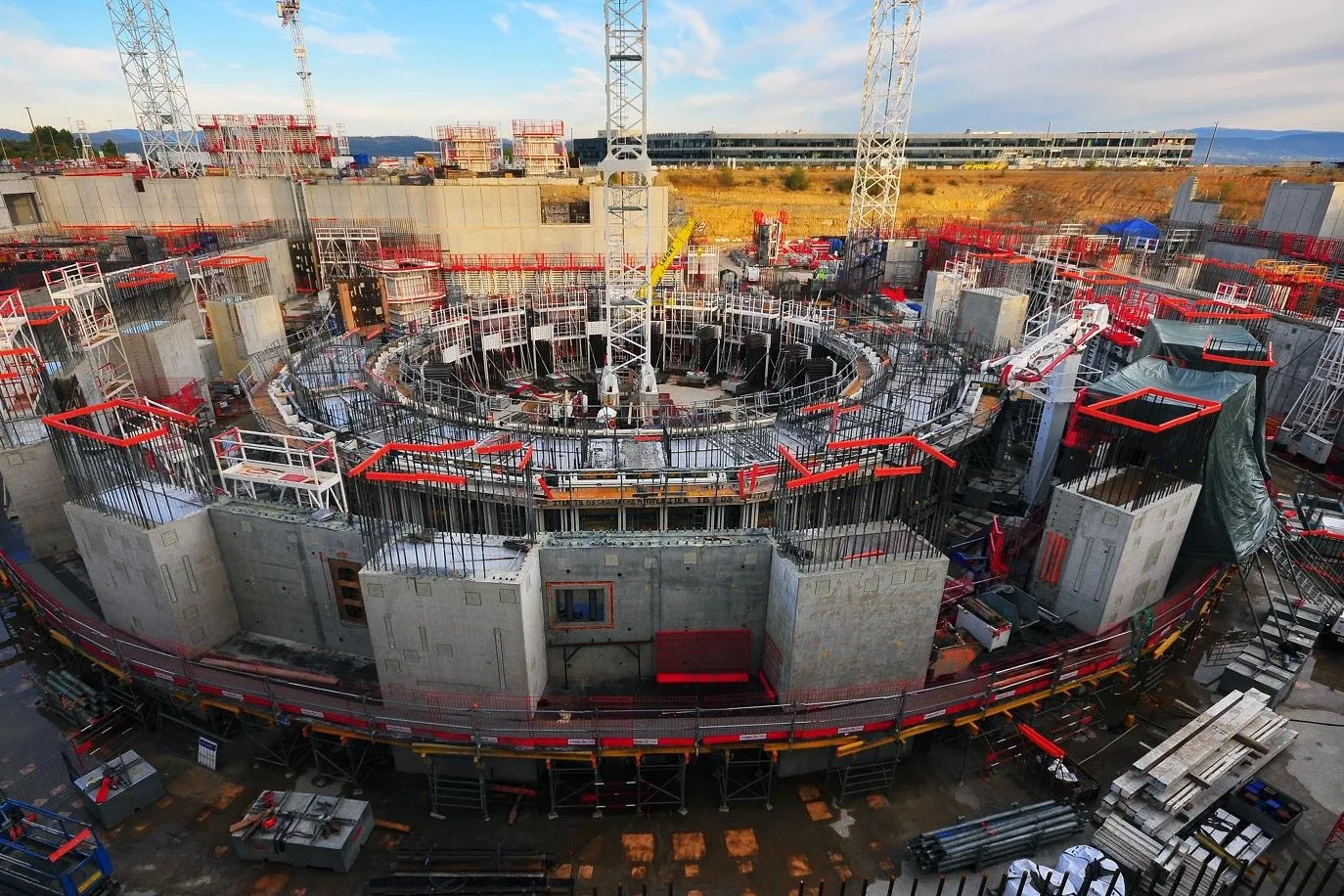
El Dabaa is Egypt’s first nuclear power plant and currently the only new large nuclear power station under construction on the African continent.
The project consists of four Russian-designed VVER-1200 pressurised water reactors, each with a gross electrical capacity of about 1,200 MW. All four units are currently classified as under construction by the International Atomic Energy Agency’s Power Reactor Information System.
Together, the four units are designed to provide approximately 4,800 MW of gross generating capacity. Egypt’s Nuclear Power Plants Authority is the project’s owner and future operator, while organisations within Russia’s Rosatom group are the main contractors.
The first unit entered construction in July 2022, followed by Unit 2 later that year, Unit 3 in 2023 and Unit 4 in January 2024.
That transition from planning into simultaneous construction of four reactors has changed Egypt’s workforce requirements dramatically.
Nuclear Workforce Means More Than Nuclear Engineers
For emerging nuclear countries, workforce discussions frequently concentrate on scientists, reactor engineers, regulators and future control-room operators.
Those professions are essential, but El Dabaa illustrates only part of the employment structure required to construct a nuclear facility.
Before a reactor can operate, thousands of workers are required to build the civil structures, containment systems, electrical infrastructure, piping networks, auxiliary facilities and supporting infrastructure around it.
That requires welders, electricians, concrete specialists, steel fixers, pipefitters, surveyors, technicians, construction supervisors, quality-control personnel and numerous other skilled trades.
Some of those competencies exist in conventional construction industries. Nuclear projects, however, impose much more demanding requirements for documentation, traceability, quality assurance and conformity with approved engineering specifications.
A welder working on safety-significant nuclear components, for example, is not simply performing the same task as a welder on an ordinary commercial building.
The broader lesson is that nuclear localisation begins in technical and vocational education as much as it does in universities.
From Jobs to Industrial Capability
Egypt’s recruitment drive therefore carries significance beyond the number of available positions.
If properly structured, major nuclear construction projects can create workers whose qualifications and experience remain valuable long after individual construction packages are completed.
Personnel trained in precision welding, advanced concrete construction, quality management, inspection, non-destructive testing, mechanical installation and project controls can contribute to other high-value industries.
These competencies can support sectors including power generation, oil and gas, petrochemicals, manufacturing, rail infrastructure and other large engineering projects.
Nuclear localisation should consequently not be assessed simply by asking how many citizens work at a construction site.
A more important question is:
What capabilities remain in the country after construction ends?
That distinction matters enormously for African newcomer states.
A Lesson for African Nuclear Newcomers
Countries considering nuclear power typically have many years between an initial programme decision and the start of reactor construction.
That period should be used to map the workforce that will eventually be required.
Universities are part of that process, but technical universities, vocational institutes and apprenticeship systems are equally important.
A credible national nuclear workforce strategy should identify future requirements across several layers: nuclear scientists and engineers; regulatory specialists; project and construction professionals; qualified technicians and tradespeople; and eventually operations and maintenance personnel.
The El Dabaa recruitment rounds provide an early indication of how large the construction layer alone can become.
Waiting until the engineering, procurement and construction contractor arrives before developing those skills risks leaving domestic companies and workers unable to qualify for significant project packages.
African nuclear programmes should therefore connect their localisation strategies to existing national technical and vocational education systems years before first concrete.
Qualification Matters More Than Nationality
There is another important lesson.
Localisation cannot simply mean instructing a foreign reactor vendor to employ a predetermined percentage of local workers.
Nuclear projects operate within stringent safety and quality requirements. Domestic workers and companies must demonstrate that they can perform work to the required standards.
That means localisation strategies need to be tied to certification, technical qualification, quality-assurance systems and practical experience.
Governments considering nuclear power could therefore begin developing programmes for nuclear-grade welding, specialised electrical installation, non-destructive testing, civil construction quality assurance and other capabilities before a reactor project reaches construction.
Where possible, these programmes could use qualifications recognised by the eventual project contractor and regulator.
The objective should not be local participation for statistical purposes.
It should be to create competitive domestic nuclear capability.
Contractors Are Part of the Workforce Strategy
The Egyptian Ministry of Labour’s announcements also highlight another reality: much of the workforce associated with a nuclear construction project will not necessarily be directly employed by the nuclear plant owner.
Large nuclear projects rely on extensive contractor and subcontractor networks.
The 5 July recruitment announcement, for example, was made in cooperation with companies involved in the El Dabaa project rather than being presented as recruitment for permanent Nuclear Power Plants Authority operating positions.
That distinction matters when governments estimate employment benefits from proposed nuclear projects.
Construction employment is different from permanent plant employment.
A reactor may require a substantial long-term operating workforce, but construction creates a much larger temporary concentration of contractors and skilled trades over particular phases of the project.
Both forms of employment are valuable, but they should not be confused.
Beyond El Dabaa
The experience emerging in Egypt could eventually become useful to the wider African nuclear industry.
As more countries on the continent develop nuclear programmes, workers and companies that gain nuclear-qualified experience at El Dabaa could become part of a broader African nuclear supply chain.
That possibility strengthens the case for thinking about nuclear workforce development at both national and regional levels.
Africa does not necessarily need every newcomer country to reproduce every specialist construction capability independently.
Regional centres for nuclear welding, non-destructive testing, quality assurance and specialist engineering could potentially serve multiple programmes if qualifications and regulatory requirements can be appropriately aligned.
El Dabaa may therefore become more than Egypt’s first nuclear power plant.
It could become an important training ground for Africa’s emerging nuclear construction workforce.
NuclearAfrica Perspective
The headline figure of 2,300 employment opportunities is significant, but the deeper lesson is about preparation.
Nuclear newcomer countries frequently begin workforce planning at the top of the skills pyramid by funding master’s degrees, PhDs and reactor-engineering programmes.
Those investments are necessary.
But constructing a nuclear power plant also requires thousands of people whose training may begin not in a nuclear engineering faculty but in a welding workshop, technical college or apprenticeship programme.
Egypt’s experience suggests that African governments considering nuclear power should begin asking a much wider workforce question:
Who will actually build the plant?
And, just as importantly:
What must be done today to ensure that as many of those workers as possible can be qualified locally when construction begins?
That is where nuclear workforce planning becomes industrial policy.
Caveat: The 2,300 figure refers to employment opportunities announced by Egypt’s Ministry of Labour for companies associated with the El Dabaa project. It should not be described as 2,300 permanent nuclear-plant operating positions or as confirmation that all vacancies have already been filled.
Sources: Egypt Ministry of Labour; Nuclear Power Plants Authority of Egypt; IAEA Power Reactor Information System.
Related


Africa Deepens Nuclear Safeguards Capacity as AFCONE Convene Hands-On Training in Nairobi
By Nuclear Africa• August 24, 2026
A 300 MW SMR Could Support More Than 12,500 Construction Jobs in Ghana: New Study Tests Nuclear’s Economic Case
By Nuclear Africa• August 24, 2026
Ghana Targets 1,000 MW of Nuclear Power by the Mid-2030s: What Must Happen Before Construction Can Begin?
By Nuclear Africa• August 24, 2026