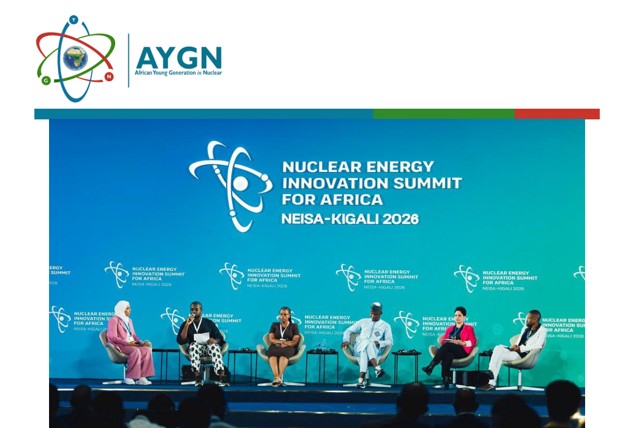
The African Young Generation in Nuclear has released a mission report outlining its participation in the 2026 Nuclear Energy Innovation Summit for Africa and highlighting a new institutional partnership with the African Commission on Nuclear Energy.
The AYGN delegation participated in policy discussions, technical sessions, industry engagements, bilateral meetings and the summit’s youth-focused activities in Kigali. Its most significant institutional outcome was the signing of a memorandum of understanding with AFCONE on 20 May 2026.
AFCONE subsequently described the agreement as a continental youth partnership intended to support the responsible and peaceful development of nuclear science and technology while strengthening the role of young African professionals.
The agreement is important because Africa’s nuclear ambitions will ultimately depend not only on agreements with reactor vendors, governments and financial institutions, but also on whether the continent develops enough qualified people to regulate, build, operate, secure and eventually decommission nuclear facilities.
Africa’s nuclear future cannot be implemented by institutions alone. It will require a sustained pipeline of scientists, engineers, regulators, lawyers, economists, communicators, safeguards specialists, security professionals and project managers.
From summit participation to institutional partnership
AYGN’s participation in NEISAfrica 2026 went beyond attendance at a major industry gathering.
According to the organisation’s mission account, its delegation contributed to policy dialogues, technical discussions, industry sessions, the Youth Summit and strategic meetings with participating institutions. The organisation used these engagements to argue that young professionals should not be treated merely as observers of Africa’s nuclear development, but as active contributors to its design and implementation.
The MoU with AFCONE gives that argument a more formal institutional basis.
AFCONE is the body established under the African Nuclear-Weapon-Free Zone Treaty, commonly known as the Pelindaba Treaty, to support its implementation and advance the peaceful, safe and secure use of nuclear science and technology across the continent.
AYGN, meanwhile, provides a continental network through which students, early-career professionals and emerging leaders can participate in nuclear education, professional development and public engagement.
Bringing the two organisations together potentially connects Africa’s official continental nuclear-governance architecture with a network representing the professionals who will inherit responsibility for that architecture.
What the agreement is expected to support
Public descriptions of the partnership identify several broad areas of cooperation:
- youth participation in Africa’s nuclear-development agenda;
- capacity building and professional development;
- knowledge exchange;
- peaceful applications of nuclear science and technology;
- regional collaboration; and
- the development of future African nuclear leadership.
These objectives are consistent with AFCONE’s wider efforts to build African expertise in safeguards, regulation, security, energy planning and peaceful nuclear applications.
AFCONE has expanded its human-capital activities in recent years through partnerships with the IAEA, Finland’s Radiation and Nuclear Safety Authority, the OECD Nuclear Energy Agency and African institutions. Its programmes have included safeguards training, leadership development, internships, expert databases and regional technical cooperation.
However, the full implementation arrangements for the AYGN agreement have not yet been publicly detailed.
The next important step will therefore be to translate the broad commitments in the MoU into a structured programme with identifiable activities, funding, timelines and measurable outcomes.
Without that transition, the partnership risks becoming another well-intentioned agreement whose value is demonstrated mainly through ceremonies and public statements.
Africa’s workforce challenge is becoming more urgent
The timing of the partnership is significant.
More African countries are moving from general interest in nuclear energy towards formal programme development.
South Africa already operates a commercial nuclear power station. Egypt is constructing the El Dabaa plant. Ghana, Kenya, Nigeria, Rwanda and Uganda are at different stages of nuclear infrastructure development, while other countries are examining research reactors, small modular reactors and expanded applications of nuclear science.
NEISAfrica 2026 itself highlighted commitments and programme signals from countries including Rwanda, Kenya, Ghana, Tanzania, South Africa and Togo. The summit brought together government leaders, regulators, investors, vendors, utilities, academic institutions and youth networks to examine how nuclear ambitions can be converted into deliverable programmes.
Every additional national programme increases demand for specialised expertise.
A country developing nuclear power needs professionals in areas such as:
- reactor engineering;
- nuclear and radiation safety;
- nuclear security;
- safeguards and material accountancy;
- radioactive-waste management;
- environmental assessment;
- emergency preparedness;
- nuclear law and liability;
- project finance;
- grid planning;
- procurement;
- quality assurance;
- stakeholder engagement; and
- regulatory inspection.
Many of these skills take years to develop.
Workforce preparation cannot begin only after a reactor contract has been signed. By that stage, a newcomer country already needs competent personnel capable of evaluating the technology, negotiating contracts, reviewing safety documentation and protecting national interests.
Youth participation should not be symbolic
African nuclear conferences increasingly include youth panels, student sessions and young-professional programmes.
These are positive developments, but representation alone is insufficient.
Young professionals must have access to pathways that allow them to move from conference participation into meaningful technical and institutional responsibilities.
This requires more than motivational speeches.
It requires:
- funded scholarships and fellowships;
- placements within regulators and nuclear institutions;
- access to laboratories and research reactors;
- structured mentoring;
- participation in national nuclear working groups;
- technical secondments;
- regional professional exchanges;
- involvement in safeguards and emergency exercises;
- support for publishing research; and
- transparent recruitment into nuclear organisations.
Youth engagement should also reflect the full diversity of nuclear work.
Not every future nuclear professional will be a reactor engineer. Africa also needs lawyers, environmental scientists, health physicists, emergency planners, economists, social scientists, communicators and specialists in international relations.
A credible continental workforce strategy must recognise these interconnected responsibilities.
The risk of losing trained professionals
Developing expertise is only one part of the challenge. African institutions must also retain it.
Young professionals may receive specialised training through the IAEA, foreign universities, national laboratories or international partnerships and then discover that no suitable position, research funding or professional progression exists at home.
Others may remain employed in nuclear institutions but lack the equipment, mentorship and institutional support needed to apply their knowledge.
This creates a cycle in which African countries repeatedly seek external training while failing to build durable domestic capability.
The AYGN-AFCONE partnership should therefore address retention as well as training.
Possible measures could include:
- continental professional-placement programmes;
- early-career research grants;
- regulatory fellowships;
- joint appointments between universities and nuclear institutions;
- regional mobility schemes;
- access to African technical-support organisations;
- innovation challenges linked to national programme needs; and
- leadership-development pathways for young professionals.
Training should be connected to an identifiable institutional need and a realistic opportunity to apply the acquired skills.
Building an African nuclear knowledge network
The agreement also creates an opportunity to strengthen cooperation among young professionals across national borders.
African nuclear programmes are developing at different speeds and possess different institutional strengths.
South Africa has extensive experience in reactor operation, fuel-cycle activities, research, regulation and waste management. Ghana has longstanding education and research infrastructure, including the Graduate School of Nuclear and Allied Sciences. Morocco operates significant nuclear research and training facilities. Egypt is gaining experience from constructing a large commercial plant, while Kenya and Rwanda are advancing newcomer programmes.
Regional cooperation could allow young professionals to learn from these different experiences rather than depending exclusively on placements outside Africa.
A continental network could support:
- shared courses;
- joint research projects;
- regional databases of expertise;
- access to specialised facilities;
- collaborative policy studies;
- peer mentoring;
- professional certification;
- technical competitions;
- safeguards and security training; and
- participation in cross-border emergency exercises.
NEISAfrica’s 2026 recap identified human capital, industrial localisation and public trust as issues that should receive attention alongside finance. Its proposed direction for the 2027 summit includes an African Nuclear Scholars Fellowship and stronger regional pooling of talent.
AYGN and AFCONE could provide an institutional bridge between these summit commitments and the professionals expected to implement them.
Youth must also participate in nuclear governance
Nuclear workforce development should not be limited to technical competence.
Young professionals should also understand the principles governing responsible nuclear development, including:
- regulatory independence;
- nuclear safety culture;
- non-proliferation;
- safeguards;
- nuclear security;
- ethical leadership;
- environmental responsibility;
- public accountability; and
- intergenerational responsibility for radioactive waste.
This is especially important because many decisions taken during the early stages of African nuclear programmes will create obligations lasting for decades.
A reactor selected today may operate for 60 years or more. Spent fuel and radioactive waste may require management long after the original project leaders have left office.
The younger generation will therefore bear responsibility for decisions it may not have participated in making.
Giving young professionals a meaningful role in policy discussions is not simply a matter of inclusion. It is a matter of sound long-term governance.
NEISAfrica is moving towards implementation
The wider context of the agreement is the growing role of NEISAfrica as a meeting point for Africa’s nuclear-development community.
The 2026 summit in Kigali convened political leaders, regulators, financiers, reactor companies, utilities, research institutions and youth organisations. Its discussions focused strongly on financing, regulation, workforce development, industrial demand and the conversion of national nuclear ambitions into investable projects.
Several cooperation arrangements were announced or signed during the summit, covering government-to-government cooperation, reactor development, energy planning, workforce development and nuclear security.
This creates an important accountability challenge.
The value of NEISAfrica should increasingly be judged not by the number of delegates, speeches or agreements announced, but by the progress achieved between summit editions.
For the AYGN-AFCONE partnership, measurable progress could include:
- a published implementation plan;
- a continental youth nuclear programme;
- training and fellowship opportunities;
- young-professional representation in AFCONE activities;
- joint research or policy outputs;
- national AYGN chapter development;
- documented participation by women and underrepresented groups; and
- an annual report on results.
The road to Togo
NEISAfrica 2027 is scheduled to take place in Lomé, Togo, with the summit’s official platform identifying 2 June 2027 as the opening date.
The event will be the first edition hosted outside Rwanda and is expected to place greater emphasis on moving from commitments to implementation.
Togo’s selection as host was also confirmed by President Paul Kagame during the Kigali summit and subsequently reported in Togo.
For AYGN and AFCONE, Lomé should serve as an accountability point.
By the time stakeholders meet again, the two organisations should be able to demonstrate what the MoU has produced beyond the signing ceremony.
Questions worth answering include:
- How many young professionals have participated in joint activities?
- Which countries and institutions have benefited?
- Has the partnership created funded training or research opportunities?
- Are young professionals participating in AFCONE programmes?
- Has a continent-wide skills or expertise database been developed?
- Have national organisations incorporated youth into their nuclear planning?
- What opportunities have been created for women and professionals from countries with less-developed nuclear infrastructure?
Clear answers would show that youth participation is becoming part of Africa’s nuclear implementation framework.
Conclusion
The AYGN-AFCONE memorandum of understanding is a welcome development because it recognises a basic reality: Africa’s nuclear ambitions will be implemented by the generation now entering universities, regulators, research centres, utilities and public institutions.
The partnership creates an opportunity to move youth engagement from the margins of nuclear conferences into the centre of continental policy, capacity building and technical cooperation.
But the signing of the MoU is only the beginning.
Its credibility will depend on whether it creates real opportunities for young Africans to acquire expertise, contribute to policy, participate in research and assume institutional responsibility.
Africa does not merely need more young people interested in nuclear energy.
It needs a deliberate system for transforming that interest into competence, employment, leadership and long-term public service.
As NEISAfrica moves from Kigali to Lomé, the success of the youth partnership should be measured not by the visibility of young professionals at the next summit, but by the responsibilities they have been given between the two events.
Related


Africa Deepens Nuclear Safeguards Capacity as AFCONE Convene Hands-On Training in Nairobi
By Nuclear Africa• August 24, 2026
A 300 MW SMR Could Support More Than 12,500 Construction Jobs in Ghana: New Study Tests Nuclear’s Economic Case
By Nuclear Africa• August 24, 2026
Ghana Targets 1,000 MW of Nuclear Power by the Mid-2030s: What Must Happen Before Construction Can Begin?
By Nuclear Africa• August 24, 2026