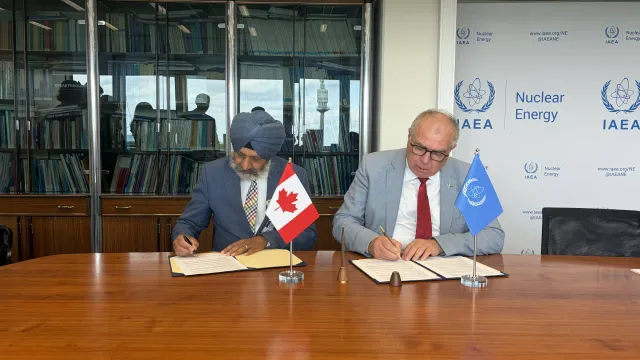
The International Atomic Energy Agency and the University of Saskatchewan have expanded their cooperation in nuclear research, education and professional training, offering a useful model for African countries seeking to build sustainable nuclear workforces rather than relying predominantly on short-term overseas training.
The two institutions signed the agreement at IAEA headquarters in Vienna on 24 July 2026, establishing a framework for closer collaboration in nuclear research and training. The University of Saskatchewan said the arrangement will support additional education and training for nuclear professionals while expanding research expertise and international cooperation.
The partnership comes as governments around the world face a growing challenge that extends beyond constructing reactors: ensuring that enough qualified people are available to regulate, operate, maintain and eventually decommission nuclear facilities.
For Africa’s emerging nuclear programmes, that workforce challenge is particularly important.
Building Institutions, Not Just Training Individuals
Many nuclear newcomer countries begin workforce development by sending scientists, engineers and officials to international workshops, fellowships and postgraduate programmes.
Such opportunities remain valuable, but they do not by themselves create a sustainable national nuclear workforce.
The Saskatchewan model demonstrates a more institutional approach: develop universities and national research centres capable of continuously educating successive generations of nuclear professionals.
The University of Saskatchewan already has research capabilities spanning nuclear medicine, nuclear fuels and energy, radioactive-waste processing and storage, and nuclear-related public policy. Its infrastructure includes the Saskatchewan Cyclotron Facility and the Canadian Light Source synchrotron.
Its relationship with the IAEA also predates the latest agreement.
In 2025, the university hosted Canada’s National Nuclear Energy Management School in cooperation with the IAEA, providing specialised nuclear-energy education to mid-career professionals. Earlier in 2026, it hosted an Executive Nuclear Energy Management School aimed at senior leaders and decision-makers from government, academia and industry — the first executive-level IAEA nuclear-management programme offered in Canada.
The progression is significant. Training is increasingly being embedded within an institution rather than treated as a sequence of isolated international courses.
The Workforce Challenge Facing African Newcomers
Countries considering nuclear power need substantially broader skills than reactor engineering alone.
Regulators require specialists in nuclear safety, radiation protection, safeguards, security, emergency preparedness, environmental assessment and inspection. Nuclear owner-operators require engineers, project managers, procurement specialists, quality-assurance professionals and eventually licensed operators and maintenance personnel.
Governments also require expertise in nuclear law, economics, financing, infrastructure planning, public communication, waste management and international nuclear governance.
These capabilities must be maintained for decades.
A nuclear power programme may operate for 60 years or more, while responsibilities for spent fuel, radioactive waste and decommissioning continue beyond reactor operation itself. Workforce development therefore cannot be approached merely as preparation for construction.
It has to become a permanent part of national education and research infrastructure.
An Opportunity for African Universities
The Saskatchewan partnership raises an important policy question for countries such as Ghana, Kenya, Uganda and Rwanda that are developing or considering nuclear-power programmes:
Should nuclear workforce development be centred more deliberately within African universities?
There are already universities and nuclear research institutions across the continent with relevant capabilities in physics, engineering, radiation protection, nuclear science, environmental science and medical applications.
The challenge is to connect these capabilities more systematically with national nuclear programmes.
Rather than attempting to create entirely new institutions, governments could strengthen selected universities as national or regional nuclear education hubs, linking academic programmes with regulators, nuclear programme organisations, utilities, research reactors and international partners.
Such institutions could develop postgraduate programmes in nuclear engineering and management while also delivering continuing professional education for regulators, policymakers and industry.
The approach would also help address a frequent problem in capacity-building programmes: knowledge gained through international training can become concentrated within individual organisations or personnel rather than being institutionalised and transferred systematically.
Universities provide a mechanism for converting expertise into curricula, research programmes, laboratories and future generations of professionals.
Regional Cooperation Could Go Further
Africa may also benefit from thinking beyond national workforce strategies.
Not every newcomer country needs to reproduce every expensive educational and research capability domestically.
A regional model could allow universities and nuclear research centres in different countries to specialise.
One institution might develop strength in nuclear engineering and reactor technology, another in safeguards and nuclear security, another in radioactive-waste management, and another in nuclear law, economics and policy.
Students and professionals could then move through a network of African institutions supported by partnerships with the IAEA and established nuclear countries.
Such an approach could reduce duplication while creating a larger continental pool of expertise.
Nuclear Education Is Infrastructure
Discussions about nuclear readiness frequently focus on visible infrastructure: sites, grids, transmission lines, reactors and financing.
Human infrastructure is less visible but equally consequential.
A country can procure reactor technology from abroad. It cannot sustainably outsource responsibility for nuclear safety, regulation, emergency preparedness and programme governance.
The new IAEA-University of Saskatchewan arrangement therefore carries a wider lesson for Africa.
Building a nuclear programme requires not only training today’s officials but establishing institutions capable of educating tomorrow’s regulators, scientists, engineers and decision-makers.
For African nuclear newcomers, universities should be considered part of the nuclear infrastructure itself.
NuclearAfrica Perspective
African countries need not replicate Canada’s nuclear research ecosystem wholesale. Their programmes differ substantially in scale, resources and stage of development.
The practical lesson is instead institutional: international nuclear training should progressively strengthen domestic educational capacity rather than create permanent dependence on external training.
Partnerships between the IAEA, African universities, regulators and national nuclear programme organisations could help transform individual capacity-building activities into enduring national and regional systems for nuclear education and knowledge management.
Caveat: The Saskatchewan agreement is a framework for research, education and training cooperation. It is not a reactor-development agreement, project-financing commitment or nuclear construction decision.
Primary source: University of Saskatchewan, 27 July 2026.
Related


Africa Deepens Nuclear Safeguards Capacity as AFCONE Convene Hands-On Training in Nairobi
By Nuclear Africa• August 24, 2026
A 300 MW SMR Could Support More Than 12,500 Construction Jobs in Ghana: New Study Tests Nuclear’s Economic Case
By Nuclear Africa• August 24, 2026
Ghana Targets 1,000 MW of Nuclear Power by the Mid-2030s: What Must Happen Before Construction Can Begin?
By Nuclear Africa• August 24, 2026