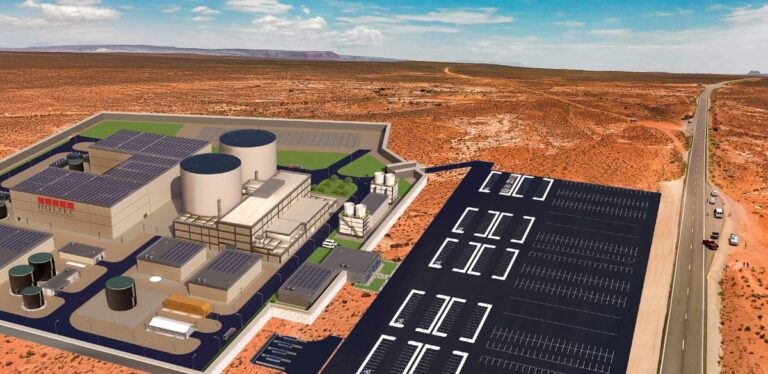
India’s effort to open its nuclear-energy sector to private investment is moving from legislation towards project planning, with Adani Power evaluating reactor technologies and potential sites for a proposed 10-gigawatt nuclear programme by 2035.
The company says it is examining both domestic and international reactor designs and assessing sites including Bina and Nigrie in Madhya Pradesh. However, Adani executives have stressed that firm investment decisions cannot be made until the Indian government finalises detailed regulations governing private participation.
Adani has also identified affordability as a decisive consideration. The company says reactor selection must produce electricity at prices that consumers and power-distribution companies can reasonably carry.
The development follows India’s enactment of the Sustainable Harnessing and Advancement of Nuclear Energy for Transforming India Act, 2025, known as the SHANTI Act. The Indian government says the legislation enables wider participation by public- and private-sector organisations in support of its target of reaching 100 GW of nuclear capacity by 2047.
A major change in India’s nuclear model
India’s commercial nuclear-power industry has historically been dominated by state institutions, particularly the Nuclear Power Corporation of India Limited.
Opening the sector to private investment represents a significant change in the ownership and financing model of one of the world’s largest emerging nuclear markets.
India currently has about 8.8 GW of installed nuclear capacity. Its government wants nuclear power to play a substantially larger role in meeting electricity demand and providing reliable low-carbon generation.
The national target of 100 GW by 2047 cannot realistically be achieved through the existing state-owned development model alone without major increases in capital, construction capacity, manufacturing and project execution.
Private participation is therefore intended to mobilise additional finance and industrial capability.
Adani’s proposed programme
Adani has stated an ambition to develop up to 10 GW of nuclear capacity by 2035.
If implemented, that would make it one of India’s largest nuclear operators. The state-owned Nuclear Power Corporation of India is targeting 50 GW, while state-controlled NTPC is aiming for around 30 GW. Other private companies, including Tata Power and Reliance Industries, are also examining nuclear-sector opportunities.
Adani’s target should nevertheless be understood as a corporate ambition rather than an approved construction programme.
Important decisions remain unresolved, including:
- the reactor technology;
- number and size of units;
- ownership structure;
- financing model;
- project sites;
- licensing arrangements;
- fuel supply;
- nuclear-liability allocation; and
- responsibilities for spent fuel and radioactive waste.
The company’s current site and technology assessments are preparatory activities.
India’s broader expansion plan
The Indian government has approved or is constructing several reactor projects using domestic and international technologies.
A July 2026 parliamentary response stated that nine reactors with a combined capacity of 7.5 GW remained under construction. It also identified government work on three domestically designed small-reactor concepts: a 220 MWe Bharat Small Modular Reactor, a 55 MWe small modular reactor and a high-temperature gas-cooled reactor of up to 5 MW thermal for hydrogen production.
India’s expansion strategy therefore combines:
- larger pressurised heavy-water reactors;
- Russian-designed reactors at Kudankulam;
- fast-breeder technology;
- domestically designed SMRs;
- possible foreign reactor partnerships; and
- greater private-sector participation.
This creates both opportunities and governance challenges.
Why private nuclear investment is difficult
A nuclear plant requires large amounts of capital before it produces electricity.
Construction may take several years, and delays can significantly increase financing costs. Private investors therefore require predictable rules concerning:
- electricity tariffs;
- cost recovery;
- construction risk;
- government guarantees;
- nuclear liability;
- fuel supply;
- waste responsibility;
- insurance;
- licensing timelines; and
- plant decommissioning.
In an ordinary power project, investors can often compare several technologies with established market prices and construction records.
New nuclear projects may involve first-of-a-kind designs, limited supply chains or policy-dependent revenue arrangements.
Private participation does not remove these risks. It changes how they are distributed among the investor, government, electricity consumer, equipment supplier and lender.
Regulatory independence must remain non-negotiable
Opening nuclear power to private capital creates a potential tension between investment speed and independent safety regulation.
Private developers may seek predictable and efficient licensing, which is legitimate. But predictability must not mean guaranteed approval.
The nuclear regulator must retain authority to:
- review reactor designs independently;
- inspect construction;
- require additional safety measures;
- enforce licence conditions;
- suspend activities;
- impose penalties; and
- refuse operation where safety requirements have not been satisfied.
The regulator must also be protected from pressure arising from the size of the investment or the political importance of the project.
A privately financed plant requires the same—or stronger—regulatory discipline as a state-owned facility.
Who should own the nuclear risk?
Private ownership raises difficult questions about responsibility.
A nuclear operator must have sufficient technical and financial capacity to manage the facility throughout construction, operation and decommissioning.
Governments must avoid structures in which profits are private but the most serious risks are transferred automatically to the public.
A credible framework should define:
- the legal operator;
- minimum financial capacity;
- nuclear-liability requirements;
- insurance obligations;
- decommissioning funds;
- radioactive-waste payments;
- responsibility following insolvency; and
- government intervention arrangements.
Nuclear projects operate for many decades. Ownership may change several times during the plant’s lifecycle.
The law must therefore ensure that safety and financial obligations survive corporate restructuring or failure.
The role of state institutions
Private participation does not mean that the state withdraws from nuclear energy.
Government institutions remain responsible for:
- national nuclear policy;
- international treaty obligations;
- safeguards implementation;
- emergency preparedness;
- national security;
- radioactive-waste policy;
- long-term spent-fuel arrangements;
- regulator funding;
- human-resource development; and
- public accountability.
The state may also remain involved through joint ventures, minority ownership, sovereign guarantees or fuel-cycle services.
India already has an example of a joint public-sector structure in ASHVINI, a partnership involving the Nuclear Power Corporation of India and NTPC for reactor development.
Future private projects may use different arrangements, but public responsibilities cannot be contracted away entirely.
Affordability and the consumer
Adani’s emphasis on affordable electricity is important.
Nuclear power can provide stable generation over a long operating life, but the final electricity price depends heavily on:
- construction cost;
- interest rates;
- completion time;
- currency exposure;
- capacity factor;
- fuel cost;
- operating expenditure;
- waste contributions; and
- decommissioning provisions.
Private investors will require a mechanism for recovering these costs.
Possible arrangements include:
- long-term power-purchase agreements;
- regulated asset-base models;
- contracts for difference;
- government guarantees;
- sovereign loans;
- capacity payments; and
- direct electricity supply to industries.
Each model allocates costs and risks differently.
Governments should publish the assumptions used to claim that nuclear power will reduce electricity prices.
Implications for Africa
India’s reform is directly relevant to African countries seeking nuclear power but facing limited public financing.
Many African governments may be unable to finance multibillion-dollar plants solely through national budgets or state-owned utilities.
Private capital may therefore appear attractive.
Potential models include:
- public-private partnerships;
- independent power producers;
- build-own-operate arrangements;
- build-own-operate-transfer models;
- vendor-financed projects;
- joint ventures with state utilities; and
- nuclear electricity supplied directly to mines or industrial users.
Each approach can mobilise capital, but each also creates distinct governance and sovereignty questions.
Could an independent power producer own an African nuclear plant?
An independent power producer model is common in renewable-energy and gas projects.
Applying it to nuclear power would be more complex because the plant carries long-term responsibilities extending beyond electricity generation.
A nuclear IPP framework would need to address:
- control over nuclear material;
- access by safeguards inspectors;
- physical protection;
- national emergency powers;
- spent-fuel ownership;
- decommissioning after the power contract ends;
- continuity following company failure; and
- restrictions on foreign ownership or control.
A government must also decide whether an essential strategic asset should be controlled by a private or foreign entity.
Build-own-operate arrangements
Some reactor vendors may propose to build, own and operate a nuclear plant while selling electricity to the host country.
This could reduce the immediate burden on a nuclear-newcomer state.
It may also create long-term dependence on the supplier for:
- plant operation;
- fuel;
- maintenance;
- digital systems;
- security services;
- waste management; and
- technical knowledge.
The contract would need to preserve the host state’s regulatory authority and sovereign control.
No commercial agreement should prevent the national regulator from enforcing safety requirements.
The mining and industrial model
Private nuclear power may first become viable in Africa through large industrial users rather than national electricity markets.
Mines, refineries, data centres and industrial parks may be willing to enter long-term electricity contracts where reliable power is essential.
SMRs or microreactors could be proposed for such customers.
However, an industrial customer cannot assume responsibility for nuclear regulation or safeguards simply because it purchases the electricity.
The state must still maintain the complete legal and institutional framework.
Lessons for African policymakers
Define private participation before inviting investors
Countries should decide which activities private companies may undertake and which responsibilities remain exclusively with the state.
Strengthen the regulator first
A regulator should have the legal authority, resources and competence to oversee powerful private developers before licence applications are submitted.
Protect the public from abandoned liabilities
Decommissioning and waste funds should be established during operation, not left to future governments.
Evaluate the total electricity cost
A lower initial government contribution may be offset by expensive long-term electricity contracts or guarantees.
Preserve national capability
Private investment should include meaningful workforce development, knowledge transfer and local participation.
Maintain transparency
Major contracts, risk guarantees and tariff commitments should receive appropriate public and parliamentary scrutiny.
India as a case to watch
India has several advantages that may not exist in many African newcomer countries.
It possesses:
- decades of reactor operating experience;
- a large domestic nuclear workforce;
- uranium and fuel-cycle institutions;
- reactor-design capability;
- component manufacturing;
- national laboratories;
- experienced project organisations; and
- an existing regulatory system.
Private companies entering India’s nuclear industry will therefore operate within a substantial national nuclear ecosystem.
African countries should not assume that adopting similar ownership rules would immediately create the same result.
Private capital works best when it enters an already credible institutional environment.
Conclusion
India’s opening of nuclear power to private participation could become one of the most important changes in the global nuclear market.
Adani’s 10 GW ambition demonstrates the scale of corporate interest, but the company’s caution also shows that legislation alone is insufficient.
Investors require clear rules, credible regulation, affordable project economics and predictable allocation of long-term responsibilities.
For African countries, India provides a valuable case study in how private capital might contribute to nuclear development.
The central lesson is not simply that nuclear power can be privatised.
It is that private participation must be governed by strong public institutions capable of protecting safety, financial sustainability, energy sovereignty and future generations.
Related

US Invests More Than $40 Million in Regional Nuclear Technology and Workforce Hub
By Nuclear Africa• July 28, 2026
Applications Open for 2026 CONNECT-NM Young Researcher Network Workshop in Germany
By Nuclear Africa• July 28, 2026
US Proposal to Retire ALARA Sparks Global Radiation-Safety Debate
By Nuclear Africa• July 28, 2026