China has recorded two significant operating milestones in the expansion of its Hualong One reactor fleet, with Changjiang Unit 3 supplying electricity to the grid for the first time and Taipingling Unit 2 completing commissioning and entering commercial operation.
Both units use China’s domestically developed Hualong One, also known as the HPR1000, a pressurised-water reactor design that has become central to the country’s nuclear construction programme and international export strategy.
Although the milestones occurred within days of one another, they represent different stages of reactor development.
Changjiang 3 has generated electricity but remains under commissioning and power-ascension testing.
Taipingling 2 has completed the commissioning programme required for it to be declared qualified for commercial operation.
The distinction matters because first electricity is not the same as full commercial service.
Changjiang 3 Supplies First Electricity
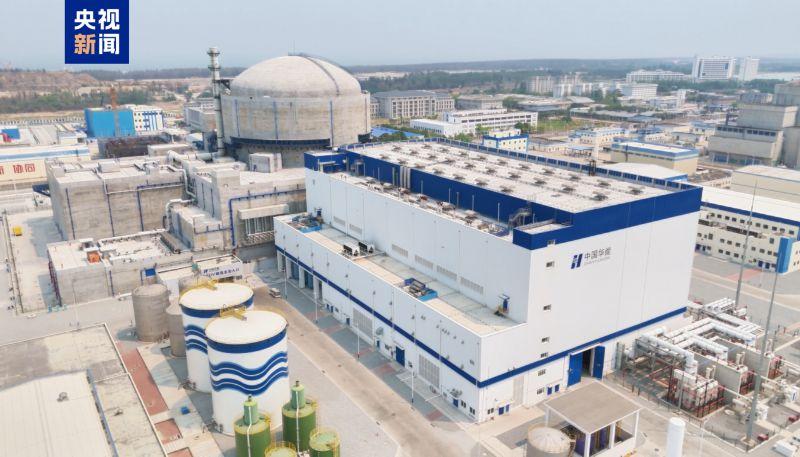
Changjiang Unit 3 was connected to the electricity grid on 1 August at the Changjiang nuclear power site in China’s island province of Hainan.
China National Nuclear Corporation said the unit generated its first electricity and entered what it described as the load-bearing trial-operation phase. The reactor will now undergo further testing at progressively higher power levels before commercial operation can begin.
Changjiang 3 had achieved first criticality on 10 July, establishing a controlled, self-sustaining nuclear chain reaction for the first time.
Grid connection confirms that the reactor, steam systems, turbine generator and electricity-export systems can operate together sufficiently to supply power.
It does not mean that all commissioning activities have been completed.
During the period following first grid connection, operators typically increase reactor power in planned stages while testing safety systems, control equipment, turbine performance and the plant’s response under different operating conditions.
Unexpected findings may require adjustments, repeat tests or additional regulatory review before full-power operation is authorised.
Changjiang 3 should therefore be described as a reactor undergoing commissioning—not as a unit already in commercial operation.
Part of Changjiang’s Second Phase
Changjiang 3 is the first of two Hualong One reactors being built as the second phase of the Changjiang nuclear power plant. Construction of Unit 3 began in March 2021, followed by Unit 4 in December of the same year. The two-unit phase represents an estimated investment of CNY40 billion, or approximately US$5.9 billion, according to China Huaneng, the majority shareholder in the project. Both units are scheduled to be fully operational by early 2027.
The Changjiang site already contains two operating CNP-600 pressurised-water reactors, which entered commercial operation in 2015 and 2016.
It is also hosting construction of China’s demonstration ACP100 small modular reactor, known as Linglong One. The 125 MWe reactor is intended for applications including electricity generation, heating, industrial steam and seawater desalination and is undergoing pre-commissioning work.
Changjiang is consequently becoming a multi-technology nuclear site containing operating reactors, large Hualong One units and China’s first demonstration land-based commercial SMR.
Taipingling 2 Enters Commercial Operation
Taipingling Unit 2 reached a more advanced milestone on 3 August.
China General Nuclear announced that the reactor had completed its commissioning programme and was qualified for commercial operation. The final commissioning activities included a continuous 168-hour demonstration run.
The unit had received an operating licence from China’s National Nuclear Safety Administration on 30 April. Loading of its 177 fuel assemblies was completed on 3 May, followed by first criticality on 25 June and first grid connection on 4 July.
Taipingling 2 has a net generating capacity of approximately 1,116 MWe.
Its progression can therefore be summarised as:
Operating licence → fuel loading → first criticality → grid connection → power testing → 168-hour demonstration → commercial operation.
This sequence illustrates why individual reactor milestones must be reported accurately.
A reactor may be producing electricity while significant commissioning work remains incomplete.
Similar Technology, Different Status
Changjiang 3 and Taipingling 2 use the same broad reactor technology, but they are not at the same operating stage.
Changjiang Unit 3
- Achieved first criticality;
- connected to the grid;
- generated first electricity;
- entered load-bearing trial operation; and
- continues commissioning and power-ascension testing.
Taipingling Unit 2
- Obtained an operating licence;
- completed fuel loading and first criticality;
- connected to the grid;
- completed commissioning tests;
- passed a 168-hour demonstration run; and
- qualified for commercial operation.
Reporting both developments simply as reactors “coming online” would obscure this difference.
The phrase can refer to first grid connection, initial electricity generation or commercial service, depending on how it is used.
More precise language helps governments, investors and the public understand what has actually been achieved.
Taipingling Develops as a Six-Unit Fleet
Taipingling Unit 2 is the second of six Hualong One reactors planned for the site in Guangdong province.
Construction of Units 1 and 2 began in 2019 and 2020 respectively. Unit 1 entered commercial operation on 19 April 2026 after completing its own commissioning programme.
Construction is also progressing on Units 3 and 4. China’s State Council approved that second phase in December 2023, with first concrete poured for Unit 3 in June 2025 and Unit 4 in May 2026.
Units 5 and 6 were approved on 31 July 2026 and are expected to use an updated Hualong One 2.0 design rated at approximately 1,217 MWe each.
When all six units are complete, CGN expects the Taipingling plant to generate more than 55 billion kilowatt-hours of electricity annually.
The complete project is expected to involve investment exceeding CNY120 billion, or approximately US$17 billion.
This is not a collection of unrelated reactor projects. It is a long-term site-development programme built around repeated deployment of a standardised reactor family.
China Moves Marginally Ahead of France in Capacity
The latest World Nuclear Association figures list China with 64 operable reactors and total nuclear generating capacity of 63,985 MWe.
France is listed with 57 operable reactors totalling 63,000 MWe.
On that statistical basis, China has moved narrowly ahead of France to become the world’s second-largest nuclear power country by operable generating capacity, behind the United States.
The margin is approximately 985 MWe—less than the output of one large modern reactor.
The comparison should therefore be presented as a narrow change in ranking rather than evidence of a decisive capacity gap.
It should also be understood that reactor databases may classify a unit as operable once it has connected to the grid, even though the reactor may still be completing the final stages of commissioning before formal commercial service.
Capacity, Output and Electricity Share Are Different
Installed nuclear capacity is only one way of comparing national nuclear programmes.
Three measurements should be distinguished:
Installed or operable capacity
This measures the combined generating capability of reactors regarded as available for operation.
It does not reveal how much electricity they actually produced during a particular year.
Annual nuclear generation
This measures the electricity generated by the reactors over a defined period.
Generation is affected by reactor availability, maintenance outages, capacity factors, demand and operating decisions.
Nuclear share of the electricity mix
This measures how much of a country’s total electricity generation comes from nuclear power.
A country can possess substantial nuclear capacity while nuclear energy still represents a relatively small part of its much larger electricity system.
China Produces More, but France Depends on Nuclear More
World Nuclear Association figures show that China generated approximately 448.4 TWh of nuclear electricity in 2025, representing about 5% of its total electricity generation.
France generated approximately 373.5 TWh from nuclear power, representing 68.1% of its electricity.
China therefore produced more nuclear electricity in absolute terms.
France, however, remained much more dependent on nuclear power as a component of its national electricity system.
The capacity ranking should not be interpreted as meaning that nuclear energy plays an equivalent role in the two countries.
China operates a much larger overall electricity system supplied by several energy sources. Its nuclear programme is expanding rapidly but continues to account for a comparatively modest share of national generation.
France’s electricity system remains structurally centred on its nuclear fleet.
Why the Hualong One Fleet Matters
China’s Hualong One programme is moving beyond the construction of individual demonstration units.
Reactors based on the design are operating or being built at several Chinese sites, including Fuqing, Fangchenggang, Zhangzhou, Taipingling, San’ao and Changjiang.
Two export Hualong One units are also operating at the Karachi nuclear power plant in Pakistan, while another is under construction as Chashma Unit 5.
Repeated deployment provides several potential advantages.
Accumulated licensing experience
Regulators and reactor developers can apply knowledge from previous assessments to later units while addressing site-specific differences.
Construction learning
Engineering teams can improve sequencing, workforce coordination and project management as similar units are constructed repeatedly.
Supply-chain continuity
Manufacturers have a continuing market for reactor vessels, steam generators, pumps, valves, instrumentation and other components.
Workforce retention
Specialised nuclear construction and commissioning teams can move from one project to another rather than being dispersed after a single build.
Operating feedback
Experience from completed reactors can inform maintenance, training, spare-parts planning and later design improvements.
Stronger export references
Potential customers can assess operating plants and multiple projects rather than relying primarily on design documents and vendor projections.
These advantages do not eliminate project risk, but they can gradually transform a new reactor technology into an established fleet product.
Standardisation Does Not Mean Identical Projects
Even reactors based on a common design will not be completely identical.
Sites differ in geology, seismic conditions, coastal hazards, cooling-water availability, grid connections and emergency arrangements.
National legal and regulatory requirements may also require modifications.
Standardisation should therefore focus on preserving the established reactor design wherever reasonable while allowing justified adaptations for national and site-specific conditions.
Excessive redesign can undermine the learning and manufacturing benefits of fleet deployment.
But refusing necessary changes merely to preserve standardisation could create safety, regulatory or infrastructure problems.
The correct balance must be determined through independent technical assessment.
Lessons for African Newcomer Countries
China’s Hualong One programme provides useful lessons for African countries considering nuclear power, although the Chinese model cannot simply be copied.
The first lesson is that nuclear power performs differently when treated as a continuing national programme rather than a single construction project.
A country building one isolated reactor may mobilise a large workforce during construction but struggle to retain those skills after completion.
Domestic manufacturers may invest in nuclear-grade capabilities without receiving enough repeat orders to sustain them.
The regulator may recruit specialised staff for one licensing process but face difficulty maintaining expertise during a long interval before another project.
A carefully planned multi-unit programme can create greater continuity.
But fleet planning also creates much larger long-term obligations.
Electricity Demand Must Support the Programme
A fleet can be justified only where electricity demand can absorb the output of multiple units.
Each Hualong One reactor produces roughly 1.1 GWe of electricity. A two-unit site would therefore add more than 2 GWe, while a six-unit development comparable to Taipingling would eventually exceed 6 GWe.
The host country must determine whether its electricity system can accommodate that capacity without creating persistent oversupply, financial losses or unacceptable grid instability.
Demand projections should be tested against:
- industrial development;
- mining and mineral-processing plans;
- electrification;
- regional electricity exports;
- transmission expansion;
- retirement of existing plants;
- seasonal demand patterns; and
- realistic economic-growth scenarios.
Optimistic demand projections should not be used merely to justify a predetermined reactor fleet.
Grid Capacity Is Equally Important
A reactor trip can remove more than 1 GWe from the electricity system within a short period.
The grid must have adequate reserves, transmission strength and system-control capability to manage that loss without causing a wider blackout.
For smaller African electricity systems, this may require substantial investment in:
- transmission infrastructure;
- reserve generation;
- regional interconnections;
- energy storage;
- frequency control;
- grid-management systems; and
- system-operator training.
A large reactor cannot be assessed independently of the grid into which it will be connected.
The appropriate reactor size may differ significantly from one African country to another.
Fleet Planning Can Improve Localisation
A multi-unit programme can create a stronger basis for domestic industrial participation than a single reactor.
Local companies may be more willing to invest in nuclear-quality certification, specialised equipment and workforce training when they can see a credible pipeline of future contracts.
Potential areas of participation could include:
- civil construction;
- concrete and reinforcement;
- electrical systems;
- conventional-island equipment;
- cables and supporting structures;
- logistics;
- maintenance;
- environmental monitoring;
- security systems; and
- professional services.
Localisation should nevertheless be based on demonstrated competence.
Safety-significant work should not be assigned to domestic suppliers merely to meet a political percentage target.
A phased approach can allow companies to begin with lower-risk activities and progress towards more specialised nuclear work as their capabilities mature.
The Regulator Must Also Plan for a Fleet
Licensing several similar units can produce efficiencies, but it does not reduce the need for a strong regulator.
The authority must be capable of:
- assessing the reference design;
- reviewing site-specific applications;
- overseeing construction at multiple units;
- inspecting manufacturing facilities;
- monitoring commissioning;
- supervising operating reactors;
- reviewing design changes;
- managing ageing and maintenance issues; and
- maintaining independent emergency and security oversight.
Several units under simultaneous construction could place greater pressure on the regulator than a single project.
Staffing, technical-support capacity and funding must therefore expand before—not after—the construction programme accelerates.
Financing Obligations Multiply
Fleet deployment may reduce costs through standardisation and repeat construction, but it also increases total financial exposure.
A country must consider:
- whether units will be financed together or sequentially;
- who will absorb construction delays and cost overruns;
- whether government guarantees are required;
- how electricity tariffs will recover costs;
- whether foreign-currency debt creates exchange-rate exposure;
- how the first unit will be financed before later savings are realised;
- whether the state can sustain simultaneous infrastructure investments; and
- what happens if demand or political priorities change.
The possibility of future fleet savings does not eliminate the financing difficulty of the first unit.
African governments should require transparent modelling of both individual reactor costs and complete programme liabilities.
Avoid Locking In Before the Evidence Is Available
A planned fleet may create pressure to commit early to several units in order to obtain favourable financing or vendor terms.
This can reduce flexibility.
Governments should distinguish between:
- selecting a preferred technology;
- signing a framework for several units;
- placing a binding order;
- authorising construction of the first unit; and
- approving later units after reviewing actual performance.
A staged approach can allow the country to learn from the first project before taking on the full financial exposure of a fleet.
Later units should not become automatic merely because they were included in an initial political announcement.
A Larger Reference Fleet Strengthens China’s Position
Each successfully completed Hualong One reactor strengthens the evidence base available to Chinese vendors.
Potential importing countries can examine:
- construction records;
- commissioning experience;
- operational availability;
- maintenance requirements;
- regulatory findings;
- fuel performance;
- supply-chain capability; and
- the experience of existing customers.
That is more valuable than relying only on projected costs and schedules.
The expanding fleet also gives China a broader base from which to offer reactor construction, financing, fuel services, training and long-term technical support.
For newcomer countries, however, a strong vendor reference fleet should be treated as evidence to evaluate—not as a substitute for national analysis.
Suitability Remains Country-Specific
The successful operation of a reactor in China does not prove that it is automatically suitable for Ghana, Kenya, Uganda, Rwanda, Nigeria, South Africa or any other African country.
A national assessment must consider:
- electricity demand;
- grid size and resilience;
- site hazards;
- cooling-water availability;
- project cost;
- financing terms;
- localisation objectives;
- fuel-supply arrangements;
- spent-fuel and radioactive-waste policy;
- regulatory capability;
- emergency preparedness;
- nuclear security;
- safeguards obligations; and
- long-term dependence on the supplier.
The country must also compare the Hualong One with other available technologies and non-nuclear alternatives.
A mature reference fleet can reduce certain technology risks.
It cannot answer whether the project is affordable, necessary or appropriate for a specific national electricity system.
Milestones Must Be Reported Precisely
The Changjiang and Taipingling developments demonstrate why nuclear reporting must distinguish among the stages of reactor commissioning.
Changjiang 3 has generated its first electricity and entered load-bearing trial operation.
Taipingling 2 has completed commissioning, passed its demonstration run and entered commercial operation.
Both are important achievements.
They are not equivalent achievements.
China’s installed nuclear capacity has also moved narrowly ahead of France’s on the World Nuclear Association’s current figures, making China the second-largest nuclear country by operable capacity.
But France continues to obtain a much larger share of its electricity from nuclear power, while China’s larger and rapidly growing system uses nuclear energy as one part of a more diverse generation mix.
For Africa, the deeper lesson lies in the structure of China’s programme.
Repeated construction can strengthen skills, suppliers, regulatory experience and operating evidence.
But a fleet is justified only where national electricity demand, grid capacity, public finances and institutions can sustain it.
China’s expanding Hualong One fleet strengthens the reactor’s international credentials.
It does not make the technology universally suitable.
Related


Africa Deepens Nuclear Safeguards Capacity as AFCONE Convene Hands-On Training in Nairobi
By Nuclear Africa• August 24, 2026
A 300 MW SMR Could Support More Than 12,500 Construction Jobs in Ghana: New Study Tests Nuclear’s Economic Case
By Nuclear Africa• August 24, 2026
Ghana Targets 1,000 MW of Nuclear Power by the Mid-2030s: What Must Happen Before Construction Can Begin?
By Nuclear Africa• August 24, 2026