
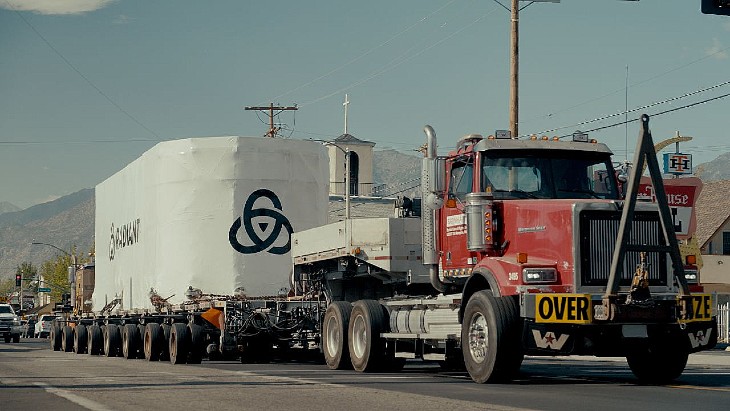
A transportable nuclear microreactor is making its way from California to Idaho for a fueled testing campaign that could provide important evidence about whether very small reactors can eventually move from advanced nuclear concepts into practical energy systems.
Radiant’s Kaleidos microreactor began its journey from El Segundo, California, on a trailer bound for the Demonstration of Microreactor Experiments facility at Idaho National Laboratory.
The physical movement of the unit is significant because transportability is one of the principal claims behind a new generation of microreactor designs.
Instead of constructing most of the reactor at its operating site, developers envision factory-manufactured systems that can be transported to customers, installed more rapidly and eventually returned or replaced for refuelling and maintenance.
For Africa, where remote mines, industrial projects, isolated communities and critical infrastructure often depend on diesel generation, that proposition deserves attention.
But the Kaleidos milestone should also be understood carefully.
The reactor has not yet demonstrated commercial operation.
The next stage is intended to test whether the technology can actually deliver many of the characteristics its developer ultimately hopes to commercialise.
From Reactor Concept to Physical Demonstration
Microreactors have generated considerable interest in recent years.
Their proposed applications range from military bases and mining operations to hospitals, data centres, disaster response and remote communities.
What distinguishes the Kaleidos development from many advanced reactor announcements is that an actual demonstration unit is now entering a testing pathway.
Idaho National Laboratory confirms that Radiant Industries is using the National Reactor Innovation Center’s DOME facility to test Kaleidos, which is being developed as a portable reactor for applications where conventional grid electricity may be unavailable, unreliable or expensive.
DOME was specifically developed to allow private reactor developers to conduct fueled experiments and generate operating data.
That matters because advanced nuclear technologies cannot be validated by computer modelling and engineering drawings alone.
They eventually have to operate.
What Is Kaleidos?
Kaleidos is a compact high-temperature gas-cooled microreactor intended to produce approximately one megawatt of electricity.
The reactor uses TRISO fuel, a form of coated particle fuel designed to retain fission products within multiple protective layers surrounding very small fuel kernels.
Radiant’s broader commercial concept is based on factory production and transportability.
The company ultimately envisages units that can be moved to customer locations by road and potentially by other transport modes, reducing some of the extensive site construction normally associated with nuclear power plants.
That could represent an important change in how certain nuclear systems are deployed.
Traditional large nuclear plants are major infrastructure projects.
They require extensive civil construction, large workforces, long project schedules and substantial grid infrastructure.
Microreactors propose a different model.
The reactor would be smaller, more standardised and more heavily manufactured before reaching the operating site.
Whether that model can ultimately be delivered economically remains to be demonstrated.
The Idaho Test Will Be Important
Radiant plans a staged testing programme at DOME.
The campaign is intended to move from low-power and criticality testing towards heat and electricity generation and eventually sustained operation.
One of the most closely watched objectives is a planned continuous 150-hour operating period without operator assistance.
That milestone has not yet been achieved.
It is one of the capabilities the test programme is intended to examine.
This distinction is important because autonomous operation is frequently discussed as one of the potential advantages of microreactors.
A reactor serving a remote mine or isolated installation would be much less attractive if it required the same scale of permanent operating workforce normally associated with a conventional nuclear station.
Automation could potentially reduce that burden.
But automation does not eliminate human responsibility.
Qualified personnel, maintenance arrangements, regulatory oversight, security systems and emergency procedures would still be required.
Why Africa Should Pay Attention
The strongest potential African use case for microreactors may not initially be national electricity grids.
It could be industry.
Mining provides a particularly interesting example.
Many African mineral deposits are located far from major electricity networks.
Mines in remote areas can require substantial quantities of electricity for extraction, crushing, processing, ventilation, pumping and other operations.
Where grid connections are unavailable, diesel generation can become an important source of electricity.
That carries several costs.
Fuel has to be transported over long distances.
Prices can be volatile.
Supply disruptions can interrupt production.
And large quantities of diesel can expose an industrial operation to significant long-term fuel expenditure.
A microreactor, if commercially proven, could offer another option.
The relevant comparison may therefore not always be:
microreactor versus a large nuclear power plant
It may instead be:
microreactor versus diesel generation, long transmission connections, renewable energy plus storage, or another isolated power system.
That is a very different economic question.
Mining Could Become an Early African Market
Africa’s mineral industry provides several possible environments in which small, highly reliable energy systems could eventually be valuable.
Copper, uranium, gold, lithium, rare earth and other mining operations can require continuous electricity even when the nearest large grid is hundreds of kilometres away.
A factory-produced reactor capable of operating for several years without conventional refuelling could potentially reduce dependence on continuous fuel deliveries.
It could also provide both electricity and heat for industrial processes.
But the word “potentially” is essential.
For microreactors to become credible mining technologies, developers will have to demonstrate more than reactor physics.
They will need to prove economics.
They will need to demonstrate reliability.
They will need credible fuel-supply arrangements.
They will need clear decommissioning strategies.
They will need workable security systems for remote locations.
And they will need licensing approaches that governments and regulators are willing to accept.
Transportability Creates New Questions
A reactor being transported on a truck is visually striking.
But transportability creates regulatory questions as well as engineering opportunities.
Moving a reactor between manufacturing, fueling, testing and operating locations involves nuclear material transport requirements.
Physical security must be maintained.
Responsibility for the reactor has to remain clear.
Emergency arrangements need to account for transportation scenarios.
Safeguards obligations must be satisfied where applicable.
And the regulator in the country where the reactor will eventually operate must still approve its deployment.
A transportable reactor is therefore not the nuclear equivalent of a conventional diesel generator that can simply be delivered and switched on.
The regulatory infrastructure follows the technology.
Could Africa Import Microreactors Directly?
This is where some advanced reactor discussions can become misleading.
Factory manufacturing may reduce the construction work undertaken at the final site.
It does not remove the responsibilities of the host country.
An African state considering a microreactor would still require a competent regulatory authority.
The proposed site would still need assessment.
The reactor would still require licensing.
Nuclear security arrangements would have to be established.
Safeguards responsibilities would apply to relevant nuclear material.
Emergency preparedness would need to be proportionate to the facility and the risks involved.
Spent fuel and radioactive waste would still require a defined management route.
Nuclear liability arrangements would also need to be considered.
Microreactors may simplify some aspects of deployment.
They do not eliminate nuclear governance.
The Fuel Question
Fuel is another issue African policymakers should watch closely.
Many advanced microreactor concepts depend on fuels that are not yet available through the same mature global supply chains serving today’s conventional light-water reactors.
TRISO fuel manufacturing is expanding, and several governments and companies are investing in advanced fuel production.
But fuel availability remains one of the issues that could influence the deployment pace of advanced reactors.
For an African customer, a microreactor contract would therefore need to answer questions extending far beyond the purchase price.
Who provides the initial fuel?
Who supplies replacement fuel?
Where is the reactor refuelled?
Who transports it?
What happens to discharged fuel?
How resilient is the supply chain?
What happens if the original reactor vendor no longer exists twenty years later?
Those questions should form part of technology evaluation before deployment, not after it.
Factory Production Is the Bigger Experiment
The long-term economics of many microreactor concepts depend on serial production.
Building one reactor is not the same as manufacturing dozens or hundreds.
Developers hope that factory production can reduce construction risk through standardisation, repetitive manufacturing and stronger quality control.
This is conceptually similar to one of the arguments made for small modular reactors more generally.
But the economic proposition will only be established when reactors begin moving through an actual production system at repeatable cost.
The Kaleidos test in Idaho will provide technical data.
Commercial production will require another set of proof points.
That includes manufacturing cost, delivery schedules, licensing repeatability, supply-chain performance and customer demand.
What African Regulators Can Learn Now
African regulators do not need to wait for microreactors to become commercially available before considering their implications.
The technologies raise issues that differ in important ways from conventional large nuclear plants.
How should a transportable reactor be licensed?
Which activities are licensed at the factory and which are licensed at the deployment site?
How should regulators oversee a reactor that may return to a central facility for refuelling?
How should emergency planning zones be determined?
What security arrangements are appropriate for an isolated industrial site?
How should safeguards inspections be conducted for a transportable unit?
What happens when a reactor crosses national borders?
These questions are likely to become increasingly important as advanced reactor developers pursue international markets.
Early regulatory cooperation could therefore be valuable.
Why This Matters for Africa
Africa does not need to decide today whether microreactors will become part of its future energy system.
The technologies are still proving themselves.
But the continent should follow real demonstration projects closely.
The most useful evidence will not come from promotional renderings or ambitious deployment targets.
It will come from operating reactors.
That means measuring fuel performance, heat removal, electrical output, reliability, autonomous operation, maintenance requirements, transportation performance and operating costs.
Kaleidos is entering that evidence-building stage.
For African policymakers, regulators, mining companies and energy planners, this is the point at which microreactors become more interesting.
The question is no longer simply whether somebody can design a small transportable reactor.
The question is whether it can operate reliably, economically and safely enough to compete with the energy systems already serving remote industrial users.
From a Truck to a Market
Kaleidos travelling more than 1,000 miles by road is an important demonstration of physical transportability.
But the more consequential tests come next.
Can the reactor perform as designed?
Can it sustain power production?
Can automation reduce operating requirements without undermining safety?
Can the technology move through licensing efficiently?
Can it eventually be manufactured repeatedly at an economically competitive cost?
And can a complete fuel, waste, security and regulatory system be built around it?
Those questions will determine whether microreactors become a meaningful energy technology rather than an interesting engineering achievement.
For Africa, particularly its remote industrial and mining economies, the results will be worth watching.
A reactor that fits on a truck may be impressive.
A reactor that can arrive on that truck and reliably replace years of diesel consumption would be transformative.
The Idaho tests will help determine how close that possibility really is.
Related

Morocco Nuclear Regulator Says No Radioactive Leak at Maâmora Research Centre
By Nuclear Africa• October 7, 2026
Amazon’s 20-Year Nuclear Deal Shows How Large Corporate Buyers Can Help Finance Nuclear Investment
By Nuclear Africa• October 7, 2026Beyond the Resolutions: GC70 and the Emerging Global Nuclear Order
By Nuclear Africa• October 6, 2026
US Nuclear Regulator’s Workforce Warning Carries a Clear Lesson for African Nuclear Newcomers
By Nuclear Africa• October 5, 2026