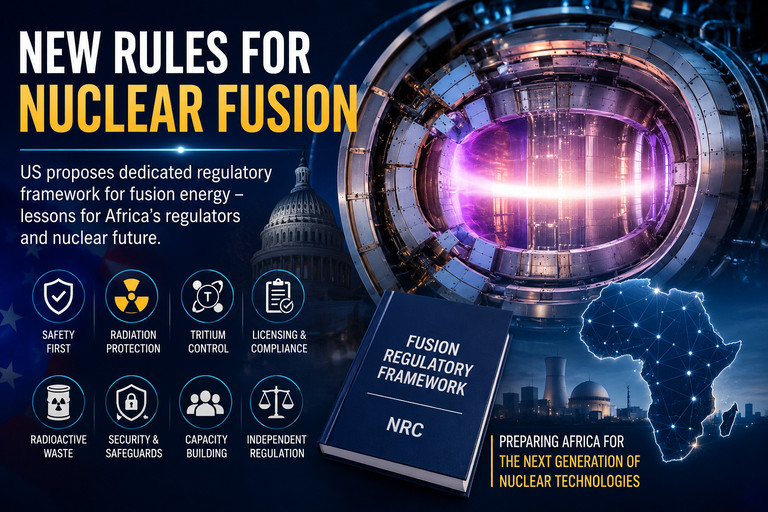
The United States Nuclear Regulatory Commission has proposed a dedicated regulatory framework for commercial fusion-energy systems, marking an important step towards determining how one of the world’s most promising emerging energy technologies will be licensed and supervised.
Published on 26 February 2026, the proposed rule would establish technology-neutral requirements for what US legislation now defines as “fusion machines”. Rather than automatically regulating these facilities under the comprehensive framework applied to conventional nuclear-power reactors, the NRC proposes to oversee most fusion activities through the regulatory system governing radioactive by-product materials.
The approach reflects the NRC’s determination that the hazards, operating characteristics and accident scenarios associated with fusion technologies are different from those of nuclear-fission reactors.
For African countries developing nuclear-power programmes or expanding nuclear-science research, the proposal raises an important policy question: should every technology described as “nuclear” be regulated through the same legal and licensing framework?
What is nuclear fusion?
Nuclear fusion occurs when two light atomic nuclei combine to form a heavier nucleus, releasing energy in the process. The reaction that powers the Sun is an example of fusion.
Many commercial fusion concepts under development use deuterium and tritium, which are isotopes of hydrogen. Developers are pursuing several technological approaches, including magnetic-confinement systems such as tokamaks and stellarators, inertial-confinement systems using lasers or particle beams, and alternative concepts such as magnetised-target fusion.
Fusion differs fundamentally from nuclear fission, the process used in existing nuclear-power reactors.
Fission produces energy by splitting heavy atomic nuclei such as uranium. The reaction releases additional neutrons that can sustain a chain reaction. Fusion instead combines lighter nuclei and does not depend on the same type of self-sustaining chain reaction.
This does not mean that fusion facilities are free from radiological or industrial hazards.
Fusion machines using deuterium and tritium must control radioactive tritium. High-energy neutrons produced during fusion can also activate surrounding structures and components, turning previously non-radioactive materials into radioactive materials that may require controlled handling, recycling, storage or disposal.
The regulatory challenge is therefore to impose requirements that are proportionate to these hazards without applying rules designed for a materially different technology.
The proposed American approach
The NRC’s proposed framework would regulate fusion primarily through the provisions applicable to radioactive by-product materials.
Under this approach, the regulator would concentrate on matters including:
- radiation protection;
- tritium possession, production and control;
- radioactive-material containment;
- occupational exposure;
- radioactive releases;
- activated components;
- radioactive-waste management;
- facility decommissioning;
- emergency arrangements;
- security controls; and
- environmental protection.
The NRC describes the framework as technology-neutral because fusion developers are pursuing widely different machine designs and fuel combinations. A regulatory framework based too narrowly on one design—such as the traditional tokamak—could quickly become unsuitable as the industry develops.
The proposed rule was accompanied by draft consolidated licensing guidance intended to explain how operators could apply for materials licences for fusion machines. The 90-day public-comment period closed on 27 May 2026.
The proposal remains part of an ongoing rulemaking process. It should therefore not be presented as a completed or final US licensing regime.
Why fusion is not being treated as an ordinary power reactor
Traditional nuclear-power regulation was developed around the hazards associated with uranium or plutonium fuel, nuclear criticality, sustained fission chain reactions, reactor-cooling requirements, spent nuclear fuel and severe reactor accidents.
Fusion facilities present a different risk profile.
They do not contain the same type of fissile-fuel inventory found in conventional reactors, and the fusion reaction cannot continue indefinitely without highly controlled operating conditions. However, fusion installations can still contain substantial quantities of tritium and other radioactive materials, powerful magnetic systems, high voltages, lasers, cryogenic materials, heat-transfer systems and activated structural components.
The NRC’s position is not that fusion requires no regulation. Its position is that regulation should correspond to the actual hazards of fusion rather than being inherited automatically from the legal framework for fission reactors.
This is a practical example of a graded approach: regulatory requirements become more demanding as the magnitude and complexity of the potential hazard increase.
The role of US state regulators
An important feature of the American system is the involvement of individual state regulators.
Under the US Agreement State programme, participating states assume responsibility for licensing, inspecting and enforcing requirements for specified radioactive materials within their jurisdictions. Their programmes must remain compatible with the national framework and provide protection comparable to that of the NRC.
Commercial fusion development is already occurring in some Agreement States, and the NRC expects these state authorities to remain important regulatory partners.
The NRC and Agreement States have therefore been working together on rulemaking, licensing guidance, inspection arrangements and regulator training.
This decentralised structure may not be directly transferable to many African countries, where nuclear and radiation regulation is normally concentrated in one national authority. Nevertheless, it illustrates the need to define clearly which institution regulates fusion research, radioactive materials, electricity generation, environmental impacts and industrial safety.
Legislation has helped clarify the regulator’s authority
The proposed framework follows amendments introduced through the United States’ ADVANCE Act of 2024.
Section 205 of the Act added a legal definition of a “fusion machine” to the Atomic Energy Act and incorporated radioactive material produced by a fusion machine within the definition of by-product material. It also directed the NRC to study possible frameworks for regulating the mass production of fusion machines.
The legislation defines a fusion machine broadly as a machine capable of transforming atomic nuclei through fusion processes and directly capturing and using the resulting particles, heat or electromagnetic radiation.
This legal clarification is significant.
A regulator cannot supervise an emerging technology effectively when the enabling legislation does not clearly identify the technology, the regulated materials, the responsible authority or the applicable licensing pathway.
Fusion regulation is becoming an international issue
The United States is not developing its approach in isolation.
The NRC has exchanged experience with regulators and institutions in the United Kingdom and Canada, including discussions on fusion regulation, visits to fusion-research facilities and engagement concerning commercial tritium operations.
The International Atomic Energy Agency has also expanded its work on fusion safety and regulation. Experts participating in IAEA activities have identified significant differences among national regulatory approaches, reflecting differences in legal systems, technological development and perceptions of fusion risk.
The IAEA’s work recognises that certain existing radiation-protection, radioactive-waste and facility-safety principles can be applied to fusion. However, additional fusion-specific guidance may be required as commercial designs move closer to deployment.
The NRC is also participating in international fusion discussions through the IAEA’s World Fusion Energy Group, which brings together governments, regulators, industry, researchers and other stakeholders.
Why this matters for Africa
Commercial fusion electricity is not yet operating on national grids, and deployment timelines remain uncertain. Nevertheless, African countries should not wait until the first fusion developer seeks approval before considering the regulatory implications.
Several African countries already operate particle accelerators, research reactors, irradiation facilities, isotope-production laboratories and other installations involving radiation or nuclear materials. Universities and scientific institutions may also participate in international fusion research before commercial fusion power becomes available.
Existing African nuclear laws may not clearly distinguish among:
- conventional fission reactors;
- small modular reactors;
- microreactors;
- research reactors;
- particle accelerators;
- fusion research devices;
- commercial fusion machines; and
- isotope-production facilities.
Where definitions are excessively broad, a small experimental fusion system could theoretically be subjected to requirements originally designed for a large nuclear-power plant.
Where definitions are too narrow, the regulator may lack clear authority over tritium, activated materials or commercial fusion-energy facilities.
Both outcomes would be undesirable.
Five lessons for African regulators
1. Review legal definitions before the technology arrives
National nuclear and radiation laws should be reviewed to determine whether terms such as “nuclear installation”, “nuclear reactor”, “radiation facility”, “particle accelerator” and “radioactive material” adequately cover emerging fusion technologies.
The objective should not necessarily be to pass an entirely new fusion law immediately. Targeted amendments, regulations or regulatory guidance may be sufficient during the research and demonstration stages.
2. Apply a technology-neutral and graded approach
Regulatory requirements should respond to the actual hazards of a facility.
A university-scale fusion experiment should not automatically face the same licensing process as a gigawatt-scale fission reactor. Conversely, a commercial fusion plant containing substantial tritium inventories and activated components should not be treated as a routine laboratory radiation source.
The regulatory framework must permit requirements to increase with facility scale, radioactive inventory, technical complexity and potential consequences.
3. Build competence in tritium and activation products
African regulatory authorities will require expertise beyond traditional reactor safety.
Relevant areas include:
- tritium accountancy and containment;
- occupational radiation protection;
- environmental monitoring;
- neutron activation;
- activated-material characterisation;
- radioactive-waste classification;
- decommissioning;
- cyber and physical security;
- advanced materials; and
- fusion-specific accident analysis.
Capacity-building should begin through universities, regulatory technical-support organisations, regional networks and international cooperation.
4. Clarify institutional responsibilities
Fusion facilities could fall across the mandates of nuclear regulators, environmental authorities, energy regulators, electricity-market institutions, occupational-safety bodies and research ministries.
Countries should prevent gaps and duplication by establishing clear responsibilities for licensing, environmental assessment, construction oversight, electricity generation, radioactive-waste control and emergency preparedness.
5. Participate in international rule development
African regulators and research institutions should participate actively in IAEA fusion activities and other international technical discussions.
If African institutions remain absent during the formative stages of fusion regulation, future international standards may not adequately reflect the legal structures, human-resource constraints, infrastructure conditions and development priorities of African states.
Implications for nuclear-newcomer countries
For countries already preparing conventional nuclear-power programmes, fusion regulation may appear to be a distant concern.
However, the broader lesson from the US proposal is immediately relevant: nuclear law must be capable of accommodating technological change.
Many newcomer programmes are considering a mixture of large reactors, SMRs, microreactors, research reactors, isotope-production facilities and advanced fuel cycles. A law written exclusively around one traditional reactor model may become obsolete before the first plant begins operation.
African nuclear-newcomer states should therefore adopt legislation that is:
- comprehensive enough to cover emerging technologies;
- flexible enough to accommodate different designs;
- precise enough to define regulatory authority;
- risk-informed and proportionate;
- consistent with international safety standards; and
- supported by detailed regulations and guidance.
This does not mean weakening safety requirements to accelerate innovation.
Regulatory predictability and regulatory rigour are not opposing objectives. A clear, proportionate and technically justified framework can protect people and the environment while giving researchers and investors a better understanding of the requirements they must satisfy.
Conclusion
The United States’ proposed fusion framework represents an important development in the global regulation of advanced nuclear technologies.
By separating fusion from the conventional power-reactor licensing model and focusing regulation on radioactive materials and technology-specific hazards, the NRC is attempting to create a system that is both protective and proportionate.
The final form of the US rules may change following public comments and further regulatory review. Their wider significance, however, is already clear.
Fusion cannot simply be treated as either an ordinary industrial technology or another version of a conventional fission reactor.
For Africa, the priority is not to copy the American system wholesale. It is to begin examining how national legislation, regulatory institutions, scientific capacity and international cooperation will respond when fusion research and commercial technologies reach the continent.
Preparing early would allow African countries to shape the rules governing the next generation of nuclear technologies rather than adopting them only after those technologies have arrived.
Related


Africa Deepens Nuclear Safeguards Capacity as AFCONE Convene Hands-On Training in Nairobi
By Nuclear Africa• August 24, 2026
A 300 MW SMR Could Support More Than 12,500 Construction Jobs in Ghana: New Study Tests Nuclear’s Economic Case
By Nuclear Africa• August 24, 2026
Ghana Targets 1,000 MW of Nuclear Power by the Mid-2030s: What Must Happen Before Construction Can Begin?
By Nuclear Africa• August 24, 2026