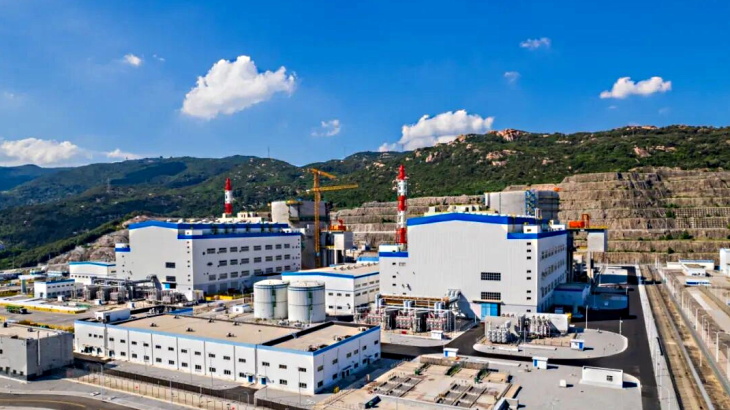
China has begun loading nuclear fuel into Tianwan Unit 7, moving the Russian-designed VVER-1200 from conventional commissioning into one of the most consequential stages before reactor startup.
The first of 163 fuel assemblies entered the reactor core on 12 August, according to China National Nuclear Corporation as reported by World Nuclear News. Unit 7 is the first of two VVER-1200 reactors under construction as Tianwan Units 7 and 8.
For Africa, Tianwan is particularly interesting because Egypt’s four El Dabaa reactors use the same broad VVER-1200 technology family.
That makes Tianwan 7 a useful real-world illustration of the stages that lie ahead after an African nuclear plant’s major civil structures and equipment have been completed.
Why fuel loading changes the project
A reactor construction site can contain a reactor vessel, steam generators, pumps and thousands of kilometres of cables without yet containing nuclear fuel.
Initial fuel loading changes that.
It transfers nuclear fuel into the reactor core in its intended operating configuration and moves the installation toward the first controlled nuclear chain reaction.
That transition brings operational-readiness, radiation-protection, safeguards, security, emergency-preparedness and regulatory requirements into sharper focus.
Fuel loading should therefore never be confused with ordinary equipment installation.
Tianwan’s route to this point
Construction of Tianwan Unit 7 began in May 2021, while Unit 8 followed in February 2022. The two units form part of wider China–Russia nuclear cooperation.
CNNC announced earlier this year that Unit 7 completed hot functional testing on 30 December 2025. Hot functional tests reproduce key operating temperatures and pressures without nuclear fuel and provide an opportunity to verify the performance and integrity of major reactor systems before loading.
Rosatom delivered the initial fuel load for Unit 7 in January 2026. The fuel was manufactured at the Novosibirsk Chemical Concentrates Plant under arrangements covering Tianwan Units 7 and 8. Rosatom described it as its first supply of VVER-1200 fuel to China.
The beginning of core loading on 12 August therefore marks the next stage in a commissioning pathway that has already involved extensive system testing and regulatory oversight.
Fuel loading is not first criticality
The terminology is important.
Once all required fuel has been loaded and subsequent checks completed, the reactor can progress toward first criticality — the point at which a controlled, self-sustaining nuclear chain reaction is established.
After that come low-power physics tests, increasing reactor power, turbine and electrical testing, grid connection, progressive power ascension and eventually the tests required before commercial operation.
The sequence can be summarised as: fuel loading → first criticality → low-power testing → power ascension → grid connection → demonstration testing → commercial operation.
Each stage represents a different technical and regulatory milestone.
Tianwan Unit 7’s current milestone is therefore initial fuel loading, not startup completion and not commercial operation.
The project schedule targets commercial operation in 2026, but that remains dependent on successful completion of the remaining commissioning programme.
What this means for El Dabaa
Egypt’s El Dabaa project remains years behind Tianwan in the construction and commissioning sequence.
Its major current activities involve civil construction and installation of large nuclear-island equipment. The fourth inner-containment tier of Unit 1 has just been completed, while the Unit 2 reactor pressure vessel was installed in July.
Tianwan should consequently not be used to predict a precise El Dabaa fuel-loading date.
But it demonstrates what Egypt will eventually need to prepare for.
Before fuel enters an El Dabaa reactor, the plant and regulator will need confidence that relevant construction has been completed, systems have been tested, operating procedures are ready, staff have been trained, emergency arrangements are functional, safeguards measures are established and the applicable regulatory authorisations have been granted.
The transition is as institutional as it is technological.
Why This Matters for Africa
African nuclear reporting will increasingly need to become more precise as projects mature.
When programmes are at an early stage, terms such as “nuclear agreement” or “reactor project” may dominate coverage.
Once construction begins, those labels are insufficient.
Policymakers and the public need to understand the difference between first concrete, reactor-vessel installation, cold testing, hot testing, fuel loading, criticality, grid connection and commercial operation.
Tianwan 7 provides an excellent technical reference because Egypt will eventually pass through broadly comparable stages with its VVER-1200 units.
For other African newcomer programmes, the broader lesson transcends reactor technology.
Building the reactor is only one part of putting a nuclear plant into service.
The final journey from construction to electricity requires a disciplined commissioning process designed to demonstrate, step by step, that the plant and the organisations responsible for it are ready for nuclear operation.
Related

Beyond the Resolutions: GC70 and the Emerging Global Nuclear Order
By Nuclear Africa• September 22, 2026
Africa Deepens Nuclear Safeguards Capacity as AFCONE Convene Hands-On Training in Nairobi
By Nuclear Africa• August 24, 2026
A 300 MW SMR Could Support More Than 12,500 Construction Jobs in Ghana: New Study Tests Nuclear’s Economic Case
By Nuclear Africa• August 24, 2026