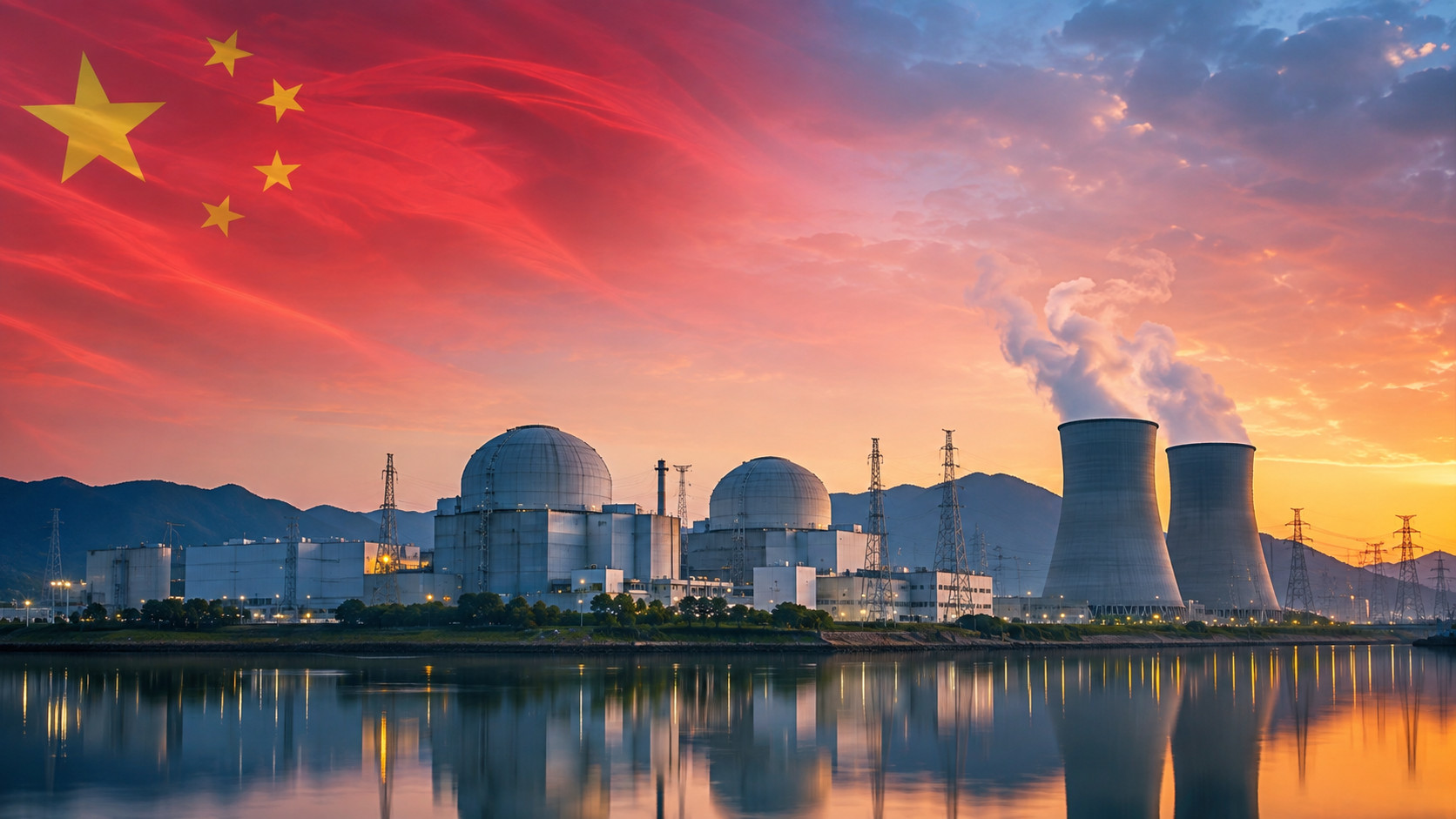
China has approved eight additional nuclear reactors across four projects, extending a construction pipeline that has become one of the most continuous and industrially coordinated nuclear programmes in the world.
The State Council approved the four projects during an executive meeting chaired by Premier Li Qiang on 31 July 2026. The government’s initial public statement identified the first phase of the proposed Zhuanghe nuclear power project in Liaoning Province and said all approved units must be constructed and operated according to the highest international safety standards.
Subsequent announcements from project companies identified the complete package as:
- Jinqimen Phase II—Units 3 and 4 in Zhejiang Province;
- Taipingling Phase III—Units 5 and 6 in Guangdong Province;
- Zhuanghe Phase I—Units 1 and 2 in Liaoning Province; and
- Laiyang Phase I—Units 1 and 2 in Shandong Province.
The first three projects involve six Hualong One reactors. Laiyang will begin with two larger Guohe One, or CAP1400, pressurised-water reactors.
The decision is significant not only because of the number of reactors involved, but also because it demonstrates China’s continued preference for maintaining a predictable sequence of approvals, construction starts and fleet expansion.
It is nevertheless important to distinguish national project approval from the formal start of nuclear construction.
The eight units have not all reached first concrete, and several regulatory and preparatory stages remain before each reactor can be classified as under construction.
Four Projects Across Four Provinces
The latest approval package expands two existing nuclear sites and authorises the first phases of two new sites.
Jinqimen Phase II
Jinqimen Units 3 and 4 will expand China National Nuclear Corporation’s project in Zhejiang Province.
The units have been designated as demonstration projects for the upgraded Hualong One 2.0 design. China’s Ministry of Ecology and Environment had already reviewed the site-stage environmental impact report and site-safety analysis for the two units in March 2026.
Jinqimen is planned as a six-unit nuclear power site. Construction of the first two Hualong One reactors began after their approval in December 2023.
Taipingling Phase III
Taipingling Units 5 and 6 will complete the currently planned six-unit development in Guangdong Province.
Like Jinqimen Units 3 and 4, the two new reactors will use Hualong One 2.0. Each is reported to have a generating capacity of approximately 1,217 MWe.
Taipingling already provides a developing reference base for the technology family. Unit 1 entered commercial operation in April 2026, while Unit 2 completed commissioning and entered commercial service in August.
Units 3 and 4 are under construction, allowing engineering, manufacturing and project-management teams to move progressively from one pair of reactors to the next.
Zhuanghe Phase I
Zhuanghe is a new nuclear power site in Liaoning Province and will begin with two Hualong One pressurised-water reactors.
China’s Ministry of Ecology and Environment approved the site-stage environmental assessment in December 2024. The assessment identified the proposed location in Zhuanghe and confirmed that the first phase would contain two Hualong One units.
The wider site is envisaged as a six-unit development. CNNC Datang Zhuanghe Nuclear Power Company will be responsible for the project’s investment, construction and operational management. Preparatory work was under way when the national approval was announced.
Laiyang Phase I
Laiyang in Shandong Province will begin with two Guohe One reactors developed through the State Power Investment Corporation.
The Guohe One, also known as the CAP1400, was developed from the Westinghouse AP1000 technology platform and enlarged to provide greater generating capacity.
Each Laiyang unit is reported to have a capacity of approximately 1,543 MWe. The planned site could eventually contain six Guohe One units. SPIC has described the approval as the beginning of standardised, batch construction of the technology.
This makes Laiyang particularly important for the future of the CAP1400 programme. It represents an attempt to move the technology from demonstration and limited deployment towards repeat construction.
Four Units Will Demonstrate Hualong One 2.0
Four of the newly approved reactors—Jinqimen Units 3 and 4 and Taipingling Units 5 and 6—will be demonstration projects for Hualong One 2.0.
The updated design is intended to incorporate lessons from the construction, commissioning and operation of the existing Hualong One fleet. Chinese developers describe it as combining established third-generation features with further design optimisation and advanced technologies.
The designation does not mean that the earlier Hualong One has been replaced or rendered obsolete.
It represents the normal evolution of a reactor family as developers accumulate information on:
- construction sequencing;
- equipment performance;
- manufacturing;
- commissioning;
- maintenance;
- operational reliability; and
- regulatory experience.
Design improvement can strengthen performance and reduce costs, but it must be carefully controlled.
Changes introduced into an updated reactor model must be reflected consistently across safety analyses, equipment specifications, operating procedures, training programmes and licensing documentation.
The benefits of fleet standardisation can be weakened if different units described under the same technology family contain substantial undocumented or poorly managed design variations.
Building a Continuous Pipeline
China’s approach contrasts with the stop-start nuclear construction cycles experienced in many other markets.
From 2022 to 2025, the country approved at least ten new reactors each year. The latest eight-unit package begins the 2026 approval cycle and continues a policy of maintaining a large forward pipeline of projects.
By approving several standardised units regularly, China creates sustained demand across the nuclear value chain.
Engineering companies can retain design and project-control teams. Heavy manufacturers can maintain production lines for reactor vessels, steam generators, pumps and other large components. Construction teams can move between sites, while regulators accumulate experience assessing related designs.
The same continuity supports:
- nuclear-fuel production;
- component inspection;
- specialist welding;
- instrumentation and control;
- commissioning services;
- operator training;
- maintenance planning; and
- radioactive-waste management.
A nuclear programme built around repeated projects can therefore retain knowledge more effectively than one that mobilises a workforce for a single reactor and disperses it after construction.
Standardisation Creates Learning Opportunities
The strongest fleet benefits usually appear when later reactors incorporate lessons from earlier projects without undergoing extensive redesign.
A recurring design can allow organisations to improve construction schedules, refine procurement packages and identify recurring quality problems.
Manufacturers can invest in specialised tooling and quality systems because they expect multiple orders rather than one contract. Operators can standardise training and maintenance procedures across several plants.
Regulators may also use experience from previous reviews while continuing to assess the safety of each unit and its site-specific characteristics.
China’s Ministry of Ecology and Environment has explicitly connected standardised design and batch construction with improvements in nuclear-project quality and efficiency. It has also emphasised the need to strengthen equipment reliability, manufacturing methods and continuing environmental oversight.
Standardisation does not guarantee success, however.
Repeated deployment can reproduce weaknesses as easily as it reproduces good practice. A design defect, supplier problem or inadequate construction method may affect several units if information is not identified and acted upon quickly.
Fleet deployment therefore requires strong operating-experience systems capable of transmitting findings across project companies, manufacturers, constructors and regulators.
China’s Industrial Conditions Support Scale
China’s construction model is supported by conditions that are difficult to reproduce elsewhere.
The country has a very large and growing electricity system, established nuclear owner-operators, experienced engineering organisations and extensive heavy-manufacturing capacity.
It also has a sophisticated national transmission network and is planning substantial grid investment during the 2026–2030 period. China’s current national plan targets 110 GWe of operating nuclear capacity by 2030.
World Nuclear Association data currently list China with 64 operable reactors totalling approximately 63.99 GWe and 37 reactors under construction with a combined capacity of about 38.58 GWe.
These conditions provide a domestic market large enough to support several reactor technologies and multiple construction companies simultaneously.
China can develop a project pipeline across numerous coastal provinces while maintaining central government planning and relying heavily on state-owned institutions for financing, engineering, construction and operation.
This does not mean that every Chinese project will automatically meet its original cost and schedule.
It means that the surrounding industrial system is structured to support repeated construction rather than one-off mobilisation.
Investment Estimates Require Caution
Chinese reporting has placed the combined investment associated with the four approved projects at more than CNY170 billion, equivalent to approximately US$25 billion.
That figure is an estimate rather than a complete set of officially disclosed, final project budgets. Detailed costs, financing arrangements and completion schedules have not been published consistently for all eight units.
Nuclear project estimates can also refer to different scopes.
One figure may cover only the nuclear generating units, while another includes grid connections, port facilities, land preparation, worker accommodation, financing costs or the eventual development of an entire six-unit site.
Project cost comparisons should therefore identify:
- the number and capacity of units;
- whether financing costs are included;
- the assumed construction period;
- supporting infrastructure;
- inflation and exchange-rate assumptions; and
- whether the figure covers one phase or the complete site.
The same caution should be applied to projected completion dates until construction licences are issued and first concrete is poured.
Approval Is Not the Start of Construction
The State Council decision gives the projects national approval, but it should not be reported as though construction has formally begun on all eight reactors.
China’s nuclear approval process contains several distinct stages.
After early site selection and preliminary approvals, the State Council may approve the project application. The National Nuclear Safety Administration must then complete further safety and environmental reviews before authorising the first structural concrete for the nuclear island.
Formal construction begins only after that regulatory authorisation and the first nuclear-safety-related concrete pour. Later stages include fuel-loading permission, operating authorisation, first criticality, grid connection and commercial operation.
Preparatory works may take place before formal construction, including:
- site clearing;
- excavation;
- access-road development;
- equipment procurement;
- temporary facilities; and
- construction of non-nuclear supporting infrastructure.
These activities demonstrate project progress but are not equivalent to the regulatory milestone of first concrete.
The approved units should therefore be described as authorised projects moving towards construction.
Implications for Chinese Reactor Exports
An expanding domestic reference fleet strengthens the international position of Chinese reactor vendors.
Potential customers can examine a larger body of evidence covering construction, commissioning and operation. They can also assess the capabilities of Chinese manufacturers, fuel suppliers and engineering organisations through projects already under way.
This is particularly relevant to the Hualong One, which China has positioned as a principal export technology, and the Guohe One, which may increasingly be promoted internationally as its domestic fleet expands. China’s nuclear policy explicitly includes the international export of reactor technology and associated supply-chain capabilities.
A substantial reference fleet allows a vendor to support its claims with information on:
- completed construction periods;
- operating availability;
- component performance;
- maintenance requirements;
- commissioning experience;
- fuel behaviour;
- design changes; and
- regulatory findings.
An operating fleet is generally stronger evidence than computer models or projected economics alone.
It does not remove the need for importing countries to conduct their own assessments.
A Reference Fleet Is Evidence, Not Automatic Suitability
African governments considering Chinese reactors should treat China’s domestic fleet as an important source of evidence.
They should not treat it as automatic proof that a particular technology is appropriate for their national electricity system.
A reactor that performs successfully in China may still be unsuitable for an African country because of differences in:
- electricity demand;
- grid size and reliability;
- access to financing;
- site conditions;
- cooling-water availability;
- institutional capacity;
- construction infrastructure;
- emergency preparedness; and
- long-term waste policy.
The Hualong One is a reactor in the one-gigawatt class. The Guohe One is larger.
The loss of a unit of this size during an unplanned shutdown would require the electricity system to provide substantial reserve capacity immediately. Smaller African grids may need major transmission, generation-reserve and regional-interconnection investments before they could safely accommodate such a reactor.
Grid compatibility must therefore be assessed before technology selection—not after a vendor has been chosen.
Financing and Sovereign Exposure
China’s domestic projects are supported by state-owned enterprises, state-directed planning and access to a large national financial system.
An African importing country would face a different financing environment.
A reactor offer may involve export credit, sovereign borrowing, government guarantees, long-term power-purchase arrangements or a combination of these instruments.
The government must evaluate the complete exposure, including:
- construction-period interest;
- foreign-exchange risk;
- cost overruns;
- repayment schedules;
- electricity-demand risk;
- government guarantees;
- decommissioning funds; and
- spent-fuel and waste liabilities.
A favourable headline loan rate does not necessarily make a project affordable if the debt is denominated in foreign currency or if construction delays postpone electricity revenues.
The Chinese domestic cost structure should not be assumed to apply automatically to an export project built under different laws, labour arrangements, supply chains and financing conditions.
Regulatory Documentation Must Be Accessible
African regulators must have timely access to the complete safety and licensing information needed to assess any proposed Chinese reactor.
This includes the design basis, safety analyses, probabilistic assessments, equipment qualifications, severe-accident evaluations, operating experience and information on design changes introduced across the reference fleet.
Documents must be available in a language and form that the regulator can use effectively.
The regulator should also be able to communicate directly with the reactor designer, reference-plant operators and the Chinese nuclear regulator where appropriate.
Supplier-country approval is relevant evidence, but the host regulator remains responsible for determining whether the design satisfies national law and is suitable for the proposed site.
International cooperation and technical-support organisations may help strengthen the review. They cannot replace the host regulator’s legal authority and independent judgement.
Localisation Must Be Based on a Programme
China’s continuous construction pipeline supports extensive domestic manufacturing because suppliers can expect repeated orders.
African countries often seek similar localisation benefits from a single proposed reactor.
The opportunities are not equivalent.
A domestic company may be reluctant to invest in nuclear-grade equipment, specialist personnel and quality certification if it expects only one short period of work.
A credible multi-unit or long-term programme can create stronger incentives for localisation in areas such as:
- civil engineering;
- electrical systems;
- conventional plant equipment;
- cables and structural supports;
- logistics;
- environmental monitoring;
- maintenance; and
- professional services.
But a fleet should not be announced solely to create a market for local suppliers.
The number and timing of reactors must be justified by electricity demand, affordability and institutional readiness.
Localisation should also be phased according to demonstrated capability. Safety-significant components should not be assigned to inexperienced companies merely to meet a political percentage target.
Technology Transfer Must Be Specific
Claims of technology transfer should be translated into clearly defined contractual obligations.
African governments should identify whether the proposed arrangement includes:
- participation in engineering;
- access to design information;
- manufacturing licences;
- supplier qualification;
- regulator training;
- operator training;
- fuel-management capability;
- maintenance knowledge;
- software access; and
- rights to technical information over the plant’s lifetime.
Training a small group of personnel is not the same as transferring the capacity to design, manufacture, regulate or independently maintain a reactor.
The host country should understand which capabilities will remain permanently dependent on the foreign supplier.
Some dependence is unavoidable in international nuclear projects. The objective is to identify it, manage it and prevent critical knowledge from being controlled entirely outside the country.
Fuel and Waste Commitments Must Be Clear
A reactor procurement decision creates obligations extending far beyond construction.
The host country must establish how fresh nuclear fuel will be procured, transported, stored and safeguarded. It must also determine what will happen to spent fuel and radioactive waste.
Questions include:
- whether fuel supply is tied exclusively to the reactor vendor;
- the duration and pricing basis of fuel contracts;
- availability of alternative qualified suppliers;
- responsibility for transport;
- storage capacity at the plant;
- long-term spent-fuel policy;
- waste-conditioning requirements; and
- financing of disposal and decommissioning.
China’s preference for a closed nuclear fuel cycle does not automatically determine the policy that would apply to a reactor exported to Africa.
The importing state must develop its own legally defined and financially credible waste-management strategy.
Fleet Planning Offers Lessons—but Not a Template
The principal lesson from China is not that every African country should approve several reactors at once.
It is that nuclear power must be treated as a long-term national programme rather than a single construction contract.
Continuity can help retain regulators, operators, engineers, manufacturers and specialised construction personnel. It can also improve learning between units and create stronger opportunities for industrial participation.
But fleet deployment requires:
- sustained electricity demand;
- grid expansion;
- long-term financing;
- an adequately staffed regulator;
- a capable owner-operator;
- workforce-development institutions;
- fuel and waste arrangements; and
- stable political commitment.
Where these conditions are absent, announcing a fleet may simply multiply the financial and institutional risks of the first project.
A staged strategy may be more appropriate.
The country can establish a long-term programme while authorising later units only after reviewing the construction and operating performance of the first reactor.
Sustaining Capability Is the Deeper Lesson
China’s approval of eight more reactors illustrates the scale and continuity of its nuclear strategy.
The decision expands three Hualong One projects, introduces four demonstration Hualong One 2.0 units and begins the standardised construction of two Guohe One reactors at Laiyang.
The approvals will help sustain demand for Chinese engineering organisations, manufacturers, fuel suppliers and skilled workers.
They also strengthen the reference base available to Chinese vendors seeking international reactor markets.
But approval is not construction. Construction is not commissioning. Commissioning is not commercial operation.
Each project must still pass through formal regulatory and implementation stages before generating electricity.
For African newcomer countries, China’s expanding fleet should be studied carefully—but not copied mechanically.
The central lesson is not simply to build several reactors.
It is to develop the electricity system, institutions, financing arrangements and industrial capacity required to sustain nuclear power over several generations.
Related


Africa Deepens Nuclear Safeguards Capacity as AFCONE Convene Hands-On Training in Nairobi
By Nuclear Africa• August 24, 2026
A 300 MW SMR Could Support More Than 12,500 Construction Jobs in Ghana: New Study Tests Nuclear’s Economic Case
By Nuclear Africa• August 24, 2026
Ghana Targets 1,000 MW of Nuclear Power by the Mid-2030s: What Must Happen Before Construction Can Begin?
By Nuclear Africa• August 24, 2026