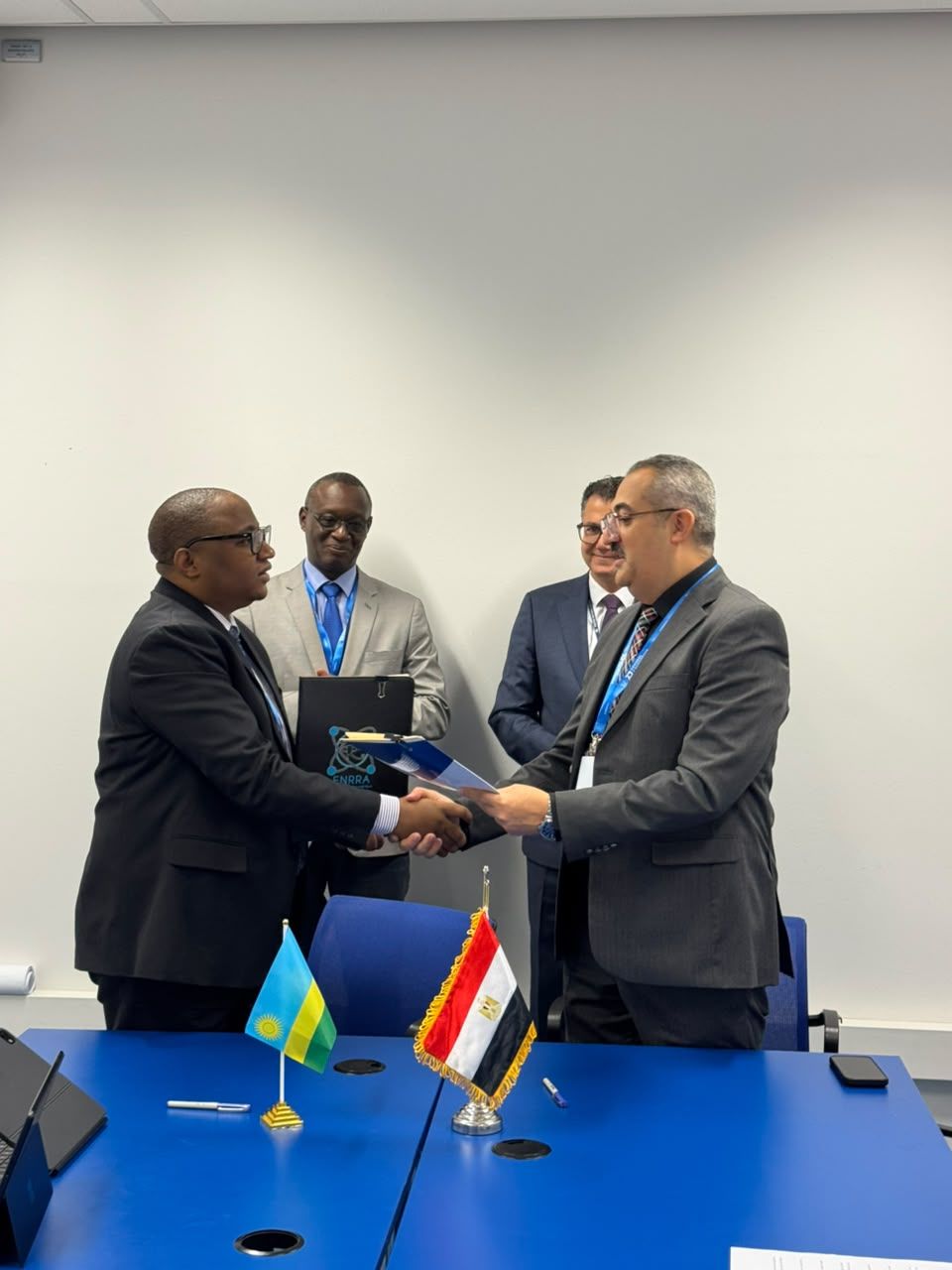
Vienna, Austria — Rwanda and Egypt have strengthened cooperation in nuclear and radiological regulation following the signing of a Memorandum of Understanding between the Rwanda Utilities Regulatory Authority (RURA) and Egypt’s Nuclear and Radiological Regulatory Authority (ENRRA).
The agreement was signed on 16 September 2026, on the sidelines of the 70th General Conference of the International Atomic Energy Agency (IAEA) in Vienna, by RURA Director General Evariste Rugigana and ENRRA Chairman Dr. Hany Khedr. The signing was witnessed by Egypt’s Ambassador and Permanent Representative to the United Nations and International Organizations in Vienna, Mohamed Nasr.
The five-year partnership is expected to strengthen institutional and technical cooperation between the two African regulatory authorities through joint training programmes, expert visits, technical knowledge exchange, sharing of regulatory experience and the dissemination of good practices.
For Rwanda, the agreement forms part of a wider effort to strengthen the regulatory capabilities required to support the safe, secure and peaceful application of nuclear and radiological technologies.
Building African Regulatory Capacity
The partnership comes at a significant period for Africa’s nuclear sector as several countries expand the application of nuclear technology in medicine, agriculture, industry, research and energy, while others explore the possible introduction of nuclear power.
This expansion places increasing demands on national regulatory bodies to develop the legal, institutional, technical and human-resource capabilities necessary to independently oversee nuclear and radiation activities.
The RURA–ENRRA agreement therefore goes beyond bilateral cooperation between Rwanda and Egypt. It demonstrates the growing importance of regulator-to-regulator cooperation within Africa as countries seek to strengthen their nuclear infrastructure and benefit from experience already developed elsewhere on the continent.
ENRRA said that exchanging expertise and building capacity among African regulatory bodies are important elements of developing effective regulatory infrastructure across the continent. Dr. Khedr also identified cooperation with African countries as a priority and expressed Egypt’s readiness to share its regulatory experience in support of nuclear and radiological safety, security and peaceful nuclear applications.
Following the signing, the two authorities agreed to begin preparing an action plan for implementation of the MoU, moving the partnership from a broad cooperation framework towards practical activities.
Rwanda Strengthens its Nuclear Regulatory Network
The agreement is particularly significant for Rwanda as the country continues to build national capabilities for regulating nuclear and radiation technologies.
A credible regulatory framework is one of the essential foundations of a sustainable nuclear programme. It requires not only legislation and regulations but also technically competent regulators capable of undertaking licensing, inspection, enforcement, safety assessment and oversight of security and safeguards requirements.
Through cooperation with more established regulatory institutions, emerging nuclear countries can accelerate knowledge transfer, strengthen regulatory competence and learn from practical experience accumulated through the oversight of complex nuclear facilities and activities.
The Rwanda–Egypt partnership reflects this approach.
Egypt has an increasingly substantial body of contemporary regulatory experience, particularly as ENRRA oversees the regulatory processes associated with the country’s nuclear programme and its first nuclear power plant. This creates opportunities for knowledge exchange in areas extending from regulatory infrastructure and licensing to inspection, radiation protection, nuclear safety and security.
For Rwanda, access to such experience could contribute to developing institutional competence ahead of more advanced nuclear activities.
South–South Cooperation in Nuclear Governance
The agreement also illustrates the expanding role of South–South cooperation in African nuclear governance.
Historically, much of Africa’s nuclear capacity-building cooperation has involved partnerships with the IAEA and nuclear institutions outside the continent. These relationships remain crucial. However, the increasing capabilities of African nuclear regulators create additional opportunities for countries to learn directly from institutions operating within comparable regional, economic and developmental environments.
African regulatory cooperation can support the sharing of expertise in areas such as radiation protection, radioactive source regulation, emergency preparedness and response, licensing, inspection, nuclear safeguards, physical protection, waste management and regulatory governance.
Stronger links between national authorities can also complement mechanisms such as the Forum of Nuclear Regulatory Bodies in Africa (FNRBA), through which regulators cooperate on strengthening nuclear and radiation safety and regulatory oversight across the continent. ENRRA participated in the FNRBA’s 18th plenary meeting during the 2026 IAEA General Conference.
As nuclear programmes develop across Africa, such networks are likely to become increasingly important in ensuring that regulatory capacity develops alongside technological ambitions.
Regulation Must Develop Alongside Nuclear Ambition
One of the central lessons for Africa’s emerging nuclear programmes is that nuclear infrastructure cannot be developed sustainably by focusing solely on reactors, research facilities or other technologies.
A functioning nuclear programme requires strong institutions capable of regulating those technologies independently and effectively.
Regulators require competent personnel, adequate financial and technical resources, laboratories and equipment, inspection capabilities, appropriate legal authority and continuous professional development. They must also remain institutionally capable of responding to technological change and emerging challenges in areas such as cybersecurity, radioactive-source security, advanced reactors and nuclear waste management.
International and regional partnerships provide an important mechanism through which those capabilities can be developed.
The RURA–ENRRA agreement therefore represents another step towards establishing the institutional foundations required for the responsible expansion of nuclear technology in Africa.
As more African countries pursue peaceful nuclear applications, strengthening cooperation among the continent’s regulatory authorities could become an increasingly important component of Africa’s wider nuclear development architecture.
Ultimately, the credibility of Africa’s nuclear ambitions will depend not only on the technologies countries choose to deploy, but also on the strength, independence and technical competence of the institutions responsible for ensuring that those technologies remain safe, secure and exclusively peaceful.
Related

Amazon’s 20-Year Nuclear Deal Shows How Large Corporate Buyers Can Help Finance Nuclear Investment
By Nuclear Africa• October 5, 2026
US Nuclear Regulator’s Workforce Warning Carries a Clear Lesson for African Nuclear Newcomers
By Nuclear Africa• October 5, 2026
US-South Korea $120 Billion Nuclear Framework Shows the Scale of State-Backed Reactor Finance
By Nuclear Africa• October 5, 2026
Morocco Nuclear Regulator Says No Radioactive Leak at Maâmora Research Centre
By Nuclear Africa• October 5, 2026