Kenya and the Republic of Korea are moving towards deeper cooperation in nuclear regulation, capacity building and technology transfer as Kenya advances preparations for its first nuclear power programme.
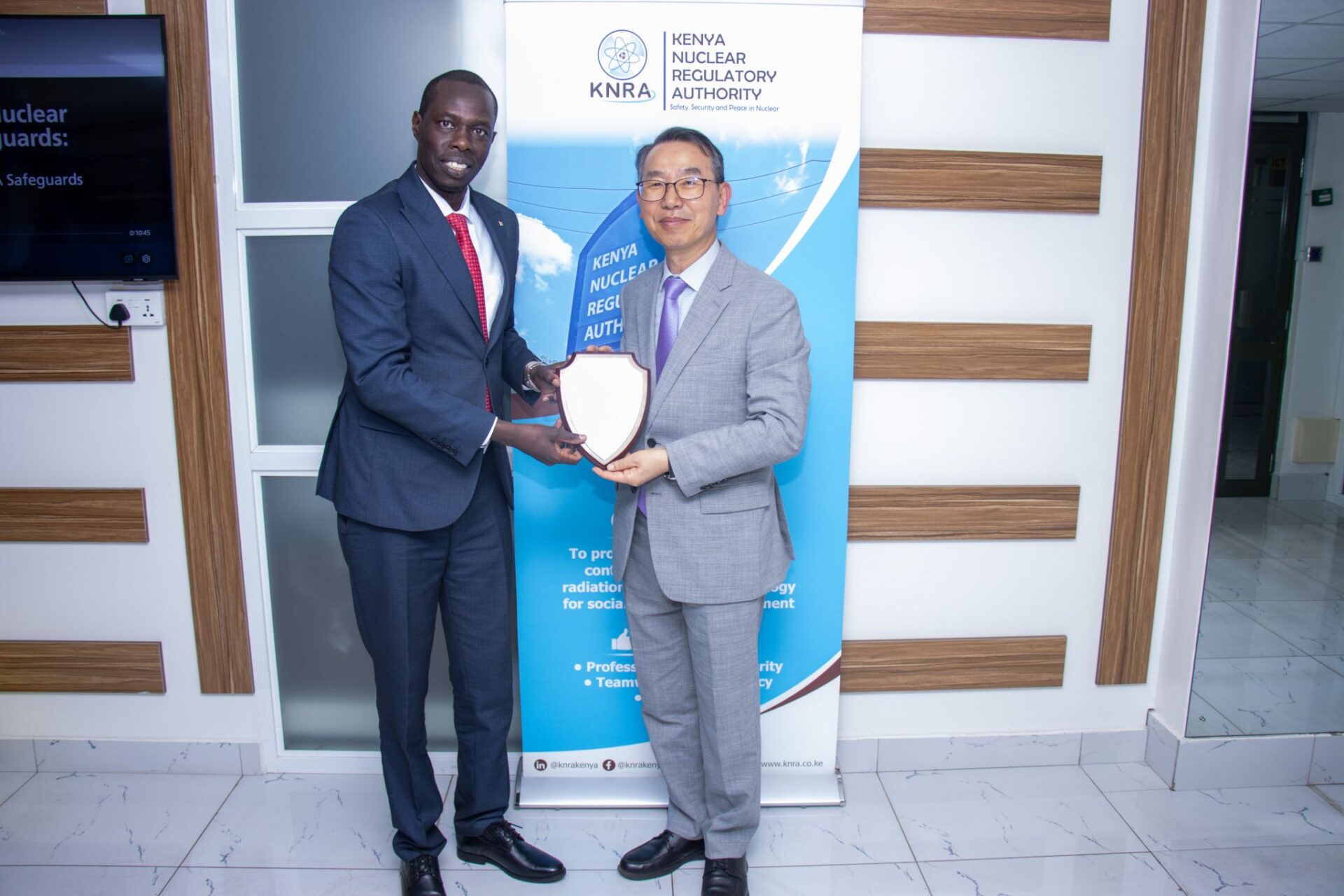
During a meeting with the management of the Kenya Nuclear Regulatory Authority (KNRA) on Thursday, Republic of Korea Ambassador to Kenya Kang Hyung-shik said Seoul intends to strengthen cooperation with Kenya in the nuclear sector, describing the country as both an important bilateral partner and a potential gateway for wider engagement in Africa.
The Ambassador’s identity and posting are confirmed by the Republic of Korea’s Ministry of Foreign Affairs, which records Kang as Korea’s Ambassador to Kenya.
According to the KNRA announcement shared with NuclearAfrica, a major Kenya-Korea conference is also planned for Nairobi in September, bringing together Korean and Kenyan specialists to explore additional areas of nuclear cooperation.
More significantly from a regulatory perspective, KNRA Director General James Chumba called for support in establishing a memorandum of understanding between the Kenyan regulator and South Korea’s Nuclear Safety and Security Commission (NSSC), together with technical cooperation involving institutions such as the Korea Institute of Nuclear Safety (KINS).
At this stage, however, the proposed MoU should be understood as an initiative under discussion rather than a concluded agreement.
Why South Korea matters to Kenya’s regulator
South Korea offers Kenya something particularly valuable at this stage of its nuclear programme: experience regulating an established commercial reactor fleet while simultaneously developing regulatory approaches for newer technologies.
The Nuclear Safety and Security Commission is Korea’s central nuclear regulatory organisation. Its responsibilities extend across reactor licensing and inspection, radiation protection, emergency preparedness, nuclear security, safeguards and radioactive-waste safety. Korean law explicitly requires the Commission to operate according to principles of independence and fairness.
KINS, meanwhile, performs many of the specialised technical functions that support nuclear regulation. Its statutory activities include regulatory safety research, technical support for nuclear-safety policy, radiation protection, environmental-radiation assessment, regulatory information management, training and international cooperation.
This distinction is particularly relevant to nuclear-newcomer countries.
A regulator does not need to maintain every specialist engineering capability entirely within its permanent staff. Mature nuclear systems often make use of technical support organisations capable of providing detailed analysis while the statutory regulator retains responsibility for the final regulatory decision.
For Kenya, cooperation with both NSSC and KINS could therefore support not only staff training but the gradual development of a broader regulatory technical-support ecosystem.
Kenya’s regulatory workload is about to become much more demanding
The timing of the proposed partnership is important.
Kenya’s nuclear programme is moving from general infrastructure development towards decisions concerning sites, technologies, licensing and eventual construction.
That transition fundamentally changes the demands placed on KNRA.
The Authority was established under Kenya’s Nuclear Regulatory Act and has responsibility for regulatory control over the siting, design, construction, operation and decommissioning of nuclear facilities, as well as nuclear and radioactive material. It is also responsible for inspections, enforcement and Kenya’s obligations relating to nuclear safety, security and safeguards.
These are extensive responsibilities.
Licensing a commercial nuclear power plant will eventually require KNRA to assess issues such as:
- site suitability and external hazards;
- reactor design and safety analysis;
- severe-accident management;
- quality assurance during construction;
- ageing and materials performance;
- radiation protection;
- radioactive-waste management;
- nuclear security;
- cybersecurity;
- safeguards;
- emergency preparedness;
- environmental monitoring; and
- commissioning and operational readiness.
The technical requirements are considerably greater than those associated with regulating conventional radiation applications.
Kenya has already been strengthening its regulatory infrastructure. The country recently highlighted improvements in inspection and enforcement, radiation monitoring and professional training during an IAEA-supported African meeting in Nairobi.
The next challenge is ensuring that this capacity develops quickly enough to match the pace of the proposed nuclear-power project.
Capacity building must go beyond training courses
The reference to opportunities for Kenyans to train in Korean institutions is therefore important.
International training allows regulatory personnel to study established licensing systems, observe inspections and develop relationships with experienced counterparts.
But Kenya will ultimately need more than individual courses.
A meaningful KNRA-NSSC-KINS relationship could potentially extend into areas such as:
- development of reactor-review methodologies;
- inspection techniques;
- construction oversight;
- safety-analysis review;
- regulatory requirements for advanced reactors;
- emergency preparedness;
- radioactive-waste regulation;
- nuclear-security assessment;
- safeguards interfaces;
- regulatory information systems;
- technical-support organisation development; and
- training of future regulatory specialists.
The objective should be institutional capability that remains in Kenya after external advisers leave.
This means developing procedures, analytical tools, knowledge-management systems and a domestic cadre of technical specialists—not simply accumulating certificates from overseas courses.
Korea is also adapting its own regulatory system for new reactors
Cooperation with Korea is potentially relevant to Kenya because South Korea itself is adapting its regulatory architecture to new reactor technologies.
The NSSC has established an Advanced Nuclear Reactor Regulatory Division and in June 2026 held an SMR Safety Regulatory Roundtable as it develops approaches for emerging reactor types.
This matters because Kenya has not yet reached the point where one final reactor technology determines all regulatory requirements.
A newcomer regulator benefits from understanding both conventional large-reactor regulation and the emerging regulatory questions associated with SMRs and other advanced systems.
These questions can include:
- passive safety claims;
- multi-module sites;
- reduced emergency-planning zones;
- novel fuels;
- digital instrumentation and control;
- cybersecurity;
- factory fabrication;
- remote or automated operations; and
- new approaches to staffing.
Cooperation with an experienced regulator confronting these issues itself can therefore be more useful than relying entirely on vendor-provided technical information.
Regulator-to-regulator cooperation is different from vendor cooperation
There is another reason this development deserves attention.
South Korea is not simply a nuclear-regulatory state. It is also a major nuclear technology supplier with an established reactor construction industry.
This makes the distinction between regulatory cooperation and commercial promotion especially important.
Kenya’s regulator must be capable of assessing whichever technology the eventual owner-operator proposes, irrespective of the vendor’s nationality.
Cooperation with Korea should therefore strengthen KNRA’s ability to independently scrutinise nuclear technology rather than create a preference for Korean technology.
That principle applies equally to partnerships with the United States, France, China, Russia or any other nuclear supplier state.
Regulatory cooperation works best when it focuses on:
- safety standards;
- inspection;
- technical competence;
- emergency arrangements;
- safeguards;
- security;
- waste regulation; and
- independent decision-making.
Technology procurement belongs to a different institutional process.
Maintaining that separation will become increasingly important as Kenya moves closer to vendor selection.
Kenya is diversifying its international regulatory relationships
The proposed Korean partnership also appears consistent with Kenya’s broader effort to develop international regulatory relationships rather than depend on a single foreign partner.
KNRA’s own strategic objectives include strengthening national, regional and international partnerships in radiation safety and nuclear security. The Authority also hosts the Eastern and Central African regional secretariat of the EU Chemical, Biological, Radiological and Nuclear Centres of Excellence initiative.
A diversified cooperation strategy has several advantages.
Different nuclear countries bring different regulatory experiences.
Korea offers experience with a standardised reactor fleet and construction programme. Other regulatory partners can contribute lessons from SMRs, decommissioning, waste disposal, probabilistic safety assessment, stakeholder engagement or different licensing models.
Kenya can compare these experiences rather than importing one country’s regulatory system wholesale.
That is particularly important because regulatory frameworks must ultimately reflect Kenyan law, institutions, technical capacity and national circumstances.
The proposed MoU needs clear boundaries
If KNRA and Korea’s NSSC proceed with a formal memorandum, its structure will matter.
The most useful agreement would define specific areas of cooperation rather than rely on broad language about knowledge exchange.
It could establish mechanisms for:
- staff secondments;
- joint workshops;
- access to regulatory training;
- peer exchange between inspectors;
- technical-support cooperation;
- sharing non-sensitive regulatory documentation;
- regulatory research;
- emergency exercises; and
- assistance in building national technical-support capacity.
At the same time, confidentiality, intellectual property, security-sensitive information and independence of regulatory decision-making would need clear protection.
Any Korean technical assistance associated with a reactor design being commercially proposed to Kenya would also need appropriate conflict-of-interest controls.
International assistance should strengthen the regulator’s ability to make its own decision—not substitute for that decision.
Nairobi conference could provide the next indication of direction
The planned September conference mentioned in the KNRA announcement could therefore become more significant than an ordinary bilateral nuclear meeting.
If it produces defined areas of cooperation, a regulator-to-regulator agreement or a structured capacity-development programme, it would represent a tangible step in Kenya’s Phase Two nuclear infrastructure development.
NuclearAfrica will be watching particularly for whether the conference addresses:
- formalisation of the KNRA-NSSC relationship;
- a role for KINS;
- training or secondment programmes;
- nuclear-power-plant licensing;
- SMR regulation;
- technical support for safety review;
- safeguards and security;
- emergency preparedness; and
- regulatory workforce development.
Until those arrangements are formally announced, however, the present development should be described as an intention to deepen cooperation, not a completed regulatory partnership.
A wider lesson for African nuclear newcomers
Kenya’s engagement with South Korea illustrates an increasingly important issue across Africa.
Countries considering nuclear power tend to attract attention first for reactor vendors, financing agreements and construction plans.
But an equally important international partnership must be developed on the regulatory side.
A country importing its first nuclear reactor is also importing an enormous body of knowledge that its regulator must be capable of independently assessing.
Regulatory cooperation can accelerate that learning.
For Ghana, Rwanda, Uganda, Nigeria and other African countries developing or considering nuclear-power programmes, structured partnerships with experienced regulators can strengthen:
- licensing capability;
- inspection competence;
- regulatory independence;
- workforce development;
- technical-support arrangements; and
- public confidence.
But international assistance should ultimately lead to stronger African regulatory institutions, rather than permanent dependence on overseas expertise.
Conclusion
The Republic of Korea’s commitment to expand nuclear cooperation with Kenya is noteworthy not because another foreign nuclear partner has entered the Kenyan market, but because the current discussion is centred on regulatory capacity.
As Kenya moves towards more technically demanding stages of nuclear-power development, the strength of the Kenya Nuclear Regulatory Authority will become one of the most important determinants of programme credibility.
South Korea’s Nuclear Safety and Security Commission and Korea Institute of Nuclear Safety bring substantial experience in reactor regulation, technical safety assessment, emergency preparedness and regulatory training.
A well-designed partnership could help Kenya strengthen the institutional competence required to independently assess future nuclear technologies.
The crucial words, however, are independently assess.
Kenya does not merely need international partners capable of helping it build a nuclear plant. It needs international partnerships that enable its own institutions to determine, with confidence and without undue influence, whether that plant should be licensed in the first place.
That distinction is fundamental to a credible nuclear programme.
Related


Africa Deepens Nuclear Safeguards Capacity as AFCONE Convene Hands-On Training in Nairobi
By Nuclear Africa• August 24, 2026
A 300 MW SMR Could Support More Than 12,500 Construction Jobs in Ghana: New Study Tests Nuclear’s Economic Case
By Nuclear Africa• August 24, 2026
Ghana Targets 1,000 MW of Nuclear Power by the Mid-2030s: What Must Happen Before Construction Can Begin?
By Nuclear Africa• August 24, 2026