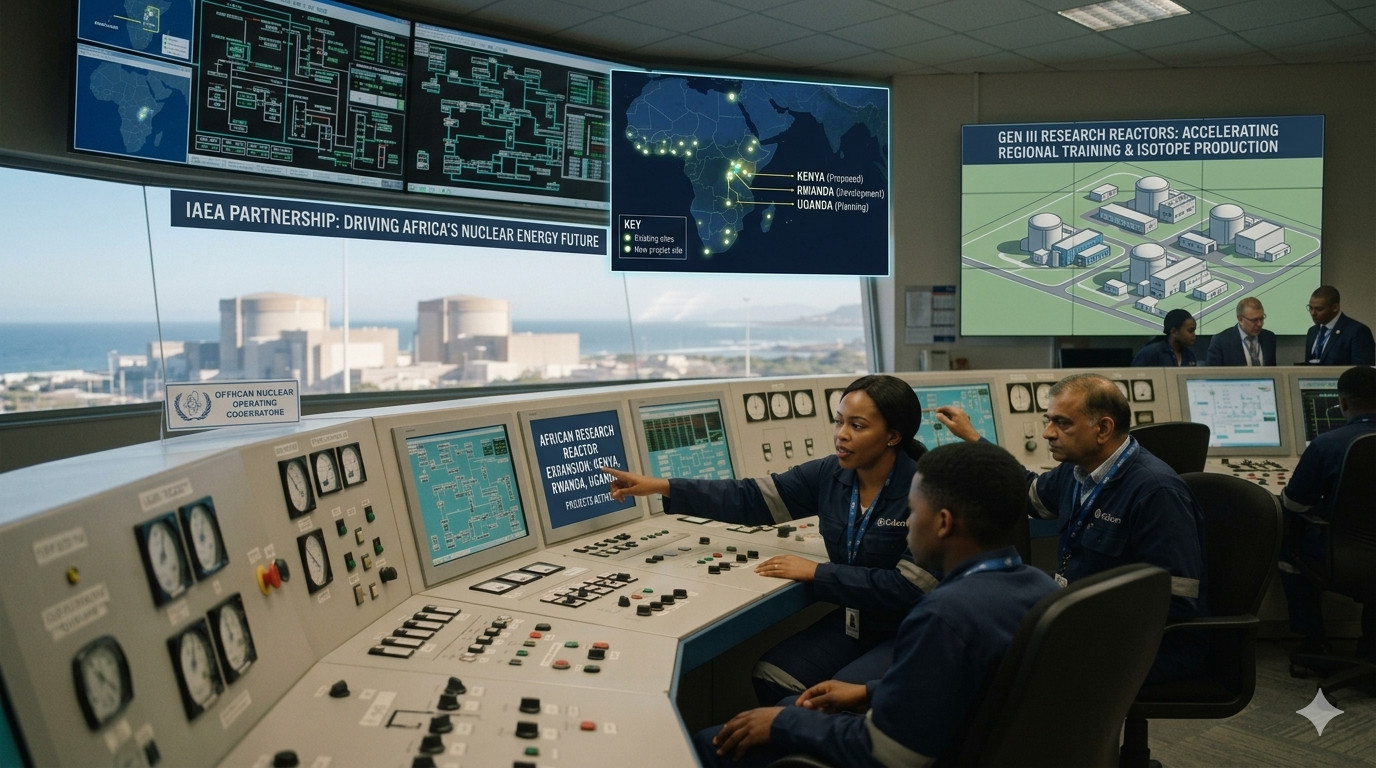
Africa’s nuclear development is expanding beyond electricity generation, with the International Atomic Energy Agency highlighting a growing continental network of research reactors supporting healthcare, scientific research, industrial applications and nuclear workforce development.
In a new global review published on 7 August, the IAEA identified eight African countries — Algeria, the Democratic Republic of Congo, Egypt, Ghana, Libya, Morocco, Nigeria and South Africa — where it is supporting activities related to existing research reactors.
More significantly for the continent’s emerging nuclear programmes, the Agency said Kenya, Rwanda and Uganda are embarking on research reactor projects, with the IAEA providing technical expertise to support their development.
The development points to a broader transformation of Africa’s nuclear landscape. While much attention has focused on planned commercial nuclear power plants and small modular reactors, research reactors could provide some of the scientific, regulatory and human-resource foundations needed to sustain larger nuclear programmes.
Research Reactors Are Not Power Reactors
Research reactors perform a fundamentally different role from commercial nuclear power plants.
Rather than primarily generating electricity, they produce neutrons that can be used for scientific research, medical isotope production, materials testing, geological investigations, agriculture, industrial applications, education and specialist nuclear training.
According to the IAEA, 228 research reactors are currently operating in 54 countries, while another 23 are under construction or being planned.
Their medical applications are particularly important. Research reactors contribute to the production of radioisotopes used for diagnostic imaging and cancer treatment, including molybdenum-99, from which technetium-99m — one of the world’s most widely used diagnostic radioisotopes — is produced.
For African countries seeking to strengthen nuclear medicine while simultaneously developing scientific and engineering capabilities, research reactors can therefore serve several national objectives.
Ghana’s GHARR-1 Shows What Research Reactors Can Do
Ghana provides one of Africa’s established examples.
The Ghana Research Reactor-1 (GHARR-1) is a low-power research reactor operated by the Ghana Atomic Energy Commission.
The IAEA’s latest report highlights a recent peer review of GHARR-1 that examined its utilisation across four principal areas: education and training, neutron activation analysis, neutron-beam research and radioisotope production for research and development.
GHARR-1 has played a role in Ghana’s nuclear-science development since the 1990s.
When the reactor was inaugurated, its objectives included improved analysis of mineral ores, production of short-lived radioisotopes and expanded training in nuclear science.
Its history also illustrates how research-reactor programmes intersect with the wider international nuclear non-proliferation regime.
In 2017, Ghana completed the conversion of GHARR-1 from highly enriched uranium to low-enriched uranium fuel. The former HEU fuel was subsequently returned to China as part of an international effort supported by the IAEA to reduce proliferation risks associated with civilian HEU.
That experience has given Ghana capabilities extending beyond the physical operation of the reactor, including nuclear safety, radiation protection, reactor physics, nuclear security and safeguards.
Kenya, Rwanda and Uganda Enter the Picture
The most significant forward-looking element of the IAEA’s latest assessment concerns Kenya, Rwanda and Uganda.
The Agency says it is providing technical expertise as the three countries embark on research reactor projects.
This should not, however, be interpreted as meaning that all three reactors have entered construction.
Research reactor development normally involves multiple stages, including determining national needs, feasibility studies, infrastructure development, site assessment, technology evaluation, financing arrangements, establishment of regulatory requirements and eventual licensing.
The IAEA statement therefore confirms the existence of developing programmes rather than simultaneous construction decisions.
That distinction is particularly important as several African governments are pursuing research reactors alongside longer-term commercial nuclear-energy ambitions.
Building Nuclear Capability Before Nuclear Power
Research reactors can have strategic value for countries considering commercial nuclear power because they allow national institutions to accumulate practical nuclear experience.
Operating a research reactor requires expertise in areas such as reactor physics, radiation protection, nuclear regulation, safety assessment, emergency preparedness, radioactive waste management, physical protection and nuclear material control.
Universities can also use the facilities to train nuclear scientists and engineers.
This matters because one of the largest challenges confronting emerging African nuclear programmes is not simply selecting a reactor technology. Countries must develop the institutions and workforce capable of regulating, operating and sustaining nuclear facilities over many decades.
Research reactors can contribute to that process.
They should not, however, be regarded as a mandatory prerequisite for nuclear power. Several countries have developed commercial nuclear programmes without first operating domestic research reactors.
Their value depends on whether governments can establish sufficient scientific, medical, industrial and educational demand to justify the investment.
Africa Already Has a Significant Research Reactor Base
The IAEA’s assessment also demonstrates that Africa is not starting from zero.
Algeria, DRC, Egypt, Ghana, Libya, Morocco, Nigeria and South Africa already possess research-reactor infrastructure.
The Agency says its regional activities are helping countries undertake safety reviews and develop refurbishment and modernisation plans aimed at maintaining reactor reliability and availability.
Morocco provides another example of how such infrastructure can support wider institutional development.
According to the IAEA, cooperation with Morocco has included research-reactor safety, operator training and strengthening regulatory oversight.
The next challenge may therefore be increasing cooperation among African facilities rather than viewing each national reactor solely as a domestic asset.
From National Reactors to Regional Nuclear Infrastructure
Research reactors are expensive scientific facilities, and not every African country considering peaceful nuclear applications necessarily needs one.
A stronger continental model could combine national facilities with regional access arrangements.
Countries without reactors could potentially use neighbouring facilities for specialist education, neutron activation analysis, materials research and other services while developing their own nuclear-science capabilities.
Such cooperation could become particularly valuable in regions where individual national demand may be insufficient to support an expensive facility independently.
The approach could also strengthen African nuclear education by allowing universities and research institutes to share infrastructure and expertise.
Medical Isotopes Could Become Particularly Important
Healthcare may provide one of the strongest economic and social arguments for expanding Africa’s nuclear-science infrastructure.
Nuclear technologies are increasingly important for diagnosing and treating cancer and other non-communicable diseases.
Globally, research reactors are integral to several isotope supply chains.
For Africa, the policy question therefore extends beyond whether additional reactors should be built.
Countries will need to determine whether future facilities can support sustainable isotope-production and distribution systems, whether sufficient domestic and regional markets exist, and how reactors would complement cyclotrons and other isotope-production technologies.
A reactor that produces valuable isotopes but lacks reliable processing, transportation and hospital infrastructure would deliver only part of the potential benefit.
Beyond the Nuclear Power Debate
The latest IAEA assessment offers an important reminder about the direction of African nuclear development.
The continent’s nuclear future will not be determined solely by how many gigawatts of nuclear electricity are eventually connected to national grids.
It will also depend on whether countries can develop laboratories, universities, regulators, research centres, isotope-production capabilities and highly trained scientific workforces.
Research reactors sit at the intersection of many of those objectives.
For countries such as Kenya, Rwanda and Uganda, the projects now being developed could therefore become important tests of whether nuclear technology can generate wider scientific and socioeconomic benefits before — or alongside — the introduction of commercial nuclear power.
And for countries such as Ghana, Nigeria, Morocco and South Africa, the challenge increasingly becomes ensuring that decades of investment in research-reactor infrastructure translate into greater utilisation, regional cooperation, innovation and economic value.
Africa’s emerging nuclear story, in other words, may be about considerably more than electricity.
It may also be about building the scientific infrastructure required for a genuinely African nuclear ecosystem.
Why This Matters for Africa
Africa’s nuclear ambitions will ultimately depend on indigenous capability. Research reactors can help build that capability through education, scientific research, isotope production, industrial applications and practical nuclear experience.
The IAEA’s identification of Kenya, Rwanda and Uganda as countries embarking on research reactor projects therefore deserves attention beyond the three countries themselves. If properly integrated with universities, healthcare systems, regulators and industry, the facilities could contribute to a new generation of African nuclear professionals and institutions.
But the crucial measure will not simply be whether the reactors are built.
It will be how extensively Africa uses them once they exist.
Related

Beyond the Resolutions: GC70 and the Emerging Global Nuclear Order
By Nuclear Africa• September 22, 2026
Africa Deepens Nuclear Safeguards Capacity as AFCONE Convene Hands-On Training in Nairobi
By Nuclear Africa• August 24, 2026
A 300 MW SMR Could Support More Than 12,500 Construction Jobs in Ghana: New Study Tests Nuclear’s Economic Case
By Nuclear Africa• August 24, 2026