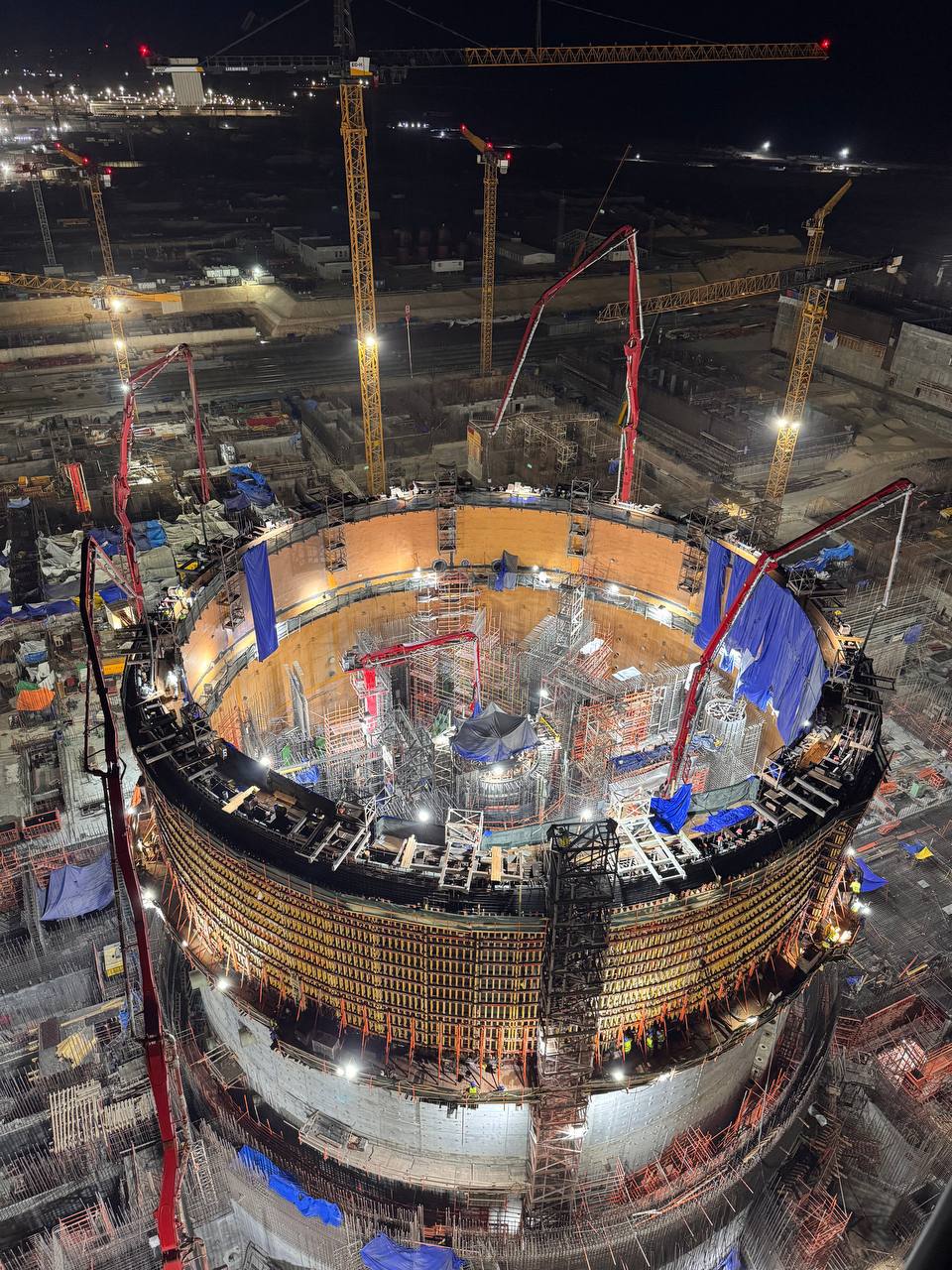
Construction of Egypt’s first nuclear power plant has passed another physical milestone, with the fourth tier of the inner containment structure completed at Unit 1 of the four-unit El Dabaa Nuclear Power Plant.
Rosatom’s Engineering Division confirmed on 12 August that the operation involved 1,608 cubic metres of concrete placed during a continuous 30-hour operation. Completion of the tier raised the elevation of the reactor building from approximately 24.4 metres to 34 metres.
Around 80 specialists worked across day and night shifts during the pour, supported by personnel maintaining the construction equipment. The next planned step is installation of the fifth tier, which Rosatom says could begin from mid-August and will prepare the structure for later installation of the polar crane.
For Africa, the significance is larger than another concrete pour. El Dabaa is the continent’s only nuclear power project presently under full-scale reactor construction and is providing the first contemporary African example of what actually happens after a country moves beyond feasibility studies, infrastructure assessments and vendor negotiations into nuclear construction.
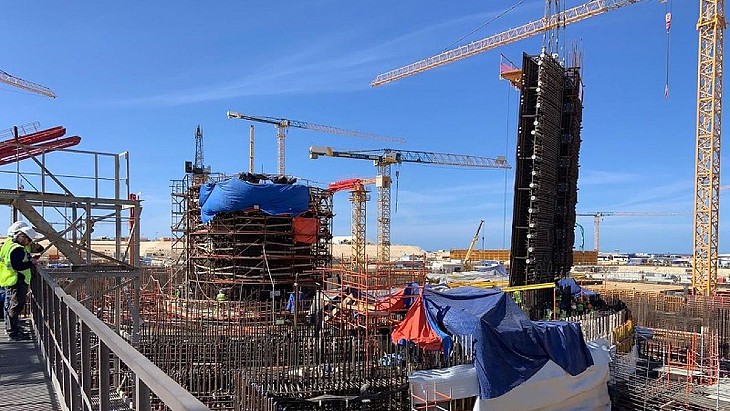
The El Dabaa Nuclear Power Plant is Egypt's first nuclear energy facility. Located on the Mediterranean coast in the Matrouh Governorate, it features four VVER-1200 Generation III+ reactors with a total capacity of 4.8 gigawatts. Built in partnership with Russia’s Rosatom, the project aims to supply about 10% of Egypt's electricity with operations slated to begin around 2028.
What the containment structure does
The inner containment is one of the major engineered barriers around the reactor and primary systems. It forms part of the safety architecture intended to confine radioactive material under normal operating conditions and specified accident scenarios.
At El Dabaa, this reinforced structure is being assembled progressively as construction advances around the nuclear island. It will ultimately be complemented by an outer containment structure, providing a layered physical barrier around the reactor systems.
Its completion is therefore more consequential than the visual height of the building might suggest. Nuclear construction places exceptional requirements on concrete quality, reinforcement, embedded components, documentation, inspection and configuration control because structures built today must continue performing safety functions decades into the future.
Egypt’s Nuclear Power Plants Authority, which owns the project, said it continues monitoring construction to ensure that quality and nuclear-safety requirements are maintained.
El Dabaa is advancing on several fronts
The Unit 1 containment milestone follows another important construction achievement at the site. On 9 July, the reactor pressure vessel for El Dabaa Unit 2 was installed in its final position, placing one of the most important components of that reactor’s nuclear steam supply system inside the reactor building.
The vessel houses the reactor core and must withstand the high temperatures and pressures associated with reactor operation. Rosatom identified welding of the main coolant pipeline as the next major construction activity following installation of the Unit 2 vessel.
Egypt is constructing four VVER-1200 Generation III+ pressurised-water reactors, each rated at approximately 1,200 MW. All four are under construction, making El Dabaa a roughly 4.8 GW nuclear development. The IAEA’s Power Reactor Information System lists the Egyptian units as under construction.
Egypt’s regulator, ENRRA, granted the site approval in 2019 and the Unit 1 construction permit in 2022. The regulatory infrastructure has continued developing alongside construction; in June 2026, the IAEA completed Egypt’s first Integrated Regulatory Review Service mission, reviewing the national safety regulatory framework against IAEA standards.
That parallel progression matters. A nuclear project cannot sustainably move ahead through construction while its regulator remains static. Engineering capability, inspection capacity, licensing competence and emergency arrangements must grow alongside the plant.
More than a reactor construction project
The contractual structure of El Dabaa extends far beyond construction. Under the arrangements governing the project, the Russian side is expected to supply nuclear fuel over the operating life of the plant, assist with training Egyptian personnel and provide operational and maintenance support during the early years of operation. Separate arrangements cover facilities and containers for spent nuclear fuel.
That model illustrates an important characteristic of newcomer nuclear programmes: the relationship with the vendor can extend for decades.
For African countries considering nuclear power, vendor evaluation should consequently examine much more than overnight construction cost. Fuel security, workforce development, technology transfer, maintenance capability, localisation, waste arrangements and long-term vendor dependence can be equally consequential.
Why This Matters for Africa
El Dabaa is increasingly becoming Africa’s most important nuclear-project laboratory.
Ghana, Kenya, Nigeria, Rwanda, Uganda and other countries considering nuclear power can study Egypt’s experience not simply to determine whether VVER technology is appropriate for them, but to understand the institutional complexity of moving from programme planning to nuclear construction.
Egypt’s experience demonstrates that construction does not replace infrastructure development. The owner-operator must mature, the regulator must expand, inspectors must be trained, contractors must work under nuclear-quality systems, emergency arrangements must develop and the future operating workforce must be prepared years before the first reactor starts.
It also highlights the importance of accurately describing milestones.
The completion of the fourth containment tier is not completion of Unit 1. It does not constitute fuel loading, first criticality, grid connection or commercial operation.
Those later stages will come only after major civil construction, equipment installation, system commissioning, regulatory verification and operational-readiness requirements have been completed.
For NuclearAfrica, preserving those distinctions is critical. As African nuclear programmes become more visible politically, credible reporting will depend increasingly on explaining exactly where each project sits between aspiration and actual operation.
Related

Beyond the Resolutions: GC70 and the Emerging Global Nuclear Order
By Nuclear Africa• September 22, 2026
Africa Deepens Nuclear Safeguards Capacity as AFCONE Convene Hands-On Training in Nairobi
By Nuclear Africa• August 24, 2026
A 300 MW SMR Could Support More Than 12,500 Construction Jobs in Ghana: New Study Tests Nuclear’s Economic Case
By Nuclear Africa• August 24, 2026