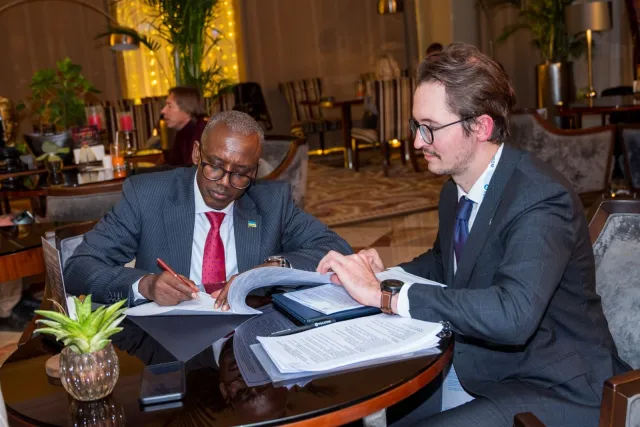
Kigali and Moscow have signed a new nuclear infrastructure agreement as Rwanda’s ambassador says construction work on nuclear projects could begin soon. But the latest document is not yet a final reactor construction contract, leaving major questions over the specific SMR technology, financing, site, licensing and project schedule.
By NuclearAfrica Editorial Desk
Rwanda has taken another significant step towards its nuclear ambitions after signing a new agreement with Russia’s state nuclear corporation, Rosatom, during the Third Russia–Africa Summit in Moscow.
The agreement has generated considerable attention because Rwanda’s Ambassador to Russia, Maj. Gen. Joseph Nzabamwita, said publicly that cooperation between the two countries would include construction of a small modular reactor and a Centre for Nuclear Science and Technology and that construction work would soon commence in Rwanda.
The announcement represents one of Rwanda’s strongest public signals yet that its nuclear programme is moving beyond general cooperation, training and policy preparation towards physical nuclear infrastructure.
However, the precise status of the agreement requires careful interpretation.
Rosatom’s own account describes the document signed on 28 October as a Memorandum of Understanding on cooperation in the assessment and development of nuclear infrastructure. According to Rosatom, the memorandum establishes steps to identify Rwanda’s nuclear infrastructure needs in line with International Atomic Energy Agency recommendations and Russian experience.
Rosatom Director General Alexey Likhachev said the two countries are already working together on projects involving a small nuclear power plant and a Centre for Nuclear Science and Technology, alongside workforce development. But the company’s statement does not announce a final engineering, procurement and construction contract for a power reactor.
That distinction matters.
Rwanda is clearly moving rapidly towards deeper nuclear cooperation with Russia. But an agreement to develop the infrastructure required for a nuclear project is not the same as a final investment decision or an authorisation to begin construction of a commercial nuclear power reactor.
From cooperation to increasingly concrete projects
Rwanda and Russia have been developing nuclear cooperation for several years.
The two governments signed an intergovernmental agreement on peaceful uses of nuclear energy in 2018. In 2019, they reached an agreement concerning the establishment of a Centre for Nuclear Science and Technology in Rwanda. That centre is envisaged as a research and training facility supporting nuclear applications in medicine, agriculture, industry, education and scientific research.
The relationship became considerably more specific in 2026.
During the first meeting of the Rwanda–Rosatom Joint Coordinating Committee, the Rwanda Atomic Energy Board and Rosatom agreed on a roadmap covering small modular reactors. The discussions also addressed the nuclear power plant project, development of national nuclear infrastructure, non-power applications, regulatory issues and human-resource development.
The October memorandum therefore builds on an existing programme rather than creating the relationship from the beginning.
What appears to be changing is the level of political confidence with which Rwanda is now discussing implementation.
Ambassador Nzabamwita described the cooperation as covering an SMR, a nuclear science and technology centre and the training of Rwandan nuclear scientists and technical personnel. He also linked nuclear development directly to Rwanda’s National Strategy for Transformation and Vision 2050.
His statement that construction works would soon commence is consequently important.
But it also raises a question that NuclearAfrica believes should be answered clearly as the project develops: which construction works?
Construction of the Centre for Nuclear Science and Technology and preparatory infrastructure could begin considerably earlier than construction of a commercial nuclear power reactor. The two projects should therefore not automatically be treated as though they have reached the same stage.
The nuclear science centre may move ahead first
This distinction becomes particularly important when Rwanda’s two principal nuclear tracks are examined separately.
The proposed Centre for Nuclear Science and Technology is already a comparatively mature cooperation project between Rwanda and Russia.
Rwanda says the centre is expected to include a research reactor and supporting laboratories. Its purpose would extend well beyond electricity generation, with potential applications in medical isotope production, cancer treatment, agricultural research, industrial testing, scientific education and workforce development.
The project has also progressed through a dedicated IAEA infrastructure review.
In July 2026, an IAEA Integrated Nuclear Infrastructure Review for Research Reactors mission examined Rwanda’s preparedness to develop a research reactor associated with the centre. The review considered safety, security and infrastructure arrangements and provided recommendations for further development.
That makes the nuclear science centre potentially more advanced institutionally than the commercial power-reactor project.
It is therefore possible that references to construction beginning soon could initially concern the centre or supporting infrastructure rather than immediate construction of an electricity-generating SMR.
Until Rwanda or Rosatom publishes a detailed construction programme, NuclearAfrica believes those possibilities should remain distinct.
The commercial SMR project still has major unanswered questions
Rwanda has stated repeatedly that it intends to introduce nuclear-generated electricity in the early 2030s.
The government has discussed an initial approximately 110 MW of nuclear capacity between 2030 and 2033 and has increasingly presented small modular reactors as being particularly suitable for the size of Rwanda’s power system.
Yet several fundamental project decisions remain publicly unresolved.
No final reactor technology associated with the Rosatom project has been announced in the newly signed memorandum.
No final commercial construction contract has been published.
No financing package has been announced.
The precise site of the proposed commercial reactor has not been publicly confirmed.
A construction licence has not been publicly announced.
And no detailed construction and commissioning timetable has been released.
Other Rwandan reporting on the October agreement has similarly cautioned that the document is an infrastructure-development memorandum rather than a final reactor construction contract.
Those are not minor administrative details.
They are the steps that separate a nuclear programme from a nuclear construction project.
Rwanda is building the institutional foundations at unusual speed
None of this diminishes the significance of Rwanda’s progress.
The country has moved unusually quickly in building a national nuclear programme.
Rwanda underwent an IAEA Integrated Nuclear Infrastructure Review mission for its nuclear power programme in March 2026. That mission examined the 19 infrastructure issues contained in the IAEA Milestones Approach, including government policy, legal and regulatory frameworks, safety, security, safeguards, human resources, radioactive waste, financing and stakeholder involvement.
A separate July mission examined infrastructure for the proposed research reactor.
Rwanda has also been expanding its nuclear workforce.
Rosatom says 102 Rwandan students are currently studying at Russian universities through its programmes, while Rwanda has announced a wider objective of developing more than 230 nuclear professionals by 2028.
These efforts demonstrate that Kigali understands that acquiring a reactor is only one part of establishing a nuclear programme.
Operating and regulating nuclear facilities requires a national ecosystem of engineers, physicists, radiation protection specialists, safeguards professionals, security experts, technicians, regulators, emergency planners and project managers.
The country is attempting to build that ecosystem before commercial operation.
But Rwanda is also pursuing more than one nuclear technology relationship
The Rosatom agreement should also be understood within Rwanda’s broader nuclear strategy.
Russia is not Rwanda’s only nuclear technology partner.
Rwanda has previously entered cooperation arrangements with several advanced-reactor developers, including American and European-linked companies. It has presented itself as a possible location for innovative nuclear technologies and as an early African adopter of small and advanced reactors.
That diversity can strengthen Rwanda’s negotiating position.
It also creates a need for clarity.
If the Rosatom relationship becomes the pathway towards Rwanda’s first commercial reactor, government will eventually need to explain how that decision relates to other reactor partnerships and how technologies were compared in terms of safety, licensing maturity, cost, fuel supply, financing, localisation and grid compatibility.
Technology selection should ultimately emerge from a transparent national project strategy rather than simply from the number of international agreements signed.
The new agreement partly changes the international assessment of Rwanda
The timing of the announcement is particularly interesting because it comes shortly after the World Nuclear Association published a cautious assessment of Rwanda’s nuclear readiness.
The World Nuclear Outlook Report 2026 categorises Rwanda as a Candidate nuclear newcomer. It rates policy readiness as Low, institutional and infrastructure readiness as Low-Moderate, project development as Low-Moderate and target achievability as Low. The Association says Rwanda’s early-2030s first-generation target appears very difficult given the current maturity of its programme.
Most importantly, the report states that Rwanda did not yet have a clearly defined first commercial project.
The latest Rosatom agreement could represent movement towards resolving that weakness.
But it does not yet fully resolve it.
For that to happen, Rwanda would need to move from general cooperation on a small nuclear power plant towards a clearly defined project with a technology, site, owner, financing structure, regulatory pathway and implementation schedule.
That is the next threshold to watch.
Financing remains one of the biggest questions
Rwanda’s ambition also confronts a financial reality.
Nuclear projects require considerable upfront capital, while Rwanda’s electricity system and economy are much smaller than those of established nuclear states.
Recent Rwandan analysis has acknowledged that conventional corporate financing alone is unlikely to be sufficient for the country’s first SMR. Financing options under discussion include sovereign support, multilateral participation and structured public-private partnerships. But no final financing package for a commercial reactor has yet been announced.
The involvement of Rosatom could eventually become important because Russia has historically coupled nuclear exports with long-term state-backed financing arrangements in several international markets.
However, no equivalent financing structure has yet been publicly confirmed for Rwanda.
Until financing is specified, the commercial viability and construction schedule of the first power reactor remain uncertain.
Grid size makes the reactor choice especially important
Rwanda’s relatively small electricity system is one reason the country has focused strongly on SMRs.
A conventional gigawatt-scale nuclear reactor would represent an exceptionally large individual generating unit relative to the national grid.
A reactor around 100 MW could potentially fit the system more comfortably while allowing capacity to be added incrementally as electricity demand grows.
But smaller size does not eliminate the need for rigorous grid analysis.
Rwanda will still need sufficient reserve capacity to manage reactor outages, strong transmission infrastructure and a long-term projection of electricity demand capable of supporting nuclear investment.
This becomes particularly important if government ultimately intends nuclear power to provide a large share of national electricity.
The World Nuclear Association notes that Rwanda’s longer-term nuclear objectives would require substantial expansion of the country’s electricity network and overall power demand.
Nuclear power is being tied directly to industrialisation
Rwanda has increasingly presented nuclear energy as more than an electricity-sector initiative.
Officials argue that reliable, high-capacity electricity will be necessary for the country’s industrialisation ambitions.
RAEB Chairman Lassina Zerbo has repeatedly linked nuclear power to industrial growth, arguing that Rwanda will require firm and reliable electricity alongside renewable generation if it is to expand manufacturing and other energy-intensive activities.
The October agreement reinforces that development argument.
The proposed nuclear cooperation extends into healthcare, agriculture and mining. Rwanda expects nuclear techniques to support cancer treatment, food preservation, geological surveys, mineral processing and scientific education.
This gives the programme a broader national-development logic.
The nuclear science centre could produce benefits well before a commercial power reactor enters service, particularly in medicine, research and workforce development.
That sequencing could help Rwanda build public familiarity with peaceful nuclear technology while strengthening the institutions required for more complex projects.
A significant development for Africa
Rwanda’s latest move is also important in the wider African nuclear landscape.
Egypt remains the continent’s major nuclear newcomer currently constructing commercial reactors, while South Africa already operates nuclear power.
Elsewhere, Ghana, Kenya, Nigeria, Uganda and Rwanda are at different stages of developing possible first nuclear power projects.
Rwanda is distinctive because of the speed with which it is attempting to combine an SMR programme, research infrastructure, workforce development, industrial localisation and multiple international partnerships.
If it succeeds, the country could become an important test case for whether a relatively small African electricity system can introduce nuclear power through advanced smaller reactor technologies.
But it could equally become a test of some of the most difficult unresolved questions surrounding SMRs globally: financing, licensing, supply-chain maturity and the commercial delivery of technologies that remain relatively new.
That makes Rwanda a programme that NuclearAfrica will continue to watch closely.
What should happen next
The next announcements from Rwanda and Rosatom will be more important than the current rhetoric surrounding construction.
The first question is whether the parties identify the specific reactor technology intended for the commercial plant.
The second is whether a site is formally selected and enters the regulatory process.
The third is whether Rwanda announces a financing arrangement.
The fourth is whether its national regulator receives and begins reviewing a formal licence application.
And the fifth is whether a binding construction contract and credible project schedule are concluded.
When those milestones occur, it will be possible to say with considerably greater confidence that Rwanda has moved from nuclear programme preparation into reactor-project implementation.
Until then, “construction soon” should be treated as an expression of political and programme intent rather than confirmation that first concrete for a commercial nuclear power reactor is imminent.
Conclusion
The Rwanda–Rosatom agreement signed in Moscow is important.
It deepens a nuclear relationship that has developed since 2018 and places the small nuclear power plant, Centre for Nuclear Science and Technology, infrastructure development and workforce training within an increasingly coordinated bilateral programme.
Rwanda’s ambassador has gone further and stated that construction works will soon begin.
That statement deserves attention.
But the evidence currently available indicates that the latest signed document itself is an infrastructure-development memorandum rather than a final construction agreement for a power reactor.
The most accurate interpretation is therefore that Rwanda is moving closer to physical nuclear development, with construction activity potentially approaching on parts of its programme, while major commercial and regulatory milestones for the first electricity-generating SMR remain outstanding.
That does not make the development less important.
It makes the next stage more consequential.
Rwanda has spent several years demonstrating political commitment to nuclear energy.
It is now approaching the stage at which that ambition must be translated into a specific reactor, a specific site, a specific financing arrangement and a licensable construction project.
When those pieces come together, Rwanda will have crossed one of the most important boundaries in any newcomer nuclear programme: the transition from preparing to build nuclear power to actually building it.
Related

From Preparedness to Response: Advancing Ghana’s Capacity to Manage Radiological Crime Scenes
By Nuclear Africa• November 17, 2026Ghana Seeks US Support to Accelerate Nuclear Power Programme Amid $200 Million Readiness Commitment
By Nuclear Africa• November 17, 2026Ghana Commits US$200 Million to Nuclear Power Readiness, Sets 2028 Deadline for Construction Contract
By Nuclear Africa• November 13, 2026
Kenya’s First ARTEMIS Review Puts Nuclear Waste Governance at the Centre of Its Energy Ambitions
By Nuclear Africa• November 11, 2026