New Ghana-specific modelling suggests that deploying a 300 MWe small modular reactor could support more than 12,500 jobs during construction and around 970 jobs annually during operation. The figures offer a potentially powerful industrial argument for nuclear power, but they also require careful interpretation: these are modelled economic impacts, not guaranteed direct nuclear jobs.
The economic debate around nuclear power in Ghana is beginning to move beyond the familiar questions of how much a reactor costs and how much electricity it could generate.
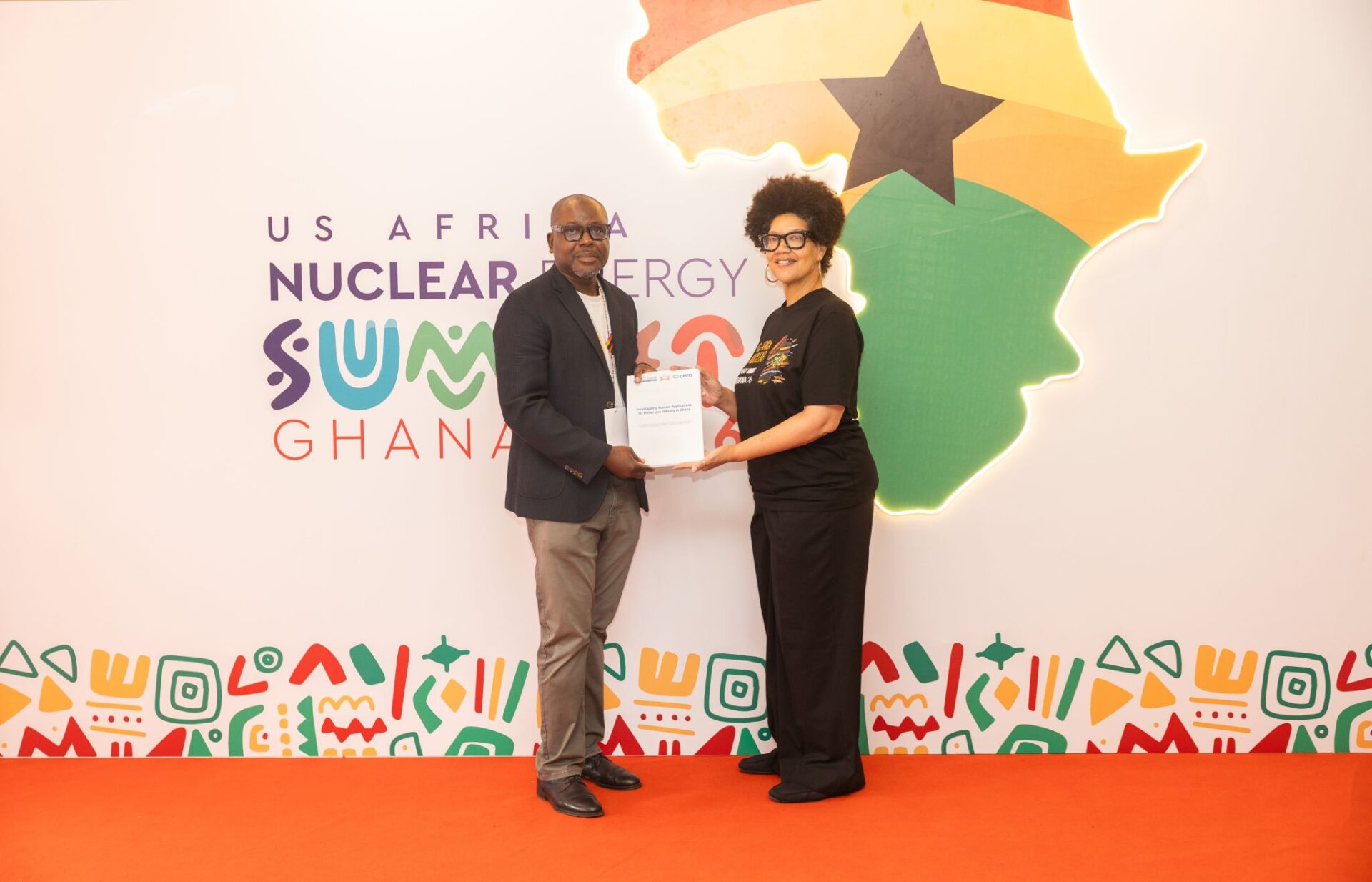
New analysis highlighted by the Ghana Atomic Energy Commission around the 2026 U.S.-Africa Nuclear Energy Summit in Accra suggests that a single 300 MWe small modular reactor could generate economic effects extending across employment, industry and wider economic activity.
According to GAEC’s public summary of Ghana-specific analysis associated with the NICE Future Initiative, one 300 MWe SMR could support more than 12,500 jobs during construction and approximately 970 jobs annually during operation, alongside broader contributions to economic activity.
The analysis also examined potential applications extending beyond electricity generation, including supplying reliable electricity and process heat for domestic alumina refining and supporting desalination to produce potable water.
For Ghana, those findings could significantly alter the way the country’s nuclear programme is discussed.
A nuclear power plant would not simply be another generating asset.
If local industries and workers capture a meaningful share of project expenditure, nuclear deployment could become part of a wider industrial, employment and manufacturing strategy.
But the size of the potential benefits will depend heavily on how Ghana structures the programme.
What does the 12,500 figure actually mean?
The first caution is important.
The finding that a 300 MWe SMR could support more than 12,500 jobs during construction should not be interpreted as meaning that 12,500 people will necessarily be employed directly at a reactor construction site.
GAEC’s public summary describes the result as a socioeconomic analysis based on Ghana-specific data, conditions and modelling assumptions. The publicly available summary does not provide sufficient methodological detail to treat the headline number as a direct construction payroll figure.
Economic-impact assessments typically distinguish between several different channels through which expenditure creates employment.
There are workers directly involved in a project.
There are jobs supported through companies supplying goods and services.
There are also wider economic effects created when wages and project expenditure circulate through the economy.
Until the complete modelling framework and underlying assumptions are examined, NuclearAfrica considers the 12,500 figure most appropriately described as jobs supported by construction-related economic activity, rather than guaranteed direct nuclear construction jobs.
That distinction is not an argument against the study. It is necessary to understand what the number means.
Why even a modelled number matters
The study is nevertheless significant because the economic value of African nuclear programmes is often discussed almost exclusively in terms of electricity.
That can miss a large part of the development case.
A nuclear project is also a major infrastructure investment requiring engineering, civil works, logistics, manufacturing, professional services, construction management, quality assurance, security, transport, accommodation, information technology and long-term technical services.
If significant shares of those activities are performed domestically, nuclear expenditure can move through multiple parts of the economy.
If most equipment, engineering and specialised services are imported, the domestic economic effect can be much smaller.
The real question for Ghana is therefore not simply whether an SMR could support 12,500 jobs.
It is: How many of those jobs could Ghana realistically capture?
Local content will determine how much value stays in Ghana
This makes local-content planning central to the economic case.
Not every component of a first nuclear plant can or should be manufactured domestically.
Safety-class equipment must meet rigorous nuclear standards, and newcomer countries normally depend significantly on established international supply chains during their first projects.
But local participation can increase progressively.
Civil construction, conventional electrical systems, transport, security, site services, certain fabrication activities, accommodation, professional services, environmental monitoring and parts of project management may provide earlier opportunities.
Over time, Ghanaian companies could potentially qualify for more demanding nuclear supply-chain roles if they meet the required quality and technical standards.
This is why nuclear localisation cannot begin when reactor construction begins.
Companies need advance visibility of future procurement requirements.
Workers require certification.
Technical institutions need appropriate training programmes.
Businesses need nuclear quality-management systems.
Regulators and owner-operators need supplier qualification arrangements.
Banks need to understand the industry.
And government must decide what level of local participation is realistic without compromising safety, quality or project delivery.
USANES 2026 brought many of these workforce questions to the centre of the African nuclear debate.
The summit included representatives from universities, technical and vocational institutions, regulators, nuclear organisations and welding specialists alongside policymakers and industry.
That combination matters because the employment potential identified by economic models will only translate into Ghanaian jobs if the workforce is capable of performing the work.
The 970 operating jobs may be even more strategically important
Construction attracts large numbers of workers but is temporary.
The more durable economic contribution comes from operation.
The NICE Future-related analysis estimates that the proposed 300 MWe SMR could support approximately 970 jobs annually during operations.
Again, the figure should not automatically be interpreted as 970 people working directly inside the nuclear power plant.
But the number points towards the wider long-term employment ecosystem surrounding nuclear operations.
A nuclear plant can operate for several decades.
During that period it requires plant operators, maintenance specialists, radiation-protection personnel, chemists, security staff, engineers, instrumentation specialists, emergency planners, regulatory inspectors, fuel-cycle services, waste-management personnel and a network of external contractors and suppliers.
That matters for countries evaluating nuclear power because nuclear employment has a different profile from short-duration construction programmes.
A project may require a very large workforce while being built, but a smaller, highly specialised workforce during decades of operation.
The employment strategy therefore has to prepare for both phases.
Nuclear power and Ghana’s industrialisation agenda
Perhaps the more interesting part of the new analysis is that it examines nuclear power in connection with industrial applications.
GAEC’s summary specifically identifies domestic alumina refining as one possible application, alongside desalination.
That is highly relevant to Ghana.
The country possesses substantial bauxite resources but has long sought to capture more value through domestic processing instead of relying predominantly on raw or lightly processed commodity exports.
Alumina and aluminium production are energy-intensive.
Any strategy aimed at expanding domestic processing must therefore confront a basic infrastructure question:
Where will the large volumes of reliable electricity and process energy come from?
Nuclear energy potentially enters the discussion not simply as a source of power for households but as infrastructure supporting energy-intensive industrial production.
That is also consistent with arguments made by the Association of Ghana Industries during USANES 2026.
AGI called for Ghana’s nuclear programme to be treated as a strategic national industrial project and linked dependable electricity with the future competitiveness of mining, steel, cement, chemicals, agro-processing and other productive sectors.
That is a different proposition from adding another generator to the national electricity mix.
It links reactor deployment to industrial policy.
The desalination opportunity
The analysis also adds to growing interest in using nuclear energy for water production.
A separate Ghana-specific study published in April 2026 examined coupling a 300 MWe SMR with seawater desalination.
The research assessed reverse osmosis and multi-effect distillation configurations using Ghana-specific assumptions concerning financing, labour, regulation and coastal conditions.
The broader implication is important.
Nuclear reactors produce large quantities of thermal energy.
Electricity is one way to use that energy, but nuclear facilities can potentially support other applications, including industrial heat, hydrogen production and desalination depending on reactor design and local economics.
For African economies facing simultaneous electricity, industrial and water-security pressures, this can change the value proposition.
The relevant comparison may not always be: nuclear versus gas for electricity.
It may become: Which energy system can simultaneously support electricity, industrial heat, water production and long-term energy security?
But the investment side cannot be ignored
The economic benefits identified by the study must be placed alongside the cost and financing challenge.
Small modular reactors are often presented as potentially easier to finance than conventional gigawatt-scale plants because individual units are smaller.
Smaller, however, does not mean inexpensive.
Recent analysis of advanced nuclear opportunities in Africa continues to place the overnight capital cost of a 300 MWe SMR in the billion-dollar range, depending heavily on technology, location, financing and whether the project is an early deployment or part of a mature fleet.
Financing costs can be particularly important.
Nuclear projects are capital-intensive, meaning the cost of borrowing, project delays and construction risk can substantially affect the eventual price of electricity.
Ghana would therefore need to evaluate the employment and industrial benefits alongside several other questions.
Who finances the reactor?
Who bears construction risk?
What is the cost of capital?
What electricity price is required?
Is government providing guarantees?
How much foreign exchange exposure is created?
How much equipment can actually be sourced locally?
And does the project remain economically competitive under realistic rather than optimistic assumptions?
The NICE Future analysis itself emphasises the importance of financing and an enabling regulatory framework.
Jobs depend on a project actually being built
There is another obvious but important qualification.
No reactor means no reactor-related construction employment.
Ghana remains in Phase Two of the IAEA Milestones Approach and still has significant preparatory work to complete before construction.
Earlier in 2026, Nuclear Power Ghana identified funding gaps affecting detailed site characterisation and environmental impact assessment, describing both as necessary for progress beyond Phase Two.
Seven Nuclear Regulatory Authority instruments also remained pending in Parliament at the end of July.
The economic model therefore represents an opportunity scenario.
Capturing that opportunity requires successful completion of the regulatory, site, financing, procurement and project-development work that comes first.
Ghana should develop a nuclear local-content baseline now
One practical policy implication follows directly from the study.
Ghana does not need to wait for reactor construction to begin before measuring its potential domestic contribution.
The country could undertake a detailed nuclear industrial-capability assessment identifying which goods, services and skills already exist locally and which require further development.
That assessment could map: existing engineering capacity; civil-construction capability; qualified welding capacity; electrical and instrumentation skills; manufacturing capability; quality-assurance systems; universities and TVET institutions; professional-service companies; transport and logistics capability; and potential supply-chain gaps.
It could then compare these capabilities with the procurement requirements of candidate reactor technologies.
The result would be a more credible local-content strategy than announcing arbitrary localisation percentages after a vendor has already been selected.
Employment should not become the only justification for nuclear
There is also a policy caution.
Nuclear power should not be selected simply because an economic model projects a large number of jobs.
The principal purpose of a power plant remains to deliver energy safely, reliably and competitively.
Employment and industrial benefits are important secondary considerations, but they should complement rather than replace rigorous assessment of electricity-system need, cost, safety, financing, environmental impact and technology suitability.
The same principle applies to other energy technologies.
An energy project that creates many jobs but produces unaffordable electricity may not improve industrial competitiveness.
Conversely, a project that delivers reliable electricity while developing a high-skilled domestic supply chain could have value far beyond the power sector itself.
The challenge is finding the correct balance.
Why This Matters for Africa
The new Ghana analysis raises a question that will increasingly confront African nuclear newcomer countries.
Should nuclear energy be evaluated merely as an electricity technology, or as a wider industrial-development platform?
For countries with young populations, high unemployment and ambitions to move into manufacturing and mineral processing, the answer matters.
If nuclear projects are almost entirely imported, significant portions of their economic value will leave the host economy.
If countries invest early in workforce development, industrial qualification and local supply chains, more value can potentially remain domestically.
The 12,500-job estimate should therefore not be treated as a promise. It should be treated as a challenge.
The question is not whether an economic model can generate an impressive employment number.
The question is whether Ghana can build the workforce, institutions and industrial capability required to turn a meaningful share of that theoretical opportunity into Ghanaian jobs, Ghanaian companies and long-term Ghanaian productive capacity.
That is ultimately where the economic case for nuclear power will be won or lost.
NuclearAfrica Assessment
Finding: A Ghana-specific socioeconomic analysis indicates that a 300 MWe SMR could support more than 12,500 jobs during construction and approximately 970 jobs annually during operation.
Important qualification: These are modelled economic impacts and should not be interpreted as guaranteed direct employment.
Industrial opportunity: Alumina refining, industrial energy, desalination and local supply-chain development could broaden the economic role of nuclear power.
Key risk: The domestic economic benefit will depend heavily on local-content capacity, financing arrangements, project execution and the extent to which Ghanaian firms qualify for nuclear supply chains.
Related

Morocco Nuclear Regulator Says No Radioactive Leak at Maâmora Research Centre
By Nuclear Africa• October 7, 2026
Amazon’s 20-Year Nuclear Deal Shows How Large Corporate Buyers Can Help Finance Nuclear Investment
By Nuclear Africa• October 7, 2026Beyond the Resolutions: GC70 and the Emerging Global Nuclear Order
By Nuclear Africa• October 6, 2026
US Nuclear Regulator’s Workforce Warning Carries a Clear Lesson for African Nuclear Newcomers
By Nuclear Africa• October 5, 2026