The third U.S.-Africa Nuclear Energy Summit has ended in Accra after three days of discussions on workforce development, regulation, industrial skills, artificial intelligence and institutional capacity. It did not produce a new reactor construction contract, but the summit may have marked a more important transition in Africa’s nuclear conversation, from choosing technologies to building the institutions and people capable of sustaining them.
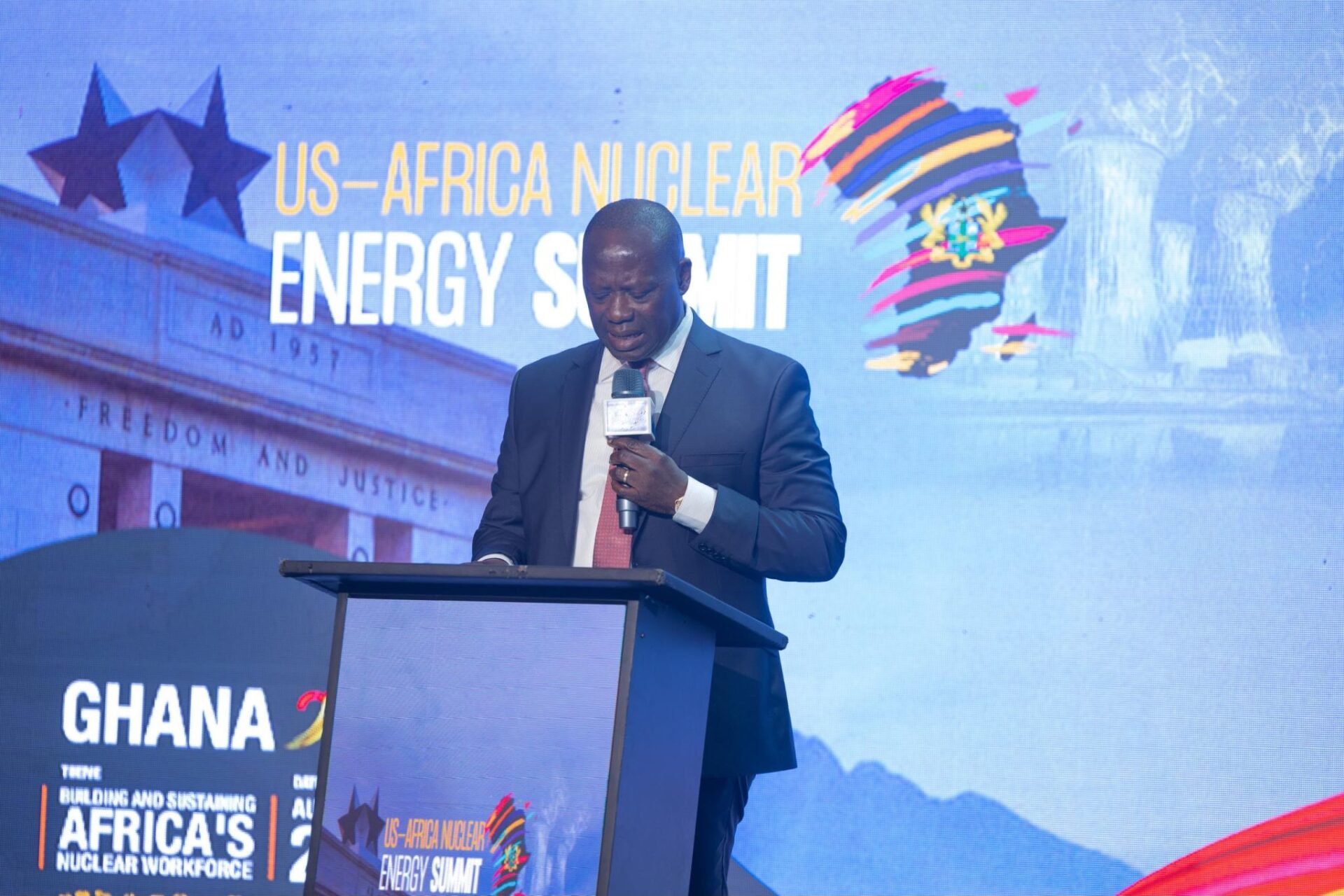
The third U.S.-Africa Nuclear Energy Summit, USANES 2026, concluded in Accra on 21 August after bringing African governments, regulators, nuclear programme organisations, universities, technical institutions, industry representatives and U.S. nuclear officials together around one question that is becoming increasingly difficult for Africa’s emerging nuclear programmes to avoid: who will actually build, regulate, operate and sustain the continent’s future reactors?
Held at the Labadi Beach Hotel from 19 to 21 August under the theme “Building and Sustaining Africa’s Nuclear Workforce,” the summit was organised by the U.S. Department of Energy’s Office of Nuclear Energy in partnership with the Ghana Atomic Energy Commission under the auspices of Ghana’s Regional Energy Training Centre.
That theme represented an important shift.
Much of the international discussion about nuclear energy in Africa over the past decade has centred on reactor technologies, vendor countries, financing arrangements and the growing competition among the United States, Russia, China, South Korea and other nuclear suppliers.
USANES 2026 moved a different set of issues much closer to the centre of the conversation: human resources, vocational skills, regulatory competence, institutional continuity, leadership development, cybersecurity and the impact of artificial intelligence on future nuclear work.
The Atlantic Council, which participated in and livestreamed the summit, described the three-day programme as covering end-to-end talent pipelines, technical and vocational education, regulatory capacity, AI and cybersecurity, and development of the next generation of nuclear leadership.
For a continent where several countries have declared nuclear ambitions but only South Africa currently operates a commercial nuclear power plant, these questions are not secondary to reactor deployment. They are part of the infrastructure required to make deployment possible.
Ghana used the summit to make a stronger political declaration
As host, Ghana used USANES 2026 to send one of its clearest recent political signals about the future of its nuclear power programme.
Speaking on behalf of President John Dramani Mahama, Emmanuel Armah-Kofi Buah, then Acting Minister responsible for Environment, Science and Technology, told the summit that Ghana had moved beyond simply considering nuclear power and was prepared to pursue its introduction.
He also reaffirmed that Ghana remains in Phase Two of the International Atomic Energy Agency’s Milestones Approach and said that work was continuing on site studies, institutional strengthening, stakeholder engagement and discussions with prospective technology vendors.
The distinction between political commitment and technical readiness remains important.
Under the IAEA’s Milestones Approach, newcomer countries are expected to address 19 infrastructure issues covering areas including nuclear safety, funding and financing, the regulatory framework, human-resource development, the electrical grid, nuclear security, radioactive waste, environmental protection, industrial involvement and procurement.
Phase Two is the stage in which the infrastructure necessary to prepare for contracting and construction is developed. Completion of the phase should put a country in a position to invite bids or negotiate a contract for its first nuclear power plant. Phase Three then covers contracting, licensing and construction.
Ghana’s statement of readiness should therefore be understood as a reaffirmation of commitment to completing that process, rather than as an announcement that every condition required for construction has already been satisfied.
The 1,000 MW ambition is becoming more clearly defined
The summit also reinforced Ghana’s intention to introduce approximately 1,000 MW of nuclear generating capacity by the mid-2030s.
The target is consistent with the broader direction of Ghana’s energy and climate planning. Ghana’s national climate investment framework includes a proposal for 1,000 MW of clean nuclear baseload capacity, while international nuclear assessments similarly place Ghana’s first commercial nuclear generation around the middle of the next decade.
This represents a significant adjustment from earlier ambitions to introduce nuclear electricity around 2029 or 2030.
By March 2026, Ghanaian project officials and energy analysts were publicly acknowledging that the original timeline had shifted towards the mid-2030s.
The revised timetable may ultimately be more credible because it provides additional space for the regulatory, site, financing, grid and human-resource work that remains before construction.
The more important question is therefore no longer whether Ghana has announced a nuclear target.
It is whether the country can convert that target into a sequenced and adequately funded implementation programme.
Ghana-U.S. nuclear cooperation moved another step forward
The summit also provided an update on one of the most important legal foundations for deeper nuclear cooperation between Ghana and the United States.
Ghana confirmed that the proposed bilateral Section 123 Agreement for peaceful nuclear cooperation had been initialled and was progressing through the remaining approval processes.
A Section 123 Agreement establishes the legal framework required under U.S. law for significant peaceful nuclear cooperation involving nuclear material, equipment and certain technologies.
Its progression is therefore strategically important for any future Ghanaian engagement involving U.S. nuclear technology.
However, the agreement should not itself be interpreted as a reactor purchase agreement.
It creates an enabling framework for cooperation. Decisions regarding specific technologies, project ownership, financing, licensing and construction remain separate processes.
For NuclearAfrica, that distinction is important because nuclear diplomacy often advances through several layers of agreements before an actual investment decision is reached.
The summit’s biggest message was about people
If USANES 2026 had one overriding message, it was that African countries cannot develop sustainable nuclear programmes by importing reactors while leaving the underlying human infrastructure underdeveloped.
GAEC Board Chairman Professor Abdulai Baba Salifu told participants that nuclear programmes require scientists, engineers, technicians, operators and regulators across the entire value chain.
He also called for greater regional cooperation so African countries can share training facilities, laboratories, simulation infrastructure, regulatory experience and emergency-preparedness resources.
The workforce conversation was noticeably broader than traditional nuclear engineering.
The summit included universities, regulators, national nuclear organisations, technical and vocational institutions, welding specialists, communication professionals and industry representatives. The participant profile reflected the reality that a nuclear project requires far more than reactor physicists and nuclear engineers.
A commercial nuclear programme also requires qualified welders, electricians, civil engineers, instrumentation and control specialists, quality-assurance professionals, project managers, lawyers, economists, cybersecurity specialists, emergency planners, radiation-protection professionals and supply-chain personnel.
For newcomer countries, developing this workforce early matters because the people required during project preparation are not identical to those required during construction or operation.
Ghana wants to become a regional training hub
The workforce agenda also reinforced Ghana’s ambition to position itself as a regional nuclear training centre.
GAEC pointed to the establishment of the Regional Energy Training Centre in Ghana through cooperation with the United States and called for greater regional use of training facilities and technical expertise.
U.S. Department of Energy official Michael Goff told the summit that Washington’s objective was not simply to provide isolated training programmes but to build institutional partnerships capable of growing alongside African nuclear programmes.
Ghana already hosts a nuclear power plant simulation capability linked to its SMR training initiatives, while other U.S.-supported programmes have covered subjects including cybersecurity, quality assurance and spent fuel management.
If developed effectively, Ghana could potentially play a role beyond preparing its own workforce.
A regional training model could allow emerging nuclear countries to share expensive specialist infrastructure rather than attempting to reproduce every training facility nationally.
That could become particularly important for smaller African programmes.
Regulation emerged as a workforce problem too
Perhaps one of the most important implications of the summit is that Africa’s nuclear workforce challenge begins long before reactor operation.
A nuclear regulator must have competent personnel before construction starts.
Regulators need the capability to assess site applications, review safety analysis, evaluate reactor designs, oversee environmental and radiation-protection requirements, inspect construction and eventually authorise commissioning and operation.
USANES included regulatory representatives from Ghana, Kenya and the U.S. Nuclear Regulatory Commission, reflecting the growing importance of this issue.
For Ghana, the subject is particularly timely.
Seven regulations under the Nuclear Regulatory Authority remained pending before Parliament when the legislature ended its second meeting on 31 July 2026.
The NRA itself states that technical and administrative regulations for nuclear and radiation activities remain at different stages of drafting, review and approval.
Workforce development therefore cannot be separated from regulatory development.
A regulator needs both qualified people and a sufficiently complete legal framework within which those people can exercise their authority.
AI and cybersecurity entered the African nuclear conversation
USANES 2026 also looked beyond today’s workforce requirements.
Artificial intelligence, digital systems and cybersecurity featured prominently in discussions about future nuclear deployment.
The U.S. Department of Energy highlighted work examining how AI could contribute to reactor design, licensing, manufacturing, construction and operation.
The implication for African newcomer countries is significant.
If future nuclear plants are increasingly digital, regulators and operators will need capabilities that combine traditional nuclear engineering with software assurance, cyber-risk management, data science and digital instrumentation and control.
Countries building nuclear education programmes today must therefore avoid designing curricula solely around the technological requirements of yesterday’s nuclear industry.
The workforce being trained in 2026 may be responsible for plants operating in the 2040s, 2050s and beyond.
A potentially important economic story also emerged
Around the summit, GAEC highlighted Ghana-specific analysis conducted through the NICE Future Initiative examining the potential socioeconomic contribution of small modular reactors.
According to the public summary, modelling suggests that a single 300 MWe SMR could support more than 12,500 jobs during construction and about 970 jobs annually during operation.
The analysis also examined possible applications of nuclear energy in alumina refining, process heat and desalination.
Those numbers require careful interpretation because they are modelled economic impacts rather than guarantees that a specific Ghanaian SMR project will directly hire those numbers of workers.
Nevertheless, the study broadens the Ghana nuclear debate beyond electricity supply and places industrial development, local economic activity and employment more firmly within the discussion.
But the summit did not remove Ghana’s implementation constraints
The enthusiasm surrounding USANES should not obscure the remaining challenges.
Earlier this year, Nuclear Power Ghana warned that critical Phase Two technical studies were facing funding constraints.
Executive Director Stephen Yamoah identified detailed site characterisation and environmental impact assessment as particularly urgent and said the programme could not progress beyond Phase Two without completing the necessary technical work. A grid impact study was also identified as an important requirement.
The Association of Ghana Industries raised similar concerns during USANES, pointing to financing constraints affecting site studies, site characterisation and environmental assessments.
These issues illustrate the difference between nuclear ambition and nuclear implementation.
Political support is necessary.
International partnerships are necessary.
A trained workforce is necessary.
But none independently substitutes for financing, site data, a completed regulatory framework, grid planning, procurement strategy and a bankable project structure.
What USANES did, and what it did not do
As of 24 August, the official summit materials and public reporting reviewed by NuclearAfrica do not indicate that USANES 2026 produced a final investment decision, financial close, construction licence or new reactor construction contract for Ghana.
That does not make the summit insignificant.
It means its significance should be classified correctly.
USANES 2026 was principally an institution-building and workforce-development summit. It strengthened political signals, advanced cooperation, placed new economic analysis into the debate and brought greater attention to the technical and institutional workforce needed to sustain nuclear programmes.
Its success should therefore be measured less by the number of reactor announcements made in Accra and more by what happens after the delegates leave.
Do African governments establish measurable workforce plans?
Do technical institutions develop nuclear-qualified programmes?
Do regulators obtain the staff, laws and tools they require?
Do training partnerships lead to nationally sustainable expertise?
Do industrial companies begin qualifying for nuclear supply chains?
And do governments allocate the resources needed to move their programmes from planning toward construction?
Those are the tests that matter.
Why This Matters for Africa
Africa’s nuclear debate is entering a more demanding stage.
Declaring interest in nuclear power is relatively easy. Building the institutions required to regulate and sustain a nuclear programme for 60 years or more is far more difficult.
USANES 2026 was important because it directed attention towards that second challenge.
Countries such as Ghana, Kenya and Nigeria are at different stages of nuclear infrastructure development, while other African states are beginning to examine whether advanced reactors could form part of their future energy systems.
For all of them, the lesson from Accra is increasingly clear.
Africa can import a reactor.
It cannot permanently import the national responsibility for regulating, operating, securing and sustaining it.
The real legacy of USANES 2026 will therefore depend on whether Africa turns the summit’s emphasis on people and institutions into durable national capacity.
NuclearAfrica Assessment
Milestone classification: Workforce, institutional-capacity and international-cooperation milestone.
What changed: Stronger political commitment, deeper workforce cooperation, progression of Ghana-U.S. nuclear cooperation, greater attention to regional training, regulatory capacity, industrial skills, AI and cybersecurity.
What did not change: Ghana has not yet reached construction, financial close or final commissioning readiness.
What to watch next: Ghana’s nuclear regulations, funding for site characterisation and environmental assessment, grid studies, technology and procurement decisions, Section 123 Agreement approval, workforce targets and financing structure.
Related

Morocco Nuclear Regulator Says No Radioactive Leak at Maâmora Research Centre
By Nuclear Africa• October 7, 2026
Amazon’s 20-Year Nuclear Deal Shows How Large Corporate Buyers Can Help Finance Nuclear Investment
By Nuclear Africa• October 7, 2026Beyond the Resolutions: GC70 and the Emerging Global Nuclear Order
By Nuclear Africa• October 6, 2026
US Nuclear Regulator’s Workforce Warning Carries a Clear Lesson for African Nuclear Newcomers
By Nuclear Africa• October 5, 2026