Ghana’s discussion about small modular reactors has moved into a more quantitative phase following the release of new Ghana-specific studies examining how SMRs could affect electricity-system costs, employment and energy-intensive industries.
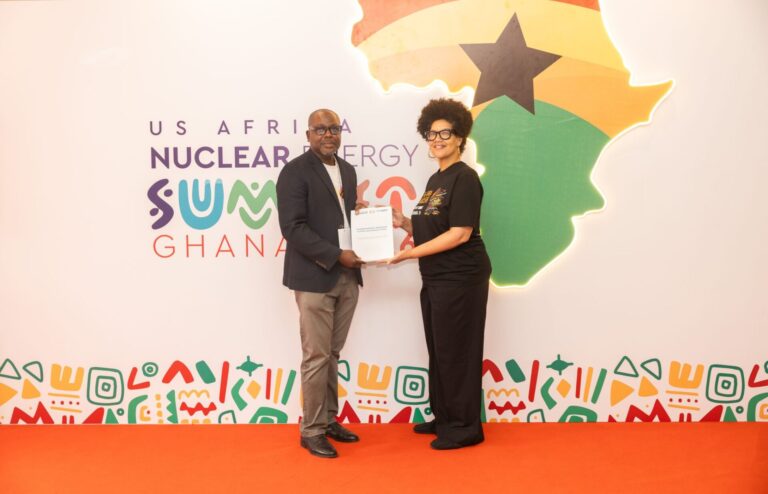
The studies were developed by the Nuclear Power Institute of the Ghana Atomic Energy Commission in collaboration with the Clean Energy Ministerial’s NICE Future Initiative and were highlighted during the US-Africa Nuclear Energy Summit held in Accra from 19 to 21 August 2026.
According to information released by NICE Future and subsequently shared by GAEC, power-sector modelling found that SMRs could become a cost-effective generation option in Ghana as early as 2030 under the assumptions examined. Across the scenarios analysed, adding SMRs reduced the modelled total cost of additional electricity generation by an average of about 10 percent compared with scenarios that excluded nuclear power.
The figures are significant, but they require careful interpretation.
They do not mean Ghana’s electricity tariffs would automatically fall by 10 percent if the country built an SMR. They also do not mean a reactor could realistically begin operating in Ghana in 2030.
Rather, the studies indicate that when nuclear is introduced into the model under certain assumptions concerning capital cost, financing, plant performance, demand growth and the alternatives available to the electricity system, the overall cost of adding future generation capacity may be lower.
That distinction matters.
The jobs argument is becoming more specific
A separate socioeconomic analysis examined the potential impact of a single 300 MWe SMR.
The study estimates that such a project could support more than 12,500 jobs during construction and approximately 970 jobs annually during operation, alongside wider contributions to gross domestic product and economic activity.
Again, these are modelled employment effects rather than jobs that have already been created or contracted.
The eventual domestic employment impact would depend heavily on the local-content share of the project, Ghana’s industrial capabilities, the proportion of specialised work undertaken locally, supply-chain qualification and the structure of the procurement agreement.
A reactor built largely through imported engineering, components and specialist labour would produce a different domestic economic impact from one supported by a deliberately developed Ghanaian supply chain.
This is why the employment numbers should encourage a deeper discussion about localisation rather than being treated simply as an argument for nuclear power.
Nuclear and Ghana’s aluminium ambition
Perhaps the most interesting aspect of the studies is their examination of nuclear energy beyond conventional grid electricity.
The researchers considered whether SMRs could provide reliable electricity and process heat for domestic alumina refining, as well as energy for desalination.
Ghana has long sought to create an integrated aluminium industry linking domestic bauxite resources to alumina refining and aluminium production. Yet the country currently lacks the refining stage that connects bauxite mining with aluminium smelting. GIADEC says Ghana plans to develop new alumina-refining capacity as part of its integrated aluminium strategy.
Energy is one of the central economic constraints.
A separate August 2026 analysis by the Natural Resource Governance Institute concluded that a Ghanaian alumina refinery would face substantial challenges from electricity, heat, infrastructure, financing and input costs. Its modelling suggests a refinery could struggle commercially under prevailing assumptions without significant interventions.
That makes the nuclear study particularly timely.
If nuclear could provide predictable long-duration electricity and industrial heat, it may alter part of the economic equation. But nuclear does not automatically make an otherwise uneconomic refinery viable.
The appropriate question is therefore not simply whether an SMR can power alumina refining.
It is whether the combination of nuclear energy costs, refinery economics, rail and port infrastructure, bauxite supply, financing and global alumina prices produces a competitive industrial value chain.
Financing may decide the result
For nuclear projects, modelling outcomes can change significantly depending on financing assumptions.
Capital-intensive technologies are particularly sensitive to discount rates, interest costs and construction duration. A low-cost financing structure can make nuclear considerably more competitive, while high financing costs can overwhelm potential fuel and operating-cost advantages.
The full value of Ghana’s new studies will therefore depend on transparency around the assumptions used.
Policymakers should eventually be able to examine the assumed reactor capital cost, financing structure, construction period, capacity factor, fuel cost, grid investment, decommissioning provisions, local-content assumptions and competing generation technologies.
Sensitivity analysis is particularly important.
A model that produces favourable nuclear economics at one financing rate may produce a very different outcome if the cost of capital increases.
Why this matters for Africa
Ghana’s work represents the type of analysis African nuclear newcomers increasingly need.
The debate should move beyond the simple question of whether nuclear electricity is “cheap” or “expensive”.
Countries need to ask what nuclear does to the entire electricity system, what industries it could support, what infrastructure it requires, what employment it creates domestically and what financing conditions make those benefits achievable.
For other African countries considering SMRs, the Ghana studies also demonstrate the value of country-specific modelling.
A reactor that appears economically attractive in one country may not produce the same result elsewhere because grid size, financing costs, industrial demand, local-content capability and competing energy resources differ.
What the study does not mean
The study does not constitute a reactor procurement decision, construction licence, final investment decision or commissioning schedule.
The 2030 result should especially not be presented as Ghana’s new target date for operating an SMR.
It is a modelling outcome.
Ghana would still have to complete the necessary national decision-making, regulatory, financing, site, grid, procurement, construction and licensing processes before any nuclear plant could enter operation.
What the studies provide is something different but valuable: a stronger analytical basis for deciding whether nuclear deserves a place in Ghana’s future electricity and industrial strategy.
Related


Africa Deepens Nuclear Safeguards Capacity as AFCONE Convene Hands-On Training in Nairobi
By Nuclear Africa• August 24, 2026
A 300 MW SMR Could Support More Than 12,500 Construction Jobs in Ghana: New Study Tests Nuclear’s Economic Case
By Nuclear Africa• August 24, 2026
Ghana Targets 1,000 MW of Nuclear Power by the Mid-2030s: What Must Happen Before Construction Can Begin?
By Nuclear Africa• August 24, 2026