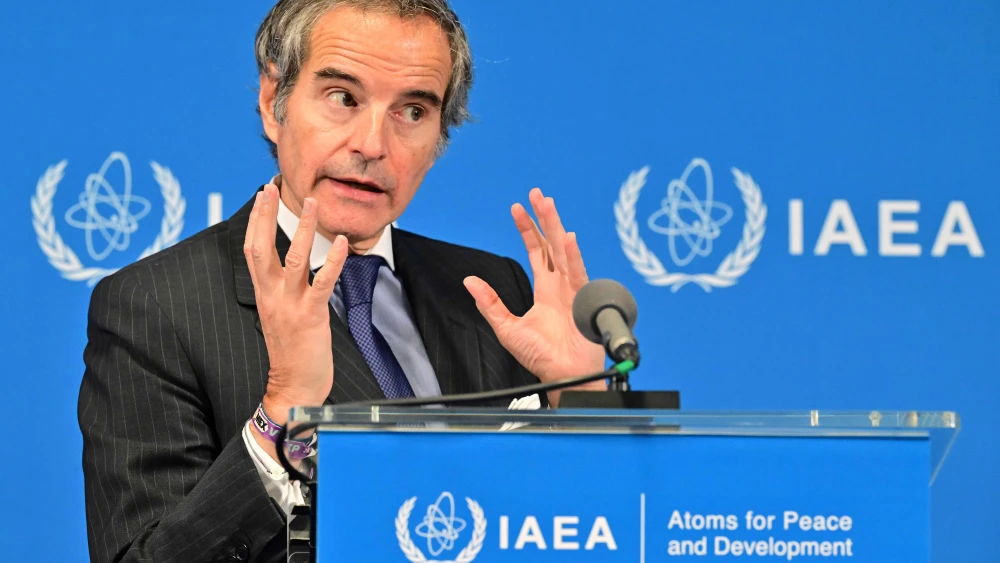
Syria has granted the International Atomic Energy Agency access to the Deir Ez-Zor site and another location connected to recently identified nuclear material, marking what the IAEA describes as the most significant advance yet towards resolving long-standing safeguards questions linked to undeclared nuclear activities under the country’s former government.
IAEA Director General Rafael Mariano Grossi visited Syria on 17 and 18 August and held discussions with Foreign Minister Asaad Hassan Al-Shaibani. During the mission, Grossi visited Deir Ez-Zor and a second location associated with nuclear material that Syria had recently identified and reported to the Agency.
The development is important not because the Syrian nuclear file has now been closed. It has not.
Rather, the significance lies in the transition from unresolved questions and limited access towards direct verification, declaration of previously unreported nuclear material and an agreed process for bringing that material fully within IAEA safeguards.
For African countries developing nuclear power, research reactors and other nuclear capabilities, the episode offers a valuable reminder that safeguards are not simply an international reporting obligation. They depend on functioning national systems capable of identifying, accounting for, declaring and controlling nuclear material.
Syria Declared Previously Unreported Nuclear Material
According to the joint statement issued by the IAEA and Syrian government on 18 August, Syria notified the Agency on 17 July 2026 of nuclear material discovered at a location that had not previously been declared.
The Syrian authorities subsequently provided information and access to the site as part of the country’s obligations under its safeguards agreement with the IAEA.
During Grossi’s latest visit, the Agency gained access to the location and began verification activities.
The IAEA says Syria facilitated the initial verification and has agreed to continue cooperating until the material has been fully verified and brought under Agency safeguards.
That process remains ongoing.
Reuters separately reported that Syrian Foreign Minister Asaad al-Shibani said the material would remain under Syrian custody and would be subject to IAEA oversight. He also stated that Syria considered the material suitable for peaceful purposes.
The nature, quantity and precise origin of the material have not been publicly established in sufficient detail to justify wider conclusions about its significance.
That is precisely why verification matters.
IAEA Returns to Deir Ez-Zor
Grossi also visited the Deir Ez-Zor site, one of the central locations in Syria’s long-running safeguards dispute.
The IAEA said the Director General was briefed on excavation work being conducted by Syrian authorities and observed features relevant to the Agency’s assessment of historical nuclear-related activities at the site.
The excavation and verification work will continue under a timetable agreed between Syria and the Agency.
The site’s history stretches back almost two decades.
In 2011, the IAEA Board of Governors found that Syria’s undeclared construction of what the Agency assessed to have been a nuclear reactor at Deir Ez-Zor, together with the failure to provide the required design information, constituted non-compliance with Syria’s safeguards obligations.
For years afterwards, significant questions remained unresolved.
More recent engagement began to change that situation. The IAEA reported that renewed cooperation from 2024 allowed Agency inspectors to visit several locations associated with the historical investigation and collect environmental samples.
The August 2026 visit represents a further step in that process.
Why Verification Matters More Than Assumption
The Syrian case illustrates one of the fundamental principles of the international nuclear safeguards system.
Safeguards are based on verification.
Governments make declarations about nuclear material and activities. National authorities maintain accounting and control systems. The IAEA then uses inspections, measurements, environmental sampling, records analysis and other verification techniques to assess whether those declarations are consistent with the information available to the Agency.
The purpose is to provide confidence that nuclear material subject to safeguards remains in peaceful activities and that relevant nuclear activities are properly declared.
This means that finding previously undeclared material does not automatically establish a weapons programme.
But neither can the discovery simply be treated as an administrative matter.
The material must be identified, quantified, documented and placed within the safeguards system.
That is what the current Syrian process is intended to accomplish.
National Custody and International Verification Can Coexist
One point in the latest announcement is especially useful for understanding how safeguards work.
Syria says the nuclear material will remain in national custody.
At the same time, the material will be subject to IAEA verification.
Those positions are not contradictory.
Nuclear material located within a country generally remains under the jurisdiction and responsibility of that state. Safeguards do not transfer ownership of the material to the IAEA.
Instead, the state assumes international obligations concerning declaration, accounting, access and verification.
The basic relationship can therefore be understood as:
national custody and control → state accounting and declaration → IAEA access and verification → safeguards assessment
This distinction is particularly important for nuclear newcomer countries.
Joining the international safeguards system does not mean surrendering sovereignty over peaceful nuclear activities.
It means accepting transparency and international verification as part of the conditions under which nuclear technology is used for peaceful purposes.
The Importance of a National Safeguards System
For African countries expanding their nuclear programmes, one of the most important lessons from the Syrian case concerns national safeguards infrastructure.
The IAEA cannot substitute for the state’s own responsibility to know what nuclear material exists within its jurisdiction.
Countries require functioning systems for accounting for and controlling nuclear material.
That includes accurate records of nuclear material inventories, movements and transfers.
It requires trained safeguards personnel.
It requires clear institutional responsibilities.
It requires procedures for reporting changes in nuclear material holdings.
It also requires effective coordination between operators, regulators, government authorities and the national institution responsible for safeguards implementation.
As nuclear programmes become more complex, those responsibilities expand.
A country operating only small quantities of nuclear material may have a relatively limited safeguards workload.
A country introducing research reactors, nuclear fuel, power reactors or other nuclear installations will require a considerably more sophisticated national safeguards system.
Why This Matters for Africa
Africa’s nuclear landscape is changing.
Several countries are considering nuclear power. Others already operate research reactors. Nuclear medicine, agriculture, industry and scientific research also involve increasing use of nuclear and radioactive materials.
As these activities grow, international attention often focuses on reactor technology, financing, vendors and construction timelines.
Safeguards receive much less public attention.
Yet safeguards are one of the foundations upon which international nuclear cooperation depends.
Supplier countries want confidence that transferred nuclear materials and technologies will remain in peaceful use.
International financing institutions need credible governance structures.
Technology providers operate within national and international export-control requirements.
The IAEA requires accurate declarations and access necessary to perform verification.
For nuclear newcomer countries, the quality of the safeguards system can therefore influence the credibility of the entire nuclear programme.
Safeguards Should Be Built Before the Reactor
There is an important sequencing lesson here.
A country should not wait until nuclear fuel arrives before developing safeguards capability.
The system should be strengthened progressively as the national programme develops.
That means training personnel early.
It means ensuring that legislation establishes clear authority for safeguards implementation.
It means developing accounting procedures and information-management systems.
It means creating reliable channels for communication with the IAEA.
It also means ensuring that future operators understand their reporting responsibilities long before nuclear material enters a facility.
This is particularly important during the transition from research-scale nuclear activities to nuclear power.
A power reactor introduces much larger quantities of nuclear material and significantly more complex accounting and verification requirements.
Safeguards readiness should therefore form part of nuclear infrastructure development from the beginning.
Transparency Can Help Resolve Legacy Problems
The latest Syrian development also demonstrates that safeguards disputes do not necessarily remain permanently unresolved.
The IAEA described Syria’s current cooperation as proactive and welcomed the country’s decision to bring the newly identified material to the Agency’s attention.
Access matters.
Documentation matters.
Environmental sampling matters.
Physical verification matters.
Most importantly, sustained cooperation matters.
Where inconsistencies arise, credible safeguards systems require mechanisms for resolving them through technical evidence rather than political assertion.
That principle has relevance far beyond Syria.
For African states, building a culture in which safeguards discrepancies are investigated and corrected promptly can strengthen confidence among international partners and reduce the likelihood that technical questions become prolonged diplomatic disputes.
Safeguards, Security and Safety Are Different
The Syrian case also provides an opportunity to clarify another issue that is frequently misunderstood in public discussion.
Nuclear safeguards, nuclear security and nuclear safety are related but distinct.
Safeguards are primarily concerned with verifying that nuclear material and activities remain consistent with peaceful-use commitments.
Nuclear security focuses on protecting nuclear and other radioactive material, facilities and associated activities against theft, sabotage and other malicious acts.
Nuclear safety concerns preventing accidents and protecting people and the environment from harmful effects of ionising radiation.
A strong nuclear programme requires all three.
Progress in one area does not automatically demonstrate readiness in the others.
For African newcomer programmes, maintaining these institutional distinctions while ensuring effective coordination among responsible organisations will become increasingly important.
The Syrian File Is Not Yet Closed
The latest developments represent progress, but they should not be interpreted as final resolution.
The IAEA has explicitly said that verification activities will continue.
Syria and the Agency have agreed on practical steps to address outstanding safeguards issues, and Grossi is expected to report the findings and conclusions of the verification work to the IAEA Board of Governors.
Only after those activities are completed will the Agency be in a position to provide a fuller assessment.
NuclearAfrica therefore cautions against describing the latest development as confirmation that all safeguards concerns relating to Syria have been resolved.
It is more accurately described as a significant advance in the process of resolving them.
A Wider Lesson for Nuclear Newcomers
The most important lesson from Syria for African nuclear programmes is not about the politics of the Middle East.
It is about institutional credibility.
A country pursuing peaceful nuclear technology must know what nuclear material it possesses.
It must maintain accurate records.
It must make required declarations.
It must provide access for verification.
And where discrepancies or historical questions arise, it must have the technical and institutional capability to resolve them.
Safeguards are therefore not an external condition imposed after a nuclear programme has been built.
They are part of the infrastructure of the programme itself.
For African countries preparing for nuclear power, that means national safeguards capacity should grow alongside regulatory capacity, workforce development, siting, financing and reactor assessment.
The Syrian case demonstrates what happens when safeguards questions remain unresolved for years.
The current cooperation also demonstrates how those questions can begin to move towards resolution.
The principle is simple:
International confidence in peaceful nuclear programmes is built through evidence, access and verification.
For Africa’s nuclear newcomers, establishing those capabilities early may prove just as important as choosing the reactor itself.
Related

Ghana Advances US Nuclear Cooperation as 123 Agreement Moves to Approval Stage
By Nuclear Africa• August 20, 2026
Koeberg Licenses 12 New Reactor Operators : What Africa’s Nuclear Newcomers Can Learn About Workforce Readiness
By Nuclear Africa• August 20, 2026
Beyond Power Reactors: Namibia’s Cancer Burden Exposes the Urgency of Nuclear Medicine Investment
By Nuclear Africa• August 20, 2026
Ghana Has a Nuclear Law But Seven Key Regulations Are Still Waiting in Parliament
By Nuclear Africa• August 20, 2026