An IAEA-led cancer-control review has highlighted serious gaps in Namibia’s radiotherapy capacity and specialist workforce, underscoring a wider African reality: nuclear technology is already essential to public health, even in countries that do not operate nuclear power plants.
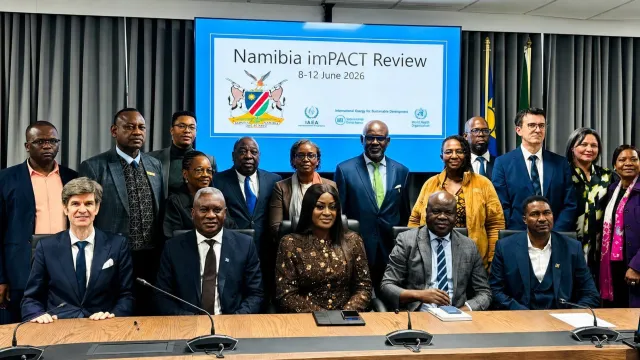
Namibia is confronting a nuclear-technology challenge that has nothing to do with electricity generation. A joint cancer-control review involving the International Atomic Energy Agency, the World Health Organization and the International Agency for Research on Cancer has identified a need to expand radiotherapy services, specialist personnel and national cancer-control infrastructure as the country’s disease burden rises.
The review is important because it exposes a recurring weakness in African nuclear policy discussions. Governments often associate “nuclear development” with power reactors, uranium and large infrastructure. Yet thousands of African patients already depend on nuclear and radiation technologies for cancer diagnosis and treatment, while many health systems lack enough machines, medical physicists, radiation oncologists, technologists and maintenance support to deliver those services consistently.
For Namibia, the challenge is especially visible. The country’s radiotherapy capacity is concentrated and limited, while cancer incidence is projected to increase substantially over the coming years. Expanding treatment therefore requires much more than purchasing additional equipment. It requires a national system capable of operating that equipment safely, maintaining it, staffing it and making treatment accessible outside the capital.
The workforce is as important as the machines
Radiotherapy is one of the most technically demanding areas of modern medicine. A treatment unit is useful only when supported by qualified radiation oncologists, medical physicists, radiation therapists, dosimetrists, engineers, radiation-protection specialists and quality-assurance systems. The IAEA-led assessment therefore places human-resource development alongside physical infrastructure.
That distinction matters for Africa because equipment donations or one-off procurement programmes can fail when maintenance contracts lapse, trained staff migrate, spare parts become difficult to obtain or quality-assurance programmes are weak. Nuclear medicine and radiotherapy require institutional continuity, not simply capital expenditure.
Namibia’s experience should therefore encourage governments to plan radiotherapy as a full service chain: cancer screening, diagnosis, imaging, treatment planning, radiation delivery, dosimetry, equipment maintenance, waste and source management, and long-term professional development.
Regional access cannot be an afterthought
Another central issue is geography. Concentrating sophisticated treatment in one city creates barriers for patients who must travel long distances, find accommodation and remain near a treatment centre for repeated sessions. The review’s emphasis on phased expansion and stronger regional access is therefore as much a social-policy question as a nuclear-technology question.
African countries with smaller populations may also need to think regionally. Specialist training, calibration laboratories, dosimetry services and equipment-maintenance expertise can be shared across borders where national demand is insufficient to sustain every capability independently.
Why This Matters for Africa
Namibia illustrates why Africa’s nuclear-development agenda should be measured not only in megawatts but also in health outcomes. A country can generate immediate development value from nuclear science through radiotherapy, diagnostic imaging, radiopharmaceuticals and laboratory applications long before a power reactor is built.
The policy lesson is straightforward: nuclear medicine needs the same seriousness applied to national power programmes. Governments should map demand, build specialist career pathways, fund maintenance, strengthen radiation regulation and integrate cancer services into long-term health financing. For many African citizens, this is where nuclear technology will have its most direct impact.
Related

Morocco Nuclear Regulator Says No Radioactive Leak at Maâmora Research Centre
By Nuclear Africa• October 7, 2026
Amazon’s 20-Year Nuclear Deal Shows How Large Corporate Buyers Can Help Finance Nuclear Investment
By Nuclear Africa• October 7, 2026Beyond the Resolutions: GC70 and the Emerging Global Nuclear Order
By Nuclear Africa• October 6, 2026
US Nuclear Regulator’s Workforce Warning Carries a Clear Lesson for African Nuclear Newcomers
By Nuclear Africa• October 5, 2026