As African countries advance plans for nuclear power, debates often focus on reactor technology, financing, localisation, and regulatory readiness. Far less attention is paid to a resource without which no conventional nuclear power plant can operate: water.
This week, Romania offered one of the clearest reminders yet that climate resilience is becoming a defining issue for the future of nuclear energy.
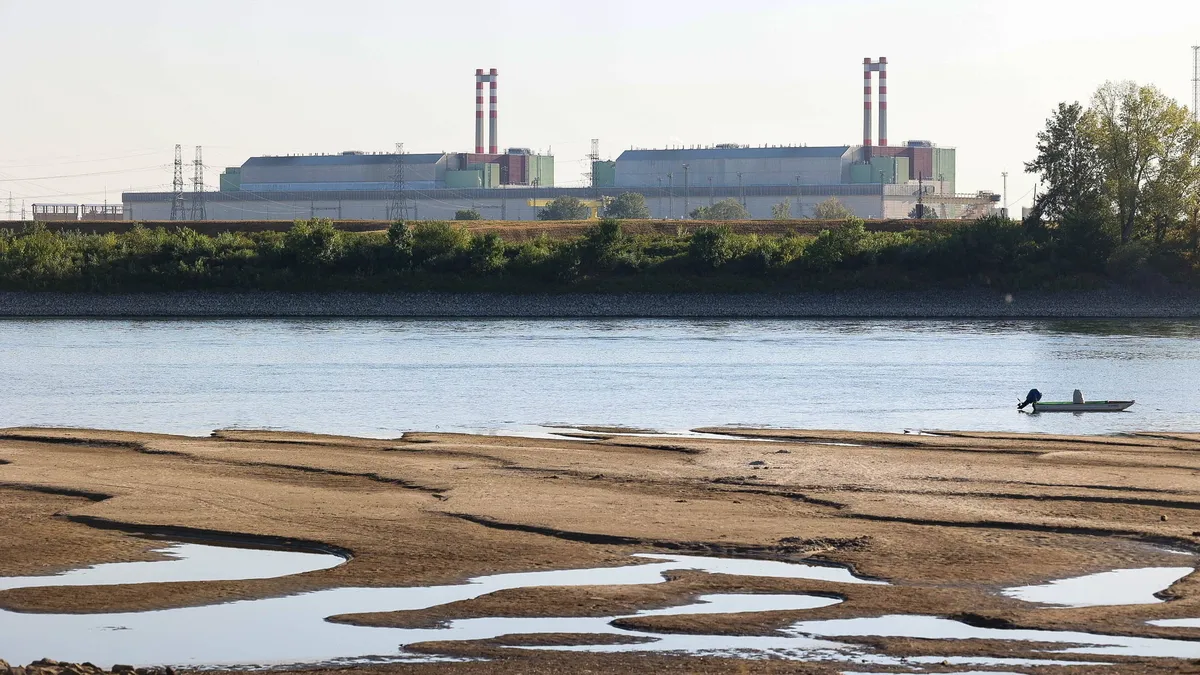
Authorities were forced to postpone an emergency engineering operation intended to redirect water from the Danube River towards the cooling-water intake of the Cernavodă Nuclear Power Plant, after river conditions made the intervention unsafe. The operation, which involves sinking four rock-filled barges to alter river flow, is part of an unprecedented effort to keep Romania’s last operating reactor online as prolonged drought pushes the Danube to historically low levels.
The situation has already forced one of Cernavodă’s two CANDU reactors offline, while officials warn that the remaining unit could also require shutdown if cooling-water availability continues to deteriorate. At the same time, the country is preparing contingency measures that include industrial electricity demand reductions should the crisis deepen.
The developments extend far beyond Romania.
They highlight a growing reality confronting nuclear operators around the world: climate change is becoming an infrastructure challenge as much as an environmental one.
For Africa’s emerging nuclear programmes, the lessons are immediate and profound.
When Water Becomes a Strategic Energy Resource
Every thermal power station—whether fuelled by coal, gas or uranium—must remove enormous quantities of heat generated during electricity production.
Although nuclear reactors do not consume river water in the way agriculture or municipalities do, they depend upon reliable cooling-water supplies to transfer heat safely and efficiently.
When river levels decline or intake temperatures become too high, operators may have to reduce reactor output or suspend generation to remain within environmental and operational limits.
This is precisely what Romania is experiencing.
Rather than indicating a failure of nuclear safety systems, the operational constraints demonstrate those systems functioning as intended.
Reactor operators are responding conservatively to changing environmental conditions long before safety margins are compromised.
That distinction is critical.
The current situation is not a nuclear accident.
No abnormal release of radioactivity has been reported, and there is no indication of damage to the reactors.
Instead, the challenge concerns maintaining sufficient cooling-water availability to continue electricity generation under licensed operating conditions.
Emergency Engineering on the Danube
Romania’s response illustrates the seriousness of the situation.
Authorities have already undertaken controlled underwater blasting to remove rock obstructions, dredged sections of the Danube and initiated emergency engineering works to increase water reaching the channel supplying Cernavodă.
The latest intervention—temporarily postponed because of unsafe river conditions—would create a diversion structure designed to improve water flow towards the plant’s intake.
Officials hope the measure could extend operation of the remaining reactor for several additional days, buying time while awaiting improved hydrological conditions.
Although temporary engineering solutions may reduce immediate operational pressures, they cannot eliminate the underlying challenge.
Long-term resilience depends upon hydrological conditions that are increasingly influenced by changing climate patterns.
The Nuclear-Hydropower Connection
Romania’s situation also illustrates another often-overlooked aspect of electricity planning.
Extreme drought rarely affects only one energy source.
The same low river flows limiting nuclear cooling are simultaneously reducing hydropower generation throughout the region.
At the same time, neighbouring countries experiencing similar climatic conditions may have less surplus electricity available for export.
This creates the possibility of multiple infrastructure systems being affected simultaneously.
For African countries where hydropower already represents a major component of national electricity supply, this interaction deserves particular attention.
Future droughts could reduce hydropower production while simultaneously constraining water availability for thermal power generation.
Planning each technology independently may therefore underestimate future system-wide risks.
Site Selection Is No Longer About Historical Records
Traditionally, nuclear site evaluations relied heavily on historical hydrological data.
River flows, flood frequencies, drought records and seasonal variations were analysed to determine whether sufficient cooling water would remain available throughout the plant’s operating life.
Climate change is altering those assumptions.
Historical averages may no longer represent future operating conditions.
Instead, site selection increasingly requires climate-adjusted modelling that considers:
- prolonged drought scenarios;
- increasing water temperatures;
- reduced river flows;
- competing municipal and agricultural demand;
- changing rainfall patterns;
- sedimentation;
- extreme weather variability; and
- long-term climate projections.
These considerations are becoming as important as geology, seismic safety and grid connectivity.
What This Means for African Nuclear Programmes
Several African countries are currently evaluating locations for future nuclear power plants.
Some proposed sites rely upon major rivers, while others are located along coastlines where seawater cooling may provide greater long-term resilience.
Romania’s experience demonstrates that future site evaluations should extend well beyond traditional engineering studies.
Governments should also examine:
- future climate projections;
- water-resource competition;
- reservoir management;
- alternative cooling technologies;
- emergency water-management capability;
- integrated basin planning; and
- long-term environmental sustainability.
These assessments should be incorporated from the earliest stages of programme development rather than being treated as secondary environmental considerations.
Cooling Technology Matters
Not all nuclear plants depend upon cooling water in the same way.
Once-through cooling systems withdraw large volumes of water before returning it to the environment.
Recirculating systems reduce overall withdrawals but consume more water through evaporation.
Hybrid and dry-cooling technologies can reduce dependence on river flows, although they may involve higher costs or reduced efficiency under certain operating conditions.
Technology selection should therefore reflect long-term climatic conditions rather than short-term construction costs alone.
African countries planning their first reactors should carefully evaluate how different cooling approaches perform under future drought scenarios.
Climate Resilience as Nuclear Policy
The Romanian case suggests that climate resilience should become an explicit component of national nuclear policy.
Future programmes may need to integrate:
- climate science;
- hydrology;
- environmental regulation;
- electricity planning;
- water governance; and
- infrastructure resilience
far more closely than has traditionally been the case.
Doing so will require cooperation not only between nuclear regulators and operators but also ministries responsible for water resources, agriculture, environment, transport and national planning.
Nuclear power cannot be considered in isolation from the wider systems upon which it depends.
Learning Before Building
One advantage available to African newcomer countries is the ability to learn from international experience before construction begins.
Unlike countries whose reactors were designed decades ago, Africa’s emerging programmes can incorporate contemporary climate knowledge into site selection, licensing and infrastructure planning from the outset.
This includes designing projects around future rather than historical environmental conditions.
Doing so may increase upfront planning costs but could significantly improve long-term operational resilience.
Why This Matters for Africa
Romania’s cooling-water emergency is not evidence that nuclear power is becoming unsafe.
Rather, it demonstrates that climate resilience is becoming central to the design and operation of modern energy infrastructure.
For Africa, where many proposed nuclear sites depend on rivers, reservoirs or climate-sensitive coastal environments, incorporating future hydrological conditions into planning may prove just as important as selecting the right reactor technology.
Countries that integrate climate resilience into nuclear policy from the beginning are likely to develop more robust, adaptable and sustainable nuclear programmes than those relying solely on historical environmental data.
Related

Poland Begins Preparing Its First Nuclear Power Plant Site: Lessons for Africa’s Construction Readiness
By Nuclear Africa• August 6, 2026
Westinghouse Files for US IPO as Nuclear Vendors Return to Public Markets
By Nuclear Africa• August 5, 2026
Uranium Market Strengthens as Kazatomprom Raises Output and Cameco Maintains Guidance
By Nuclear Africa• August 5, 2026
Finland Reaches Historic Spent-Fuel Repository Milestone—but Disposal Has Not Started
By Nuclear Africa• August 5, 2026