Finland has crossed a historic nuclear-waste milestone after its Radiation and Nuclear Safety Authority concluded that Posiva’s spent-fuel encapsulation and final-disposal facility meets the safety requirements needed for an operating licence.
STUK issued its formal statement to the Ministry of Economic Affairs and Employment on 4 August 2026. The regulator concluded that Posiva’s facility at Olkiluoto satisfies the relevant requirements of Finland’s Nuclear Energy Act and Decree and that there is no radiation- or nuclear-safety obstacle to granting the requested operating licence.
It is the first time that a geological disposal facility for spent nuclear fuel has reached the operating-licence phase. If the remaining approvals and commissioning activities are completed, the ONKALO facility is expected to become the world’s first industrial-scale deep geological repository to begin disposing of spent reactor fuel.
The development strengthens Finland’s position as the most advanced country in implementing a permanent disposal solution for high-level nuclear waste.
But the distinction between regulatory assessment, government licensing and operational commencement remains important.
STUK has provided a favourable safety assessment.
It has not issued the final operating licence, and Posiva has not yet begun disposing of spent fuel.
A Major Step, Not the Final Licence
The Finnish government is responsible for deciding whether to grant the operating licence, following preparation by the Ministry of Economic Affairs and Employment.
STUK’s favourable statement is a legal prerequisite for that decision. The ministry has indicated that a proposal could be prepared and submitted to the government during autumn 2026. Posiva has applied for a licence extending to the end of 2070.
Even if the government grants the licence, disposal operations cannot begin immediately.
STUK must first complete the inspection required under Section 20 of Finland’s Nuclear Energy Act and issue a separate decision confirming that the encapsulation plant and underground repository satisfy all conditions for safe operation. Commissioning and procedural tests are still partly under way.
The remaining sequence can therefore be understood as:
- STUK’s favourable safety assessment;
- preparation of the licence proposal by the ministry;
- the government’s operating-licence decision;
- completion of commissioning and procedural testing;
- STUK’s statutory pre-operational inspection;
- a separate STUK decision permitting operations to begin; and
- commencement of fuel encapsulation and underground emplacement.
These are separate regulatory and operational milestones.
Reporting that Finland has already opened or begun operating the repository would therefore be premature.
What STUK Concluded
STUK examined both the operational safety of the facility and its expected performance after the repository is eventually closed.
The regulator assessed the encapsulation plant, underground disposal system, radiation protection arrangements, organisational competence, waste-management provisions and the long-term safety case intended to demonstrate that radioactive material will remain isolated from people and the environment.
STUK concluded that the proposed operations meet Finland’s statutory safety requirements and that the post-closure system is safe for people and the environment as required under the Nuclear Energy Act. The authority said it had reviewed extensive technical information and safety analyses and had used more than 250 person-years of internal and external expert work in supervision and licensing assessments since 2000.
The positive conclusion does not mean that scientific and regulatory work has ended.
STUK has proposed operating-licence conditions requiring Posiva to continue developing and updating its safety assessments as operational experience becomes available.
How the Disposal System Works
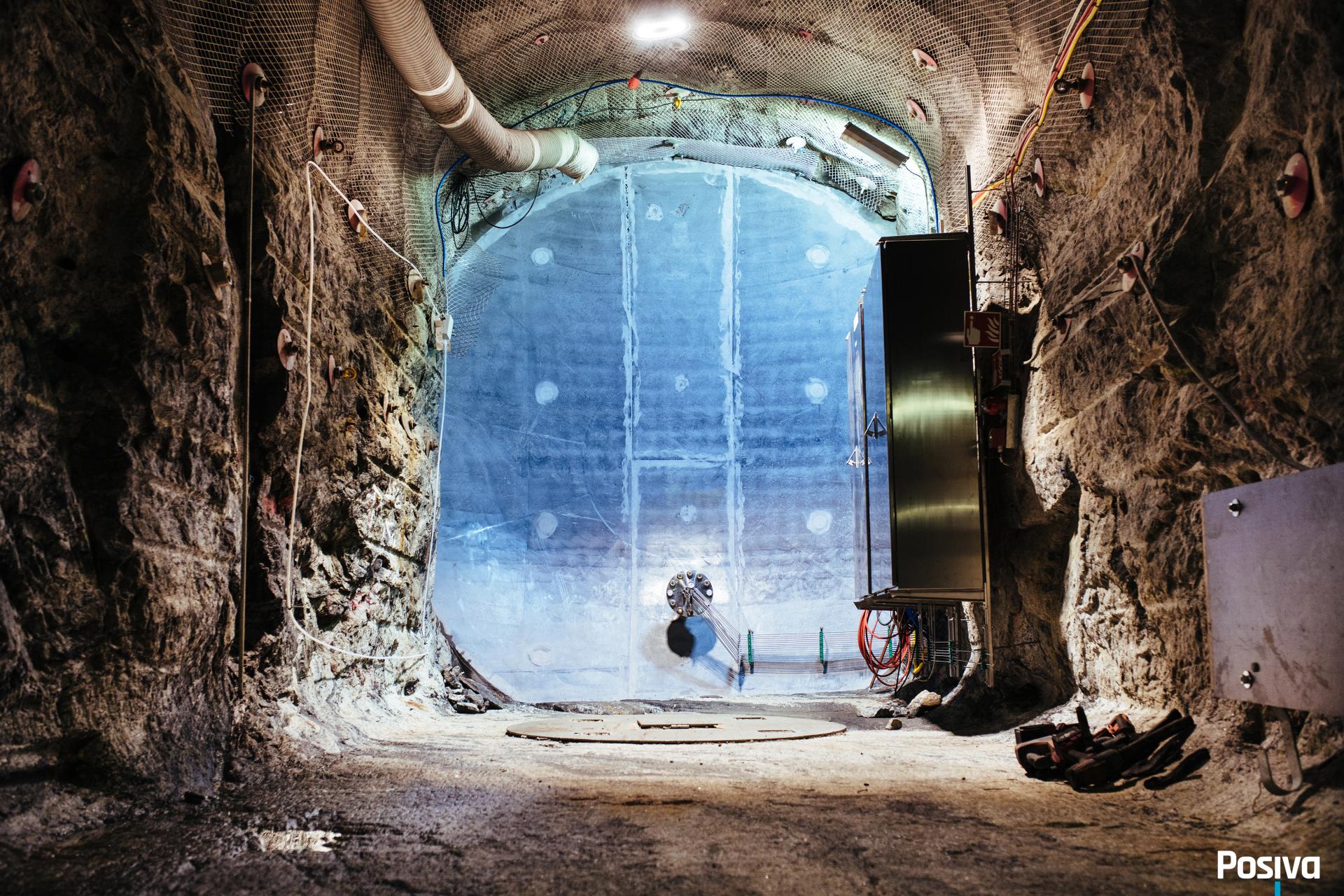
The ONKALO system combines an above-ground encapsulation plant with an underground repository excavated into crystalline bedrock.
Spent-fuel assemblies from Finland’s Olkiluoto and Loviisa nuclear power plants will be transferred to the encapsulation plant and sealed inside disposal canisters. The canisters will then be moved underground and placed in deposition locations approximately 400 to 450 metres below the surface.
The safety concept does not depend on a single material remaining perfect indefinitely.
It uses several complementary barriers:
- the physical form of the spent fuel;
- an iron and copper disposal canister;
- bentonite clay surrounding the canister;
- tunnel backfill and sealing systems; and
- the surrounding bedrock.
The canister is intended to contain the fuel. The bentonite is designed to restrict water movement, protect the canister and slow the movement of radioactive substances. The stable bedrock provides isolation from the surface environment.
The repository’s long-term safety case must consider processes that could occur over extremely long periods, including groundwater movement, corrosion, changes in bentonite performance, geological evolution and the eventual release and transport of radionuclides.
The IAEA notes that deep geological disposal programmes must demonstrate passive safety over timescales potentially extending to hundreds of thousands or even one million years.
Four Decades of Preparation
Finland’s progress did not begin with the construction of ONKALO.
In November 1983, the Finnish government approved an initial roadmap for disposing of spent nuclear fuel in the country’s bedrock. That decision established a long-term direction for research, site selection and implementation.
Posiva submitted its operating-licence application in December 2021, following decades of geological investigation, engineering development and regulatory review. Finland had previously granted the project a construction licence in November 2015, and construction of the encapsulation and disposal facilities began in 2016.
The programme has involved:
- development of a national waste-management policy;
- definition of responsibilities for waste producers;
- geological investigations and site characterisation;
- underground research;
- development of the disposal canister and bentonite system;
- establishment of an independent regulatory review process;
- construction and commissioning of specialised facilities;
- financial provision for long-term waste management; and
- formal opportunities for authorities, organisations and citizens to comment on the operating-licence application.
Finland’s Ministry of Economic Affairs and Employment organised a consultation process in 2022 as part of the licence review.
The timeline demonstrates that permanent spent-fuel management is a national programme extending across political administrations and generations—not an activity that can be improvised near the end of a reactor’s operating life.
The Safety Case Must Be Updated
One of the most important details in STUK’s assessment concerns the continued development of Posiva’s disposal design.
The long-term safety case submitted for licensing was based on a 2018 design freeze. Since then, elements of all the disposal barriers have continued to evolve. Posiva submitted additional assessments arguing that the changes did not invalidate the safety conclusions, and STUK accepted those analyses as sufficient for the present licensing decision.
However, STUK requires the complete post-closure safety case to be updated so that it corresponds to the final system that will actually be commissioned.
The regulator also identified areas requiring continued improvement, including:
- uncertainties relating to bentonite performance;
- definitions of safety functions and performance targets;
- scenario analysis;
- dose-assessment models;
- requirements management; and
- the traceability and verification of models and source data.
These findings do not overturn the regulator’s favourable conclusion.
They demonstrate that geological disposal is managed through continuing assessment rather than a single permanent declaration that all uncertainty has disappeared.
Earlier Safety Review Required
STUK has proposed that Posiva complete its first periodic safety assessment within ten years of receiving the operating licence.
That is earlier than the normal 15-year minimum discussed in the licensing documents.
The regulator justified the shorter period on the basis that ONKALO is a globally unique facility with no equivalent operational experience available elsewhere. Early operations will generate new information about the behaviour of the equipment, procedures, workforce, engineered barriers and underground disposal system.
The earlier review would allow STUK to evaluate:
- operational experience;
- departures from expected performance;
- design changes;
- the effectiveness of procedures;
- organisational development; and
- necessary improvements to the safety case.
This is an important regulatory lesson.
First-of-a-kind nuclear facilities require stronger learning and feedback arrangements precisely because previous operating experience is limited.
Financing Responsibility Was Established Early
Finland’s nuclear operators are legally responsible for managing the waste they produce and covering the associated costs.
Posiva is owned by the nuclear utilities Teollisuuden Voima and Fortum, whose reactors generate the spent fuel intended for disposal at ONKALO.
Financial contributions have been collected through Finland’s National Nuclear Waste Management Fund since 1988. The system is intended to ensure that money is available for waste management rather than leaving future governments and taxpayers to finance obligations created by current electricity production.
The principle is significant:
The generation benefiting from nuclear electricity should make financial provision for managing the waste it produces.
Funding arrangements must cover more than the initial construction of a repository. They must account for interim storage, transport, encapsulation, operation, monitoring, closure, decommissioning and long-term institutional responsibilities.
What African Nuclear Newcomers Must Learn
Finland’s progress carries an important message for African countries considering their first nuclear power plants.
Radioactive-waste management cannot be postponed until after a reactor has been procured or constructed.
The IAEA Milestones Approach includes the nuclear fuel cycle and radioactive-waste management among the 19 infrastructure issues that newcomer countries must address while developing a national nuclear programme. A national policy for spent fuel and radioactive waste is particularly important during the earliest stages, when technology and contractual options remain open.
African newcomer programmes should address at least seven questions before committing to reactor construction.
1. Who owns and controls the spent fuel?
National legislation and reactor contracts must define whether spent fuel remains the property of the operator, becomes the responsibility of a national waste organisation or may be returned to the original supplier.
Responsibility must remain clear even if the owner-operator is restructured, becomes insolvent or ceases to exist.
2. Where will spent fuel be stored initially?
A deep geological repository will not be available when a newcomer country’s first reactor begins operation.
The country will therefore need licensed interim storage, initially in reactor pools and potentially later in dry-storage systems.
The technical and financial transition between reactor storage, transport and eventual disposal must be planned from the beginning.
3. How will waste management be financed?
Electricity tariffs and project financing should include contributions to legally protected funds for spent-fuel management, radioactive-waste disposal and decommissioning.
These resources should not remain vulnerable to routine government spending pressures or the financial condition of the reactor operator.
4. Is a supplier take-back arrangement real?
Some vendor proposals may refer to fuel leasing, spent-fuel return or supplier-country disposal.
Such arrangements should never be assumed from diplomatic statements or non-binding cooperation agreements.
The host country must determine whether the arrangement is:
- legally binding;
- accepted under the supplier country’s laws;
- supported by a licensed destination facility;
- financially defined;
- valid for the complete reactor lifetime; and
- enforceable if political relations change.
Until these conditions are satisfied, the host country should plan on the basis that it may remain responsible for the spent fuel.
5. Which institution will manage the waste?
The reactor owner, regulator and waste-management organisation have different responsibilities.
The regulator must independently assess safety. The operator must manage the waste it generates. A specialised national organisation may eventually be required to develop storage or disposal facilities.
Creating these institutions after the reactor has begun operation would be too late.
6. How will communities participate?
Repository siting cannot be treated only as a geological or engineering exercise.
Communities require access to information, meaningful participation, independent technical advice and confidence that their concerns can influence decisions.
Public engagement should begin before a preferred site becomes politically or commercially irreversible.
7. Is a national repository the only option?
Countries with small nuclear programmes may find an independent national deep repository disproportionately expensive.
Regional or multinational disposal arrangements could potentially provide economies of scale, but they would require complex agreements covering sovereignty, liability, transport, safeguards, security, ownership and long-term institutional control.
Such options remain politically difficult and cannot be treated as guaranteed solutions.
Small Reactors Do Not Remove the Waste Question
SMRs and microreactors are sometimes marketed as reducing the complexity of nuclear infrastructure.
They may produce smaller quantities of spent fuel per unit, but they do not eliminate the need for safe storage, transport and disposal.
Some advanced reactors also use fuels that differ significantly from conventional light-water-reactor fuel. These may have different enrichment levels, physical forms, volumes, thermal characteristics and disposal requirements.
Countries must therefore assess the proposed reactor and its complete fuel cycle together.
A vendor’s claim that a reactor core can be removed and returned after several years of operation is not a national waste strategy unless the receiving country, transport arrangements, licensing basis and long-term financing are clearly established.
Finland Is a Model, Not a Template
African countries cannot simply reproduce ONKALO. Finland’s crystalline bedrock, established nuclear industry, regulatory institutions, financial system and relatively small number of reactor operators created particular conditions for the programme.
African countries will have different:
- geological environments;
- reactor technologies and fleet sizes;
- electricity markets;
- public institutions;
- financial capacity;
- population distributions;
- transport infrastructure; and
- regional political relationships.
Some may eventually choose geological disposal. Others may rely on extended interim storage while participating in regional research or future multinational arrangements.
The transferable lesson is not the exact Finnish canister or repository design.
It is the structure of the programme:
- define responsibility early;
- establish independent regulation;
- conduct long-term research;
- protect financial resources;
- engage affected communities;
- preserve records and expertise; and
- require the waste solution to develop alongside the reactor programme.
The Back End Must Precede the Front End
STUK’s favourable assessment brings Finland closer than any other country to the industrial-scale geological disposal of spent nuclear fuel.
The government must still decide on the operating licence. Posiva must complete commissioning, and STUK must separately confirm that the facility is ready to begin operations.
The milestone should therefore be celebrated accurately.
Finland has not yet started final disposal.
It has demonstrated that a country can move from a long-term policy commitment through research, siting, construction and regulatory assessment towards an implementable disposal system.
For African nuclear-newcomer countries, the central lesson is clear:
A credible nuclear programme cannot concentrate only on obtaining a reactor, fuel and financing for construction.
It must also determine—before construction begins—who will manage the spent fuel, how that responsibility will be financed and what institution will remain accountable long after the electricity has been consumed.
The back end of the nuclear fuel cycle is not a future problem.
It begins with the first decision to build.
Related


Africa Deepens Nuclear Safeguards Capacity as AFCONE Convene Hands-On Training in Nairobi
By Nuclear Africa• August 24, 2026
A 300 MW SMR Could Support More Than 12,500 Construction Jobs in Ghana: New Study Tests Nuclear’s Economic Case
By Nuclear Africa• August 24, 2026
Ghana Targets 1,000 MW of Nuclear Power by the Mid-2030s: What Must Happen Before Construction Can Begin?
By Nuclear Africa• August 24, 2026