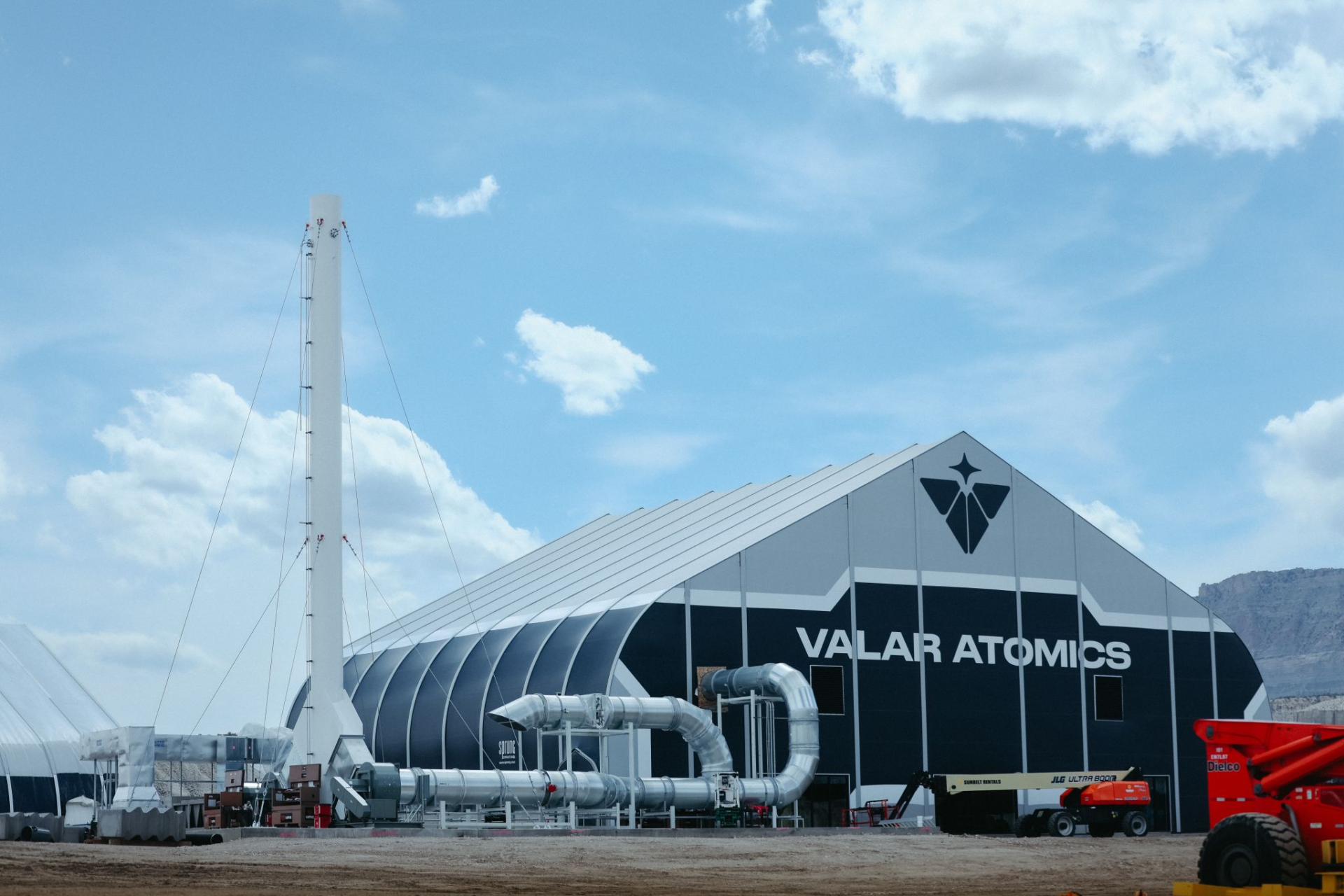
Valar Atomics has closed a US$1 billion Series B financing round led by Sequoia Capital, marking one of the largest private-capital commitments announced by an advanced nuclear and microreactor developer.
The California-based company also secured a separate US$200 million credit facility led by Erebor Bank, acting as administrative agent, and JPMorgan, with participation from Crescent Cove and Hercules Capital.
Sequoia partner Shaun Maguire will join the company’s board of directors. Other investors in the equity round included Apandion, Atreides Management, Conviction, Dream Ventures, HOF Capital, Point72, Riot Ventures, Snowpoint Ventures and Valor Equity Partners.
Valar said the financing would support its transition from experimental reactor development towards the manufacturing of standardised nuclear systems intended for artificial intelligence infrastructure, industrial facilities and national-security applications.
The company did not announce a valuation in its official statement. Independent reporting, however, placed Valar’s valuation following the financing at approximately US$6 billion.
The transaction demonstrates exceptionally strong investor interest in advanced nuclear energy. It does not, however, establish that Valar has achieved commercial reactor readiness.
From Demonstration to Manufacturing
Valar says its business model is based on applying manufacturing economics to nuclear energy through standardised designs, vertical integration and repeat production.
According to the company, the new capital will support reactor manufacturing, deployment capabilities, long-term operations and nuclear-fuel production. Valar ultimately envisages factories producing large numbers of compact reactor systems rather than delivering conventional nuclear projects individually.
The company argues that repeated manufacturing and operational feedback could progressively reduce reactor production times and costs.
That proposition remains to be demonstrated commercially.
Manufacturing multiple nuclear systems is fundamentally different from manufacturing conventional industrial equipment. Every reactor must satisfy demanding requirements related to nuclear safety, quality assurance, material traceability, fuel qualification, physical protection, cybersecurity, safeguards, transport, operator competence, emergency preparedness and radioactive-waste management.
The US Nuclear Regulatory Commission is still developing specialised approaches for the regulation of microreactors. Its work covers staffing, operations, inspections, security, safeguards, emergency preparedness, risk analysis, decommissioning, transport and siting—demonstrating the range of issues that must be resolved before widespread deployment can occur.
Financing Is Not Commercial Deployment
The scale of the Series B transaction is significant, but corporate financing should not be confused with reactor licensing or commercial performance.
A US$1 billion equity investment is not the same as:
- regulatory approval of a standard reactor design;
- authorisation to construct and operate a commercial nuclear power plant;
- a binding customer order;
- a completed first-of-a-kind commercial project;
- a demonstrated reactor supply chain;
- sustained electricity generation under commercial conditions; or
- independently verified lifetime economics.
Investment decisions are based partly on expectations about a company’s future value. Nuclear licensing decisions, by contrast, must be based on evidence that a proposed facility can meet established requirements throughout construction, operation and decommissioning.
Commercial readiness will therefore depend on more than Valar’s ability to attract capital.
The company must demonstrate that its reactor systems can be licensed, manufactured consistently, fuelled reliably, transported safely, operated securely and maintained economically over their intended lifetimes.
What Ward 250 Has Demonstrated
Valar has nevertheless achieved notable experimental milestones.
On 18 June 2026, its Ward 250 reactor completed a zero-power fuelled criticality demonstration at the Utah San Rafael Energy Lab under the US Department of Energy’s Reactor Pilot Program.
The Department of Energy described Ward 250 as the first DOE-authorised reactor constructed outside a US national laboratory. It was also the second advanced reactor to achieve criticality through the pilot programme.
Achieving criticality means that a reactor has established and maintained a controlled, self-sustaining nuclear chain reaction.
A zero-power criticality experiment is an important reactor-physics and engineering milestone. It can validate core calculations, control-system performance and aspects of the reactor’s neutronic behaviour.
It does not demonstrate sustained commercial electricity production.
The DOE programme was established to accelerate research, testing and demonstration of advanced reactor concepts through the department’s authorisation process. The programme is intended to support an eventual pathway towards commercial licensing, but participation does not itself provide a commercial power-reactor licence.
Valar subsequently reported that Ward 250 generated electricity used during a demonstration involving an Nvidia Blackwell computing system. The company also announced cooperation with Nvidia concerning a proposed water-independent, 30-megawatt artificial-intelligence facility. These remain company-led demonstrations and development plans rather than evidence of an operating commercial reactor fleet.
The distinction matters.
An experimental reactor can provide valuable data without having completed the licensing, reliability, supply-chain and economic demonstrations necessary for repeat commercial deployment.
A Different Regulatory Pathway
Ward 250’s experimental activity was conducted under DOE authorisation rather than a conventional Nuclear Regulatory Commission commercial power-reactor licence.
The DOE Reactor Pilot Program uses the department’s authority to facilitate research and development involving selected advanced reactor concepts. The NRC separately regulates commercially owned nuclear power reactors and provides licensing pathways under federal nuclear regulations.
Moving from DOE-authorised experimentation to commercial deployment would therefore require additional regulatory work.
Among other matters, regulators would need to assess:
- the complete reactor design;
- safety analysis and accident behaviour;
- fuel performance and qualification;
- manufacturing quality assurance;
- instrumentation and control systems;
- operator requirements;
- security and safeguards arrangements;
- emergency planning;
- environmental impacts;
- decommissioning provisions; and
- the suitability of each proposed deployment model.
The regulatory challenge becomes more complex when companies propose factory production, transportable reactors, remote operation or fleets distributed across multiple locations.
A successful criticality experiment is therefore better understood as an important point on the development pathway—not the end of that pathway.
Fuel Remains a Strategic Challenge
Valar’s Ward system uses high-assay low-enriched uranium, or HALEU, incorporated into TRISO fuel.
HALEU contains a higher concentration of uranium-235 than the fuel used in most conventional commercial reactors. It can allow advanced reactors to operate with smaller cores, longer fuel cycles and different performance characteristics.
However, the availability of commercial HALEU remains a major constraint on the advanced reactor industry.
The US Department of Energy has acknowledged that limited HALEU availability represents a significant obstacle to advanced reactor development and deployment. The federal government has consequently created programmes to stimulate enrichment, deconversion, fuel fabrication and transport capabilities.
Transport also presents challenges. Existing packages and logistics arrangements were not necessarily designed for the volumes and physical forms that a large advanced reactor market could require.
Valar says it intends to build its own fuel capabilities alongside reactor manufacturing.
Vertical integration could reduce dependence on external suppliers. It would also require the company to develop and license sophisticated nuclear-fuel-cycle infrastructure involving enrichment products, fuel fabrication, material accountancy, safeguards, security, quality assurance and radioactive-material transport.
Producing reactor fuel is not simply another manufacturing activity. It is itself a heavily regulated nuclear undertaking.
Why Microreactors Interest Africa
Microreactors are frequently proposed for electricity systems that cannot easily accommodate conventional large reactors.
Potential applications include:
- remote mining operations;
- isolated industrial facilities;
- small electricity grids;
- remote communities;
- military and security installations;
- desalination;
- hydrogen and synthetic-fuel production; and
- data centres requiring reliable continuous power.
These applications could be relevant to African countries with extensive mining sectors, weak transmission infrastructure or communities located far from national grids.
Microreactors may also offer advantages where diesel fuel is expensive to transport or where industrial operations require reliable power and high-temperature heat.
The International Atomic Energy Agency has noted that microreactor concepts may be useful for remote locations and low-capacity electricity systems. However, their transportability, long refuelling intervals, sealed cores and potential for unattended operation introduce new safeguards and security considerations.
The US Government Accountability Office has similarly identified potential benefits from rapid and remote deployment while warning about limited fuel availability, security risks and waste-management requirements.
Microreactors should therefore not be treated as conventional generators that happen to use nuclear fuel.
They remain nuclear installations requiring competent national institutions and long-term lifecycle arrangements.
Questions African Governments Must Ask
Any future proposal to deploy microreactors in an African country should be assessed against the country’s complete nuclear infrastructure.
Governments should ask:
Who will own and operate the reactor?
A mining company or industrial customer may purchase the energy, but reactor operations must be conducted by an organisation possessing the necessary legal authority, technical competence, safety culture and financial capacity.
Who will regulate it?
The national regulator must be capable of independently assessing the reactor design, proposed site, operator, security arrangements and emergency plans. It should not depend exclusively on information supplied by the vendor.
How will the fuel be transported?
Fuel transport could involve ports, airports, public roads and border crossings. Each movement would require physical protection, regulatory approvals, emergency arrangements and coordination among multiple government agencies.
How will the reactor be secured?
Remote deployment does not eliminate security requirements. Isolated installations may create additional challenges involving response times, communications, surveillance, cybersecurity and access control.
Who will maintain emergency preparedness?
A smaller emergency planning zone does not mean that emergency arrangements are unnecessary. Roles, communications, medical capabilities, environmental monitoring and public information responsibilities must still be established.
Where will the spent fuel go?
A vendor may propose to remove the reactor core at the end of an operating cycle, but the legal and financial responsibility for spent fuel must be defined before deployment.
Remote sites may have limited capacity for spent-fuel storage and may require the transport of irradiated HALEU or other novel fuel forms to an interim facility.
Will the country remain dependent on foreign specialists?
A reactor designed for limited staffing may still require specialised support for maintenance, security, fuel handling, inspections, software, instrumentation and emergency response.
The host country must understand which capabilities will be developed locally and which will remain under foreign control.
Economics Must Be Independently Tested
Microreactor economics remain uncertain because no large commercial fleet has yet established standardised lifetime cost data.
Smaller reactors may reduce the amount of capital required for an individual unit. They may also lose some of the economies of scale available to larger nuclear plants.
Their commercial competitiveness will depend on:
- factory production costs;
- financing terms;
- fuel prices;
- capacity factors;
- staffing arrangements;
- security costs;
- maintenance requirements;
- transport expenses;
- spent-fuel management;
- decommissioning liabilities; and
- the number of units produced.
The appropriate comparison will also depend on the proposed application.
For an isolated mine, a microreactor should be compared with diesel generation, grid extension, renewable-energy systems, battery storage, gas generation and other firm-power options.
For a grid-connected project, it should be compared with the full range of available generation, transmission and demand-management alternatives.
The analysis must consider complete system costs and reliability requirements rather than comparing only the advertised cost of reactor-generated electricity.
A high corporate valuation does not establish that a reactor will be the least-cost option for a particular African country or industrial user.
Avoid Transferring First-of-a-Kind Risk
The financing available to Valar may allow the company to advance engineering, testing, manufacturing and fuel-development activities.
But African governments should be cautious about becoming early commercial deployment sites before the technology has accumulated substantial operating experience in its country of origin.
Newcomer countries generally have less regulatory experience, fewer specialised nuclear professionals and more limited emergency and technical-support infrastructure than established nuclear countries.
They should not be expected to absorb risks that remain unresolved in the vendor’s domestic market.
Before approving an imported microreactor, an African government should require evidence of:
- a complete and independently reviewed safety case;
- regulatory approval in a country with an experienced nuclear regulator;
- successful operation of a reference unit;
- qualified and dependable fuel supply;
- demonstrated manufacturing quality;
- credible lifetime cost estimates;
- binding spent-fuel and waste arrangements;
- adequate insurance and nuclear-liability coverage;
- enforceable decommissioning responsibilities; and
- access to operational data throughout the reactor’s lifetime.
Commercial pressure should not be allowed to weaken these requirements.
Investor Enthusiasm Must Not Replace Evidence
Valar Atomics’ US$1 billion Series B represents a major vote of confidence in the possibility that nuclear systems can be manufactured faster and deployed more widely.
It could provide the resources required to build engineering teams, establish factories, develop fuel capabilities and generate the operational data needed for future licensing.
The financing therefore matters.
But investor confidence is not regulatory approval. A valuation is not a safety assessment. Experimental criticality is not sustained commercial operation. A demonstration is not a mature fleet.
African governments assessing future microreactor proposals should rely on independently verified technical, regulatory and economic evidence—not the reputation of investors, the size of a financing round or the promotional claims of a reactor developer.
Private capital can accelerate technological development.
It cannot replace the evidence required for responsible nuclear deployment.
Related


Africa Deepens Nuclear Safeguards Capacity as AFCONE Convene Hands-On Training in Nairobi
By Nuclear Africa• August 24, 2026
A 300 MW SMR Could Support More Than 12,500 Construction Jobs in Ghana: New Study Tests Nuclear’s Economic Case
By Nuclear Africa• August 24, 2026
Ghana Targets 1,000 MW of Nuclear Power by the Mid-2030s: What Must Happen Before Construction Can Begin?
By Nuclear Africa• August 24, 2026