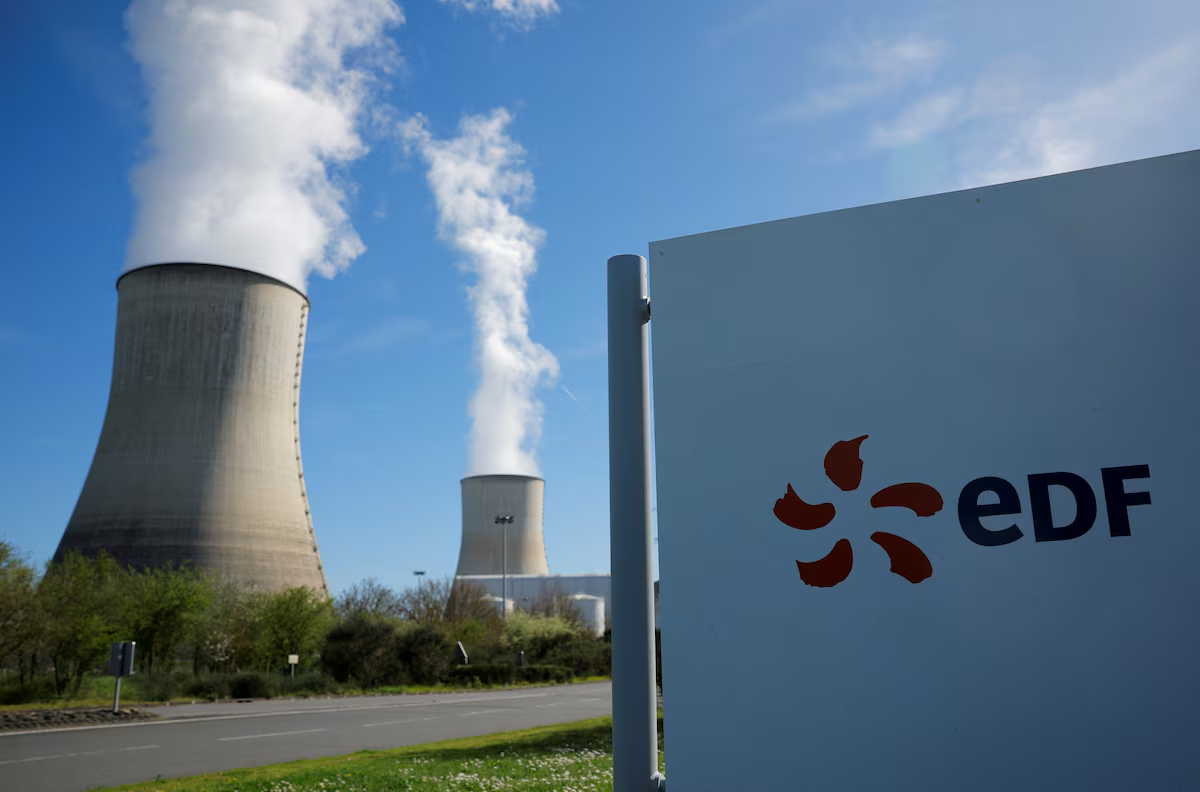
French utility EDF is seeking external investors for its redesigned NUWARD small modular reactor programme, highlighting the financial and commercial challenges that remain even for SMR developers backed by experienced state-owned nuclear companies.
EDF confirmed that it aims to bring investors into the NUWARD subsidiary by the end of 2026.
The proposed financing structure is intended to bring together prospective European customers and industrial partners to support the development of an initial reactor series tailored to their requirements. EDF has not disclosed the amount of capital it intends to raise or a proposed valuation for the subsidiary.
A Redesigned Reactor Programme
EDF abandoned NUWARD’s original design in 2024 after concluding that it would be too complex and costly to commercialise competitively.
The company subsequently repositioned the project around a simpler pressurised-water reactor using established technologies and components.
The revised design is expected to produce up to 400 MW of electricity as well as industrial heat.
NUWARD describes the reactor as a multi-energy platform that could support hydrogen production, district heating, industrial facilities and seawater desalination.
EDF has said it intends to finalise the conceptual design by the end of 2026 and has set a long-term ambition of placing 30 reactors in service by 2050. These remain development targets, not confirmed projects.
Why Investor Participation Matters
Advanced reactor development requires substantial expenditure before a developer earns revenue from a completed plant.
Money is needed for engineering, testing, safety analysis, licensing, manufacturing preparation, supply-chain qualification and first-of-a-kind construction.
Bringing prospective customers and industrial companies into the ownership or financing structure could give NUWARD additional capital while aligning the design more closely with buyer requirements.
It could also distribute the financial risk beyond EDF and the French state.
The strategy demonstrates that a credible reactor concept still needs a commercially sustainable development model.
The Promise and Reality of SMR Financing
SMRs are frequently presented as easier to finance than conventional large reactors because each unit requires less capital.
That proposition remains plausible, but it has not yet been demonstrated through repeated commercial deployment in Western markets.
The cost of an individual unit may be lower while the cost of developing, licensing and establishing factories for a new reactor design remains extremely high.
The expected economic advantages also depend on building multiple standardised units. A country ordering only one or two reactors may not receive the same benefits as a large fleet customer.
NUWARD’s redesign and search for investors therefore provide an important warning against assuming that every announced SMR is already commercially bankable.
Implications for African Newcomers
Several African countries are exploring SMRs because smaller units may be easier to integrate into relatively limited electricity grids.
SMRs may also support industrial heat, mining operations, desalination and phased capacity expansion.
But African buyers must examine the maturity of each design carefully.
Key questions include:
- Has the conceptual design been completed?
- Has the reactor entered formal licensing?
- Is a reference plant under construction?
- Who will finance first-of-a-kind deployment?
- Has the supply chain been qualified?
- What guarantees exist if the design changes?
- How many firm customer orders have been secured?
- Who carries cost-overrun and schedule risk?
- Is long-term fuel and technical support available?
An attractive computer rendering or memorandum of understanding does not answer these questions.
Technology Change and Procurement Risk
A reactor redesign can improve affordability and constructability.
It can also invalidate earlier assumptions about cost, schedule, licensing and localisation.
Countries engaging an SMR vendor must therefore ensure that agreements clearly define what happens if the design changes substantially before construction.
Governments should avoid committing public funds to site preparation or enabling infrastructure before they understand whether the vendor’s product will reach commercial maturity.
Independent technical advice is particularly important where newcomer countries have limited experience assessing advanced reactor claims.
African Applications Require Evidence
NUWARD has identified desalination and industrial heat as possible uses for its reactor.
These applications are relevant to Africa, particularly in water-stressed regions and energy-intensive industries.
But coupling a nuclear plant to desalination, hydrogen production or industrial facilities creates additional commercial and technical interfaces.
The buyer must assess heat demand, water markets, industrial creditworthiness, transmission requirements and the consequences of outages.
A multi-purpose reactor does not automatically create a viable multi-purpose project.
NuclearAfrica Perspective
EDF’s investor search should not be interpreted as evidence that NUWARD is failing.
External capital and customer participation are normal components of developing major infrastructure technology.
The more important lesson is that SMR development remains financially demanding and commercially uncertain.
African governments should not treat the smaller physical size of a reactor as proof of lower overall project risk.
The strength of the vendor, maturity of the design, reference-project experience and financing structure matter as much as reactor capacity.
Related


Africa Deepens Nuclear Safeguards Capacity as AFCONE Convene Hands-On Training in Nairobi
By Nuclear Africa• August 24, 2026
A 300 MW SMR Could Support More Than 12,500 Construction Jobs in Ghana: New Study Tests Nuclear’s Economic Case
By Nuclear Africa• August 24, 2026
Ghana Targets 1,000 MW of Nuclear Power by the Mid-2030s: What Must Happen Before Construction Can Begin?
By Nuclear Africa• August 24, 2026