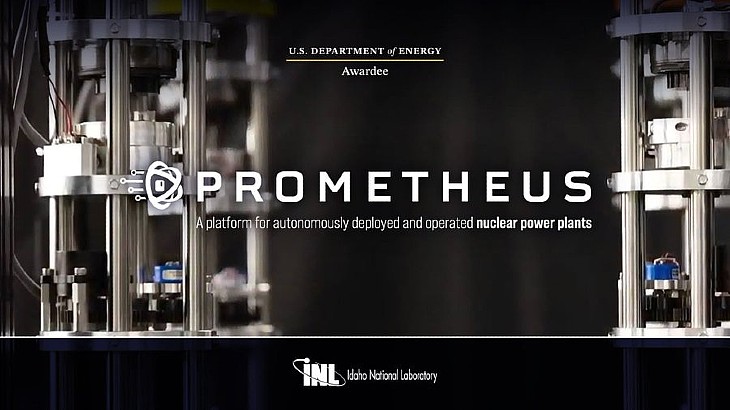
The US Department of Energy has selected an Idaho National Laboratory-led project for a proposed investment of $60 million over three years to apply artificial intelligence across the nuclear-energy lifecycle.
Known as Prometheus, the project will explore the use of AI in reactor design, licensing, manufacturing, construction and operation. It will also examine applications in nuclear-fuel fabrication and the management of extensive historical nuclear records. The award remains subject to congressional appropriations and final funding arrangements.
The initiative brings together 32 partners, including national laboratories, universities, technology companies and reactor developers.
Its central proposition is that AI-supported tools could reduce the time and cost required to deploy nuclear systems while keeping qualified humans responsible for important decisions.
Why nuclear projects generate so much information
Nuclear projects produce exceptionally large volumes of technical and regulatory information.
A reactor programme may involve:
- design calculations;
- safety analyses;
- engineering drawings;
- material specifications;
- licensing submissions;
- operating procedures;
- inspection records;
- construction reports;
- environmental studies;
- maintenance histories;
- incident reports; and
- quality-assurance documentation.
Regulators and operators must determine whether information is complete, consistent, traceable and technically justified.
Reviewing these documents can take considerable time, particularly where information is poorly organised or repeated across different submissions.
AI systems could help classify records, identify inconsistencies, retrieve relevant historical evidence and support technical analysis.
Planned applications
According to Idaho National Laboratory, Prometheus will apply AI to several stages of the nuclear lifecycle while using human-in-the-loop workflows.
Potential applications include:
Reactor design
AI could help engineers explore large numbers of design options, identify promising configurations and optimise components against safety, performance and cost requirements.
Licensing
Systems could organise regulatory submissions, compare requirements with supporting evidence and identify missing or inconsistent information.
Manufacturing and construction
AI could support quality inspections, schedule analysis, supply-chain tracking and detection of construction deviations.
Fuel fabrication
Machine-learning systems could analyse production data, improve process control and identify conditions associated with defects.
Operations and maintenance
AI could support equipment monitoring, predictive maintenance, anomaly detection and operator decision-making.
Historical-document management
Decades of nuclear experience are stored in reports, scanned records and specialised databases. AI could make this knowledge easier to search and use.
AI should support—not replace—judgement
The nuclear sector cannot rely on AI outputs without qualified human review.
AI models may produce incorrect conclusions, omit relevant information or present uncertain results with unwarranted confidence.
Their performance depends on the quality, representativeness and security of the data used to develop them.
Human oversight is particularly important for:
- safety decisions;
- licensing findings;
- inspection conclusions;
- emergency actions;
- security assessments;
- safeguards determinations; and
- authorisation of reactor operation.
A regulator must remain able to explain and defend its decisions based on law, evidence and technical judgement.
“An AI system recommended it” cannot become an acceptable regulatory justification.
Why this matters to Africa
African nuclear-newcomer countries face shortages of specialised personnel and institutional experience.
AI-supported tools could help national organisations manage complex programmes by:
- organising legal and technical documents;
- comparing vendor submissions with regulatory requirements;
- preserving institutional knowledge;
- supporting training;
- analysing project schedules;
- identifying infrastructure gaps;
- translating technical information into accessible formats; and
- strengthening records management.
These applications could be particularly useful where regulators and project organisations have limited staff.
However, AI cannot compensate for the absence of basic national capacity.
A country still needs competent engineers, scientists, lawyers, inspectors and decision-makers who understand both the technology and the limitations of the software.
Applications for African regulators
Regulators could use carefully governed AI systems to support:
- document triage;
- regulatory-requirement mapping;
- inspection planning;
- operating-experience searches;
- identification of recurring compliance issues;
- preparation of non-sensitive public information; and
- training exercises.
These tools could reduce administrative workloads and allow specialists to concentrate on higher-value technical assessments.
Regulators should not allow reactor vendors to control the AI systems used to evaluate their own licence applications.
Independent tools, transparent methods and access to underlying evidence will be necessary to prevent conflicts of interest.
Data-quality problems
AI is only as reliable as the data and assumptions supporting it.
African nuclear programmes may face difficulties such as:
- incomplete historical records;
- inconsistent document formats;
- limited digitalisation;
- unreliable infrastructure data;
- outdated legal documents;
- missing operating experience;
- poor cybersecurity; and
- dependence on proprietary vendor information.
Using weak data could produce misleading recommendations.
Governments should therefore prioritise data governance, document control and digital infrastructure before adopting sophisticated AI systems.
Cybersecurity and sensitive information
Nuclear organisations hold sensitive information concerning facility design, physical protection, nuclear-material locations and security vulnerabilities.
Uploading such material to uncontrolled public AI services could create serious security and confidentiality risks.
National policies should define:
- which data may be used;
- where systems and data are hosted;
- who may access them;
- how information is encrypted;
- whether foreign service providers can retain data;
- how model outputs are recorded;
- how cyber incidents are reported; and
- which information must never enter an AI system.
The convenience of a digital tool must not override nuclear-security obligations.
Explainability and accountability
A regulator or operator must understand how an AI-supported conclusion was reached.
Some advanced models function as “black boxes”, making it difficult to explain which factors determined the output.
This can be problematic when a decision affects public safety, licensing or enforcement.
AI systems used in the nuclear sector should provide traceable evidence, identify uncertainty and allow independent review.
Responsibility must remain with a named institution and qualified officials.
The use of automation should not create a gap in legal accountability.
Bias and technological dependence
Most advanced nuclear datasets and software are developed in countries with long-established nuclear programmes.
African infrastructure, workforce, climate and regulatory conditions may differ.
An AI system trained mainly on North American or European projects could make assumptions that do not fit African contexts.
Countries should validate models against local conditions before relying on their results.
They should also avoid becoming completely dependent on proprietary foreign systems that cannot be audited or maintained domestically.
Building African capability
African participation in nuclear AI should extend beyond purchasing software.
Universities, regulators and nuclear institutions can develop expertise in:
- data science;
- reactor simulation;
- model validation;
- cybersecurity;
- digital safeguards;
- predictive maintenance;
- explainable AI; and
- technology governance.
Regional cooperation could support shared training and research facilities.
Existing organisations such as the African Commission on Nuclear Energy, African Regional Cooperative Agreement networks and regional regulatory forums could help coordinate capacity-building.
Possible safeguards applications
AI may support nuclear safeguards by analysing surveillance information, material-accountancy records and patterns that require further investigation.
It could help inspectors identify anomalies across large datasets.
However, safeguards conclusions have diplomatic and national-security implications.
AI-generated indicators should therefore be treated as analytical inputs, not automatic evidence of non-compliance.
Human inspectors must evaluate context, verify information and apply agreed legal standards.
The need for an African governance framework
African countries introducing AI into nuclear programmes should establish clear policies covering:
- approved uses;
- data classification;
- human oversight;
- validation and testing;
- audit trails;
- cybersecurity;
- procurement;
- conflicts of interest;
- vendor access;
- model updates; and
- accountability when errors occur.
These rules should be adopted before AI tools become embedded in critical workflows.
Conclusion
The Prometheus initiative reflects growing confidence that artificial intelligence can help nuclear organisations manage complexity, preserve knowledge and improve project delivery.
The proposed $60 million award could accelerate the development of tools spanning design, licensing, fuel manufacturing and operation. Final funding, however, remains subject to appropriations and negotiations.
For Africa, AI presents a genuine opportunity—but not a shortcut around institution-building.
Used carefully, it could strengthen regulators, support workforce development and improve project management.
Used without strong governance, it could introduce opaque decisions, cybersecurity vulnerabilities and new forms of dependence.
The appropriate objective is therefore not autonomous nuclear regulation. It is better-informed human regulation supported by secure, validated and accountable digital tools.
Related


Africa Deepens Nuclear Safeguards Capacity as AFCONE Convene Hands-On Training in Nairobi
By Nuclear Africa• August 24, 2026
A 300 MW SMR Could Support More Than 12,500 Construction Jobs in Ghana: New Study Tests Nuclear’s Economic Case
By Nuclear Africa• August 24, 2026
Ghana Targets 1,000 MW of Nuclear Power by the Mid-2030s: What Must Happen Before Construction Can Begin?
By Nuclear Africa• August 24, 2026