
The Port of Long Beach in California is positioning itself as a development centre for maritime nuclear technology as US authorities explore how small modular reactors could be used in ports, commercial vessels and floating power systems.
The port has signed a memorandum of understanding with the US Maritime Administration to cooperate on the development of safety, inspection and operating arrangements for nuclear applications in the maritime sector. The initiative is expected to involve the US Coast Guard, Department of Energy, Nuclear Regulatory Commission and other relevant authorities.
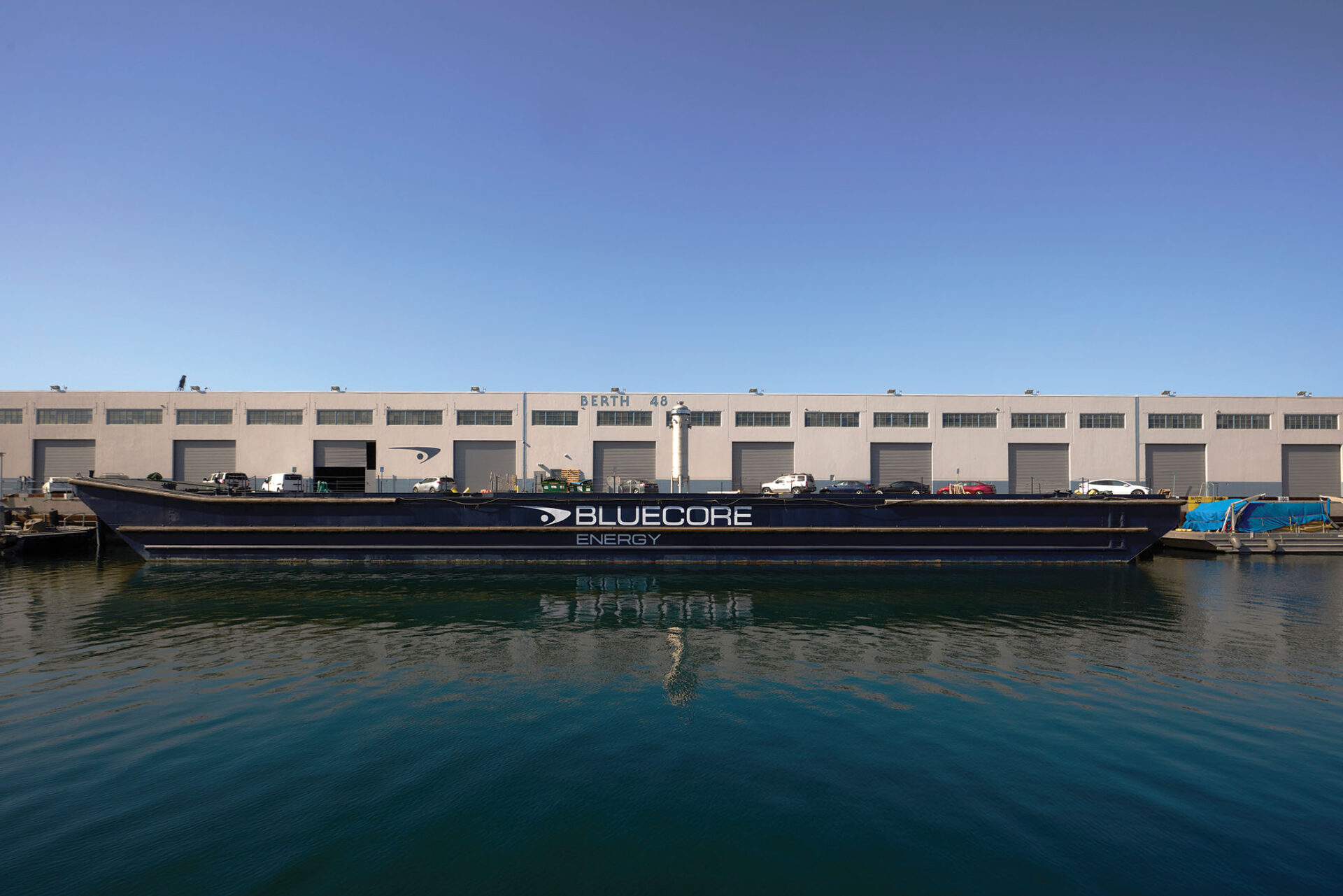
The development coincides with Bluecore Energy establishing a research and development presence at the port. Public planning documents show that the company has been granted access to warehouse, paved and submerged land for assembling and testing non-nuclear prototype maritime-reactor modules and mooring a barge.
The current work does not involve an operating nuclear reactor at the port. It centres on engineering development, prototype assembly and the creation of regulatory and operational frameworks that could support future maritime nuclear deployment.
What Bluecore is developing
Bluecore Energy is developing a concept in which compact nuclear reactors would be installed on barges or incorporated into maritime applications.
The company describes its objective as providing portable nuclear energy that could support ports, coastal infrastructure, utilities and other electricity users. Its public materials emphasise floating nuclear power and the integration of nuclear engineering with maritime and advanced-manufacturing expertise.
The Port of Long Beach facility is intended to support the construction and testing of non-hazardous steel prototype modules. These structures will allow engineers to test sensors, monitoring equipment, controls and other non-nuclear systems before any future installation involving nuclear fuel.
This distinction is important. Bluecore has established a technology-development base, but it has not yet deployed an operating maritime reactor.
The company will still need to complete reactor design, safety analysis, licensing, fuel arrangements, safeguards planning, security assessments, environmental reviews and extensive testing before commercial deployment could occur.
Why ports are considering nuclear energy
Modern ports consume large quantities of electricity.
Power is needed for container cranes, refrigeration, warehouses, data systems, cargo-handling equipment, ship repair, rail connections, hydrogen production and the electrification of trucks and other vehicles.
Ports are also under pressure to reduce emissions from ships and cargo operations.
A compact reactor located onshore or on a barge could theoretically supply continuous low-carbon electricity without requiring a large area of port land. A floating system might also be manufactured at a central facility and moved between locations.
Potential applications include:
- port electricity and shore power;
- coastal industrial facilities;
- desalination;
- hydrogen and synthetic-fuel production;
- remote communities;
- mining operations;
- data centres; and
- propulsion for commercial vessels.
These potential benefits remain subject to technical, regulatory and economic demonstration.
Maritime nuclear power is not entirely new
Nuclear propulsion has been used for decades in naval vessels, and Russia operates a floating nuclear power plant.
Commercial maritime applications, however, remain limited. The licensing and operating arrangements developed for military vessels cannot simply be transferred to civilian ports and commercial shipping.
Commercial systems would need rules covering:
- reactor design and construction;
- vessel classification;
- port entry and inspection;
- operator competence;
- safeguards;
- physical protection;
- emergency preparedness;
- nuclear liability;
- fuel supply;
- spent-fuel management;
- decommissioning; and
- movement between national jurisdictions.
The Port of Long Beach initiative is therefore significant because it attempts to bring port, maritime and nuclear authorities together before commercial deployment begins.
Why the development matters to Africa
Africa has more than 30,000 kilometres of coastline and depends heavily on maritime trade.
Major ports such as Durban, Mombasa, Tema, Lagos, Abidjan, Tanger Med, Alexandria and Djibouti support national and regional economies. Many face growing electricity demand, grid congestion and pressure to improve the environmental performance of cargo operations.
Floating or port-based reactors could eventually be proposed as an option for:
- coastal industrial zones;
- port electrification;
- island states;
- remote mining and processing facilities;
- desalination plants;
- regional electricity systems; and
- areas where large land-based projects are difficult.
The technology could also allow reactor systems to be assembled internationally and delivered to a host country by sea.
That convenience would not eliminate the host country’s responsibilities.
An African state receiving a floating reactor would still need a competent nuclear regulator, appropriate legislation, emergency arrangements, environmental monitoring, security capabilities and trained personnel.
The jurisdiction challenge
A floating nuclear plant would sit at the intersection of nuclear law and maritime law.
Governments would have to determine:
- whether the reactor is regulated as a nuclear installation, vessel or both;
- which regulator has authority while it is at sea;
- which authority is responsible when it enters a port;
- whether the flag state or host state carries safeguards responsibility;
- which courts have jurisdiction following an incident;
- how liability is allocated among the owner, operator, vessel manager and host utility;
- how nuclear fuel crosses territorial waters; and
- whether neighbouring or transit states may object.
These issues become more complicated when the reactor, owner, operator, fuel supplier and electricity customer are located in different countries.
African governments should therefore avoid treating floating reactors as simple leased electricity generators.
Security and safeguards
A maritime reactor would contain nuclear material and could move between locations.
This creates distinct safeguards and security considerations.
International safeguards arrangements would need to ensure continuous knowledge of the nuclear material and verify that it is not diverted from peaceful use.
Security arrangements would need to protect the reactor against theft, sabotage, cyberattack and unauthorised access while in operation, during maintenance and in transit.
Ports are already complex environments involving ships, cargo operators, contractors, customs services, security agencies and large numbers of workers. Integrating a nuclear installation into such an environment would require careful access control and coordination.
Security measures would also need to avoid unnecessarily obstructing normal commercial port operations.
Nuclear liability
Liability may become one of the most difficult policy issues.
A nuclear incident involving a floating reactor could affect the host port, nearby communities, shipping companies, fisheries, coastal ecosystems and neighbouring states.
Before deployment, contracts and legislation would need to establish:
- who is legally considered the nuclear operator;
- what financial security must be maintained;
- which state has jurisdiction;
- how cross-border claims are handled;
- whether the reactor supplier retains responsibility;
- whether maritime conventions apply alongside nuclear-liability conventions; and
- what happens if damages exceed the operator’s insurance.
These issues should be addressed before a host country signs a procurement, lease or power-purchase agreement.
The business case must be demonstrated
Floating reactors are often presented as a way to reduce construction risk by shifting manufacturing from the project site to a controlled shipyard or factory.
This could reduce some civil-engineering work and permit repeated production of standardised units.
However, the final cost will depend on:
- reactor manufacturing;
- specialised barges or vessels;
- port modifications;
- security;
- fuel;
- financing;
- licensing;
- insurance;
- operations and maintenance;
- spent-fuel arrangements; and
- decommissioning.
Countries must compare these costs with grid extensions, conventional nuclear plants, renewable energy, energy storage, gas generation and regional electricity trade.
A movable reactor could also raise questions for lenders, since the generating asset might theoretically be removed from the host country.
Lessons for African regulators
The Long Beach initiative offers several early lessons.
First, maritime nuclear regulation requires cooperation between nuclear, maritime, environmental, security and port authorities.
Second, regulatory preparation should begin before a developer submits a final reactor application.
Third, non-nuclear prototypes and test facilities can help developers validate equipment without introducing radioactive material.
Fourth, host countries must retain enough technical knowledge to assess vendor claims independently.
Finally, accelerated innovation must not be confused with permission to bypass licensing or international obligations.
Conclusion
Bluecore Energy’s establishment at the Port of Long Beach and the port’s cooperation with the US Maritime Administration represent meaningful steps in the development of maritime nuclear technology.
They do not yet amount to the construction or approval of a commercial floating reactor.
The immediate work involves prototype development, institutional coordination and the creation of safety and operating frameworks for a technology that remains at an early stage.
For Africa, the development deserves close attention.
Floating reactors could eventually offer new energy options for ports, islands and coastal industries. They could also introduce complex questions involving sovereignty, security, safeguards, liability and long-term fuel management.
African countries should begin studying those questions before maritime reactor vendors arrive with commercial proposals.
Related

Amazon’s 20-Year Nuclear Deal Shows How Large Corporate Buyers Can Help Finance Nuclear Investment
By Nuclear Africa• October 5, 2026
US Nuclear Regulator’s Workforce Warning Carries a Clear Lesson for African Nuclear Newcomers
By Nuclear Africa• October 5, 2026
US-South Korea $120 Billion Nuclear Framework Shows the Scale of State-Backed Reactor Finance
By Nuclear Africa• October 5, 2026
Morocco Nuclear Regulator Says No Radioactive Leak at Maâmora Research Centre
By Nuclear Africa• October 5, 2026