Poland’s first nuclear power project has moved into a more visible phase of implementation after state-owned developer Polskie Elektrownie Jądrowe handed management of the Lubiatowo-Kopalino project site to Bechtel as major earthworks and construction-site preparation begin.
The transfer represents an important step in Poland’s effort to build its first commercial nuclear power station, planned around three Westinghouse AP1000 reactors on the Baltic coast in the Choczewo municipality of Pomerania. Bechtel says the project is now moving from years of planning, permitting and design into large-scale preparation of the physical site.
For Africa’s nuclear-newcomer countries, however, the significance of Poland’s latest milestone goes beyond European reactor construction.
It illustrates the often-overlooked transition between announcing a nuclear programme and actually becoming ready to construct one.
That transition involves far more than choosing a reactor vendor. It requires an effective project owner, regulatory approvals, land and site preparation, financing arrangements, engineering capability, contractor management, supporting infrastructure, domestic industrial participation and a workforce capable of sustaining activity on a major construction site for years.
Poland is now beginning to translate those elements into physical work on the ground.
Bechtel Takes Control of the Project Site
Bechtel formally announced on 7 August that it had assumed responsibility for managing the site of Poland’s first nuclear power plant.
The company will coordinate site preparation, contractors and construction activities as the project advances toward the main construction phase.
World Nuclear News reported that the handover coincides with the selection of Polish construction company Budimex as the principal contractor for the initial earthworks.
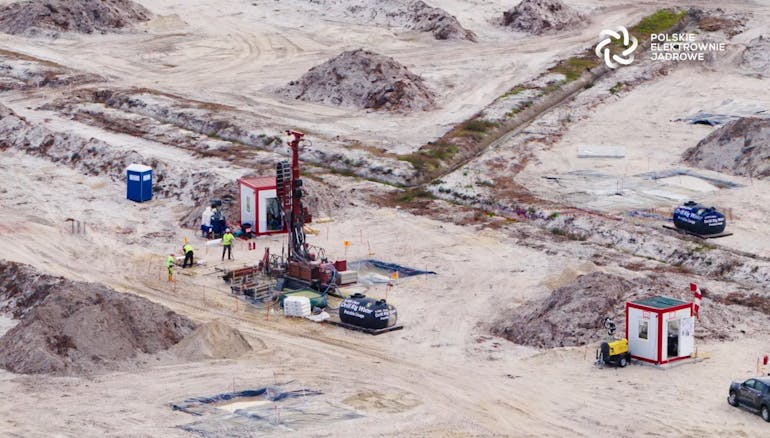
Those activities include levelling the site, reconstructing and expanding drainage systems, establishing approximately 16 kilometres of temporary roads and preparing areas for technical, production and logistical facilities.
Facilities planned as part of the preparation include storage yards, equipment-maintenance areas, material warehouses, fuel-handling areas and temporary office, staff and sanitary infrastructure.
The site itself covers more than 300 hectares.
More than 200 people are already reported to be working there, with the workforce expected to expand as preparation intensifies.
These may appear to be conventional civil-engineering activities rather than nuclear milestones.
That is exactly why they matter.
A nuclear project cannot begin serious reactor construction without first creating the physical environment capable of supporting thousands of workers, heavy components, specialised machinery, concrete production, security arrangements, drainage, transport and long-term construction logistics.
Earthworks Are Not Yet Nuclear Construction
The latest development requires careful terminology.
Poland has not yet reached first nuclear concrete.
Nor should the current work be described as the formal construction start of the AP1000 reactors themselves.
PEJ submitted its application for a construction permit to Poland’s National Atomic Energy Agency, PAA, on 31 March 2026. Regulatory review must progress before the project reaches the legally significant stage at which nuclear construction can begin.
PEJ currently expects first nuclear concrete for the first unit in the fourth quarter of 2028. Before then, the project also requires a building permit from the Pomeranian regional authority, with that application expected in 2027.
The distinction is important because nuclear projects move through a series of very different milestones:
site selection → environmental and regulatory approvals → early works → construction authorisation → first nuclear concrete → major component installation → fuel loading → first criticality → grid connection → commercial operation.
Collapsing these stages into a single statement that a country has “started building a nuclear plant” can give the public and policymakers an inaccurate picture of project maturity.
For African nuclear programmes, where political announcements can sometimes be interpreted as evidence of imminent construction, Poland provides a useful example of how carefully milestones should be communicated.
Poland Selected the AP1000 in 2022
The Polish government selected Westinghouse’s AP1000 technology in 2022 for the country’s first nuclear station.
The Lubiatowo-Kopalino project is planned to contain three AP1000 units, with Westinghouse providing the reactor technology and Bechtel playing the central engineering and project-delivery role.
PEJ is the state-owned company responsible for developing the project.
Westinghouse, Bechtel and PEJ subsequently began engineering work aimed at adapting the AP1000 design to the Polish site. More recent agreements have continued work on the nuclear island, turbine island, balance of plant and geological investigations while negotiations progress toward the eventual engineering, procurement and construction arrangements.
Poland’s current schedule envisages the first unit entering commercial operation around 2036, with subsequent units following in 2037 and 2038.
Those dates remain project targets rather than guarantees.
Large nuclear projects remain vulnerable to licensing delays, financing changes, supply-chain constraints, engineering challenges and construction overruns.
The Real Lesson Is Project Readiness
For African countries contemplating nuclear power, the temptation can be to treat technology selection as the decisive milestone.
A government announces that it prefers a particular reactor.
A vendor signs an agreement.
Political leaders announce an intended generating capacity and a target date.
But none of those developments alone creates a buildable project.
Poland’s experience demonstrates the extensive infrastructure that must exist between national policy and first nuclear concrete.
That includes a capable owner organisation able to supervise sophisticated international contractors.
It requires a regulator capable of assessing the safety case independently.
It requires detailed site data, environmental approvals and supporting infrastructure.
It requires procurement systems, engineering management and construction quality assurance.
And it requires financing capable of surviving a long development period before the first kilowatt-hour is sold.
The transition Poland is now making is therefore best understood as a move from programme readiness toward project readiness.
That distinction should matter greatly to Africa.
Why the Owner Organisation Matters
One particularly useful lesson concerns the role of the nuclear project owner.
PEJ is not simply a government department announcing policy.
It is a dedicated project company responsible for taking Poland’s first plant through development, contracting, licensing and implementation.
Bechtel’s assumption of responsibility for physical site coordination does not eliminate PEJ’s responsibility as the national project owner.
Instead, it illustrates a crucial principle of nuclear programme development: a country can rely extensively on international vendors and contractors, but it cannot outsource national ownership of the project.
The owner must retain enough technical and managerial capability to understand what contractors are doing, control interfaces between work packages, manage risk, protect national interests and maintain the project knowledge that will eventually support operation of the plant.
This is especially important for newcomer countries.
If practically all technical knowledge remains with the foreign vendor, the host country risks becoming dependent on external contractors not only during construction but throughout the facility’s operating life.
Building a competent owner organisation should therefore begin well before construction.
Localisation Begins Before the Reactor Arrives
The Polish project also provides a useful lesson about local content.
Budimex’s role in the current earthworks demonstrates that domestic participation does not need to wait for nuclear-grade reactor construction.
Local companies can enter the programme through conventional infrastructure long before they become qualified suppliers of safety-related nuclear equipment.
Early opportunities can include:
civil construction;
roads;
earthworks;
drainage;
accommodation;
warehousing;
transport;
security infrastructure;
surveying;
logistics;
non-safety electrical works;
and construction-support services.
That staged approach may be particularly relevant for African economies whose domestic industries do not initially possess nuclear certifications.
Trying to manufacture reactor-pressure-vessel components immediately may be unrealistic.
Building domestic capability through progressively more demanding work packages is often more practical.
Polish localisation efforts have also included engagement with universities, engineering institutions and domestic suppliers, reflecting an attempt to connect the first project with development of a longer-term national nuclear industry.
A Lesson for Ghana and Other Newcomers
Several African countries are working through nuclear infrastructure decisions at different levels of maturity.
Poland shows why progress should be measured using concrete implementation indicators rather than political declarations alone.
A newcomer preparing for construction should be able to demonstrate progress in areas such as:
site characterisation;
environmental licensing;
regulatory review;
owner-operator capability;
grid studies;
financing;
contracting strategy;
supply-chain assessment;
workforce development;
supporting infrastructure;
and local emergency arrangements.
Technology selection is one part of that picture.
It is not the picture itself.
A country may announce a preferred reactor vendor and still remain years away from a construction-ready project.
Conversely, progress in seemingly less dramatic areas such as geotechnical investigation, road construction, workforce accommodation and drainage may indicate that a programme is becoming materially more advanced.
Conventional Infrastructure Can Determine Nuclear Schedule
One of the most useful insights from Poland’s current phase is how much of nuclear-project delivery depends on infrastructure that is not itself nuclear.
A reactor may incorporate highly sophisticated nuclear-safety systems, but those systems cannot be installed if oversized components cannot reach the site.
Thousands of workers cannot be deployed without accommodation and transport.
Heavy construction cannot proceed without reliable roads, electricity, water and drainage.
Concrete production requires qualified materials and dependable supply chains.
Security arrangements must be integrated into the developing site.
The quality and schedule of these conventional activities can therefore determine the schedule of the nuclear project.
This is particularly relevant in locations where supporting infrastructure is limited.
For African newcomer states, nuclear site selection should consequently consider not only geology, seismicity and environmental characteristics but also the cost and complexity of developing the surrounding infrastructure required to support construction and decades of operation.
Procurement Must Become More Sophisticated
Nuclear projects also require governments to move beyond conventional public procurement approaches.
Major nuclear programmes include thousands of interfaces between engineering packages, construction contracts, equipment suppliers and regulatory requirements.
Delays in one contract can affect several others.
Quality assurance requirements may extend deep into the supply chain.
Changes in design can affect previously ordered equipment.
Long-lead components may need to be purchased years before installation.
The owner organisation therefore needs advanced programme-management capability.
Poland’s decision to place Bechtel in charge of coordinating the site reflects the importance of managing these interfaces systematically.
African countries evaluating nuclear projects should therefore regard project-management capability as part of national nuclear infrastructure, not merely as a service to be purchased after a reactor contract is signed.
Construction Readiness Is Different From Political Readiness
Governments can become politically ready for nuclear power relatively quickly.
A cabinet can approve a policy.
A parliament can endorse legislation.
A president can announce a capacity target.
A memorandum can be signed with a vendor.
Construction readiness develops much more slowly.
It requires institutions, engineering information, permits, financing and physical infrastructure to converge at the same time.
Poland’s latest milestone shows what that convergence begins to look like.
The project has a state owner.
It has selected technology.
Engineering work is advancing.
The construction-licence process is under way.
The site has entered large-scale preparation.
Domestic contractors are becoming involved.
And an international nuclear construction organisation has assumed responsibility for coordinating work on the physical site.
These developments do not guarantee that the project will meet every future schedule or budget target.
But they provide tangible evidence of implementation.
What This Means for Africa
African nuclear-newcomer states should resist measuring progress primarily by the number of international agreements they sign.
A more meaningful measure is whether national institutions are becoming capable of converting policy into a licensed, financed and constructible project.
Poland’s experience illustrates that this conversion requires thousands of decisions that rarely make headlines.
Who owns the land?
Who manages the site?
Which regulator authorises construction?
Which domestic companies can participate?
Where will the workers live?
How will major components reach the plant?
Who controls project interfaces?
What happens when a contractor falls behind?
How are engineering changes approved?
And who within the host country retains enough technical knowledge to challenge the foreign contractor when necessary?
These questions determine whether a nuclear programme is genuinely progressing.
For Africa, the lesson from Poland is therefore not simply that another country has moved closer to building nuclear power.
It is that construction readiness has to be deliberately built.
The reactor may ultimately be the most visible part of a nuclear programme.
But long before the reactor arrives, the project must already exist—in its institutions, licences, roads, contracts, engineering systems, workforce and national capability.
That is the point at which nuclear ambition begins to become nuclear infrastructure.
Five Suggested Excerpts
1. Poland’s first nuclear project is moving from years of planning into physical site preparation—but earthworks should not be confused with the formal start of nuclear construction.
2. For Africa’s nuclear newcomers, Poland demonstrates that technology selection is only one step between announcing a programme and creating a construction-ready project.
3. Nuclear localisation can begin long before reactor components arrive, with domestic firms participating in roads, earthworks, logistics, accommodation and other conventional infrastructure.
4. A country can rely on foreign vendors to build a reactor, but it cannot outsource national ownership of the nuclear programme.
5. Nuclear construction readiness is built through institutions, licences, infrastructure, financing, engineering capability and project management—not political announcements alone.
Recommended Categories
Nuclear Power
Reactor Projects
Nuclear Newcomer Programmes
Nuclear Infrastructure
Workforce & Localisation
Tags
Poland, PEJ, Bechtel, Westinghouse, AP1000, Lubiatowo-Kopalino, Nuclear Construction, Nuclear Newcomers, Nuclear Infrastructure, Local Content, Nuclear Supply Chain, Nuclear Workforce, Nuclear Project Management, Africa
SEO Meta Description
Poland has handed its first nuclear power plant site to Bechtel as major earthworks begin, offering important lessons for African nuclear newcomers on construction readiness, localisation and project delivery.
Related

Morocco Nuclear Regulator Says No Radioactive Leak at Maâmora Research Centre
By Nuclear Africa• October 7, 2026
Amazon’s 20-Year Nuclear Deal Shows How Large Corporate Buyers Can Help Finance Nuclear Investment
By Nuclear Africa• October 7, 2026Beyond the Resolutions: GC70 and the Emerging Global Nuclear Order
By Nuclear Africa• October 6, 2026
US Nuclear Regulator’s Workforce Warning Carries a Clear Lesson for African Nuclear Newcomers
By Nuclear Africa• October 5, 2026