India’s ambitious nuclear expansion is beginning to expose a challenge that every large nuclear programme eventually has to confront: building reactors is only one part of nuclear-energy security. The reactors must also be supplied with fuel for decades.
A parliamentary review of India’s nuclear expansion has warned that domestic uranium production could struggle to keep pace with the country’s planned reactor fleet, potentially increasing its long-term dependence on imported uranium unless new mines are developed faster and international supply arrangements are diversified.
The numbers underline the scale of the issue. According to India’s Committee on Public Undertakings, the planned expansion of the country’s indigenous pressurised heavy-water reactor fleet could require approximately 5,400 tonnes of U3O8 annually for around 25 GWe of capacity. Uranium Corporation of India Limited, or UCIL, currently estimates that domestic production could meet only about 30% of that requirement.
The committee has consequently called for faster uranium-mine development, greater diversification of foreign supplies, progress towards strategic uranium stockpiles and consideration of investments in overseas uranium assets.
For Africa, this is more than an Indian fuel-security story.
It is another indication that the next phase of global nuclear expansion could reshape the strategic value of African uranium resources, particularly as large nuclear programmes seek long-term diversity in their fuel supplies.
Reactor Expansion Creates Fuel Demand
India has one of the world’s most ambitious long-term nuclear programmes, with a national objective of reaching approximately 100 GWe of nuclear generating capacity by 2047.
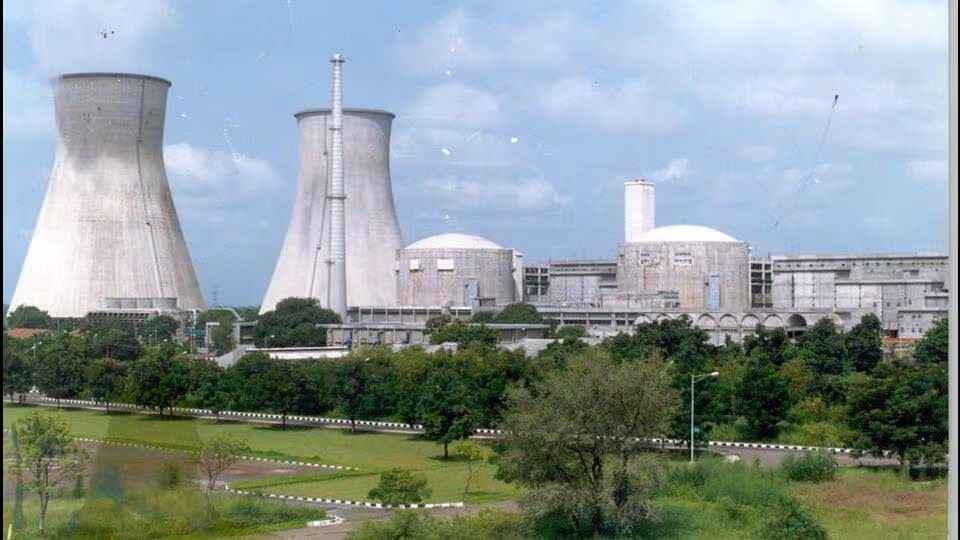
A large part of the country’s domestic reactor programme is built around pressurised heavy-water reactors, or PHWRs. Unlike most conventional light-water reactors, which use enriched uranium, India’s PHWR fleet operates using natural uranium fuel.
This places the uranium-mining and fuel-fabrication system directly alongside reactor construction as a strategic element of the expansion programme.
India has established a largely domestic PHWR fuel-manufacturing chain. Uranium concentrate supplied by UCIL or obtained through government-arranged imports is processed into reactor fuel by the Nuclear Fuel Complex for use in Nuclear Power Corporation of India Limited reactors.
But domestic fuel fabrication does not eliminate dependence on the upstream uranium resource.
The material still has to come from somewhere.
As the reactor fleet expands, uranium demand rises accordingly.
Parliament Sees a Timing Problem
The central concern identified by the parliamentary committee is not that India has suddenly run out of uranium.
It is a question of timing.
The Department of Atomic Energy has indicated that UCIL intends to substantially expand uranium production by 2036 through improvements to existing mines and development of additional projects in states including Jharkhand, Rajasthan and Chhattisgarh.
Indian Express reports that UCIL’s uranium-oxide production capacity is expected to rise from around 580 tonnes to 1,160 tonnes by 2036 once four additional mining and processing projects are commissioned.
The parliamentary committee welcomed that roadmap but warned that significant additions to India’s nuclear generating capacity are expected earlier.
If mining projects are delayed, the gap between domestic uranium production and reactor requirements could therefore persist for longer than planned.
This is an important distinction.
The committee is not reporting an immediate nuclear-fuel crisis. It is warning that a major nuclear expansion programme requires the fuel supply chain to expand at a similar pace.
Mining a Reactor’s Fuel Can Be Harder Than It Looks
India possesses substantial uranium resources, but turning geological resources into reliable annual production is a different matter.
According to the parliamentary review, the Atomic Minerals Directorate for Exploration and Research has established around 431,000 tonnes of in-situ uranium oxide resources, although only part of that resource base has been transferred to UCIL for development under the relevant mining framework.
Domestic mining faces several constraints.
The committee identified challenges including low ore grades, deep ore bodies, land acquisition, public opposition and the management of uranium tailings. Some Indian uranium deposits have ore grades of around 0.02–0.045%, creating additional processing and waste-management requirements compared with significantly higher-grade deposits elsewhere.
The case illustrates an important principle for uranium-producing countries.
Having uranium underground does not automatically create nuclear-fuel security.
Commercial supply requires exploration, mine development, environmental assessment, licensing, financing, processing facilities, radiation protection, waste and tailings management, transport infrastructure and community acceptance.
The resource is only the beginning.
India Is Looking Outside Its Borders
Recognising that domestic production alone may not be sufficient, India has developed a diversified uranium-import strategy.
The parliamentary committee noted supply relationships involving Kazakhstan, Russia, Uzbekistan and Canada, while India and Australia recently completed an administrative arrangement enabling Australian uranium exports for peaceful nuclear use under their longstanding bilateral nuclear cooperation framework.
The committee is also seeking clarity on a possible new long-term uranium arrangement with Uzbekistan after the present contract period and has encouraged the proposed creation of a joint venture between UCIL and Indian utility NTPC to acquire stakes in uranium assets overseas.
Such investments could allow India to move beyond conventional buyer-seller relationships and secure longer-term exposure to uranium production itself.
The committee has also supported the creation of strategic uranium inventories linked to reactor refuelling requirements as protection against future market or geopolitical disruptions.
Taken together, these measures point towards a more sophisticated definition of nuclear-energy security.
It is no longer enough to own reactors.
Countries increasingly want diversified fuel suppliers, strategic inventories and, in some cases, direct exposure to uranium resources.
Why Africa Enters the Picture
This is where the Indian development becomes particularly relevant to Africa.
The continent is already an important part of the global uranium industry. The IAEA estimated in May that African countries account for around 14% of global uranium production, identifying Namibia, Niger and South Africa among the continent’s important producers.
Namibia alone accounted for approximately 12% of global mine production in 2024, making it the world’s third-largest uranium-producing country after Kazakhstan and Canada.
Africa also possesses substantial identified uranium resources. World Nuclear Association data place significant resources in Namibia, Niger and South Africa, with additional identified resources in countries including Botswana and Tanzania.
Global nuclear expansion therefore creates an economic opportunity for the continent.
But the more important question is what Africa chooses to do with it.
Beyond Digging and Shipping Uranium
Historically, much of Africa’s participation in the nuclear fuel cycle has occurred at the mining stage.
Uranium is extracted, concentrated and exported, while much of the subsequent value chain—conversion, enrichment, fuel manufacturing and reactor use—takes place elsewhere.
Growing international demand could reinforce that model.
African countries could simply produce more uranium for expanding nuclear programmes in Asia, Europe and North America.
But it also creates an opportunity to reconsider how much economic value uranium-producing states capture from their resources.
That discussion requires realism.
Uranium conversion, enrichment and nuclear-fuel fabrication are not ordinary mineral-processing industries. They involve substantial capital investment, specialised engineering, sophisticated regulation, nuclear safeguards, physical protection and international non-proliferation considerations.
Not every uranium-producing country should attempt to establish the entire nuclear fuel cycle.
But greater value addition does not have to mean immediate uranium enrichment.
African countries can strengthen geological services, laboratory capability, uranium processing, transport infrastructure, radiation protection, environmental monitoring, mining technology, local procurement and specialist workforce development.
They can also seek stronger participation in long-term supply contracts and commercial arrangements as international demand increases.
Long-Term Contracts Could Become More Valuable
India’s parliamentary concern also illustrates why long-term uranium contracts matter.
Nuclear plants may operate for sixty years or longer.
The fuel requirement therefore extends far beyond the construction period.
A country planning a large fleet must evaluate not only whether uranium is available today, but whether reliable suppliers will remain available throughout decades of reactor operation.
For African uranium producers, that can create opportunities for long-duration commercial relationships rather than purely short-term commodity sales.
Such contracts could provide greater revenue predictability for producers and supply certainty for reactor operators.
But African governments would need to balance long-term commitments against market conditions and the possibility that uranium prices may change significantly as global nuclear demand develops.
The objective should be to capture value while preserving enough flexibility to benefit from future market conditions.
Uranium Security Is Also a Governance Issue
Expanding uranium production comes with responsibilities.
Uranium mining requires strong environmental and radiation-protection regulation, particularly in relation to workers, communities, tailings and contaminated water.
The geopolitical importance of uranium can also create pressure to accelerate projects, making independent oversight particularly important.
Africa’s opportunity in the global nuclear-fuel market should therefore not be measured only by tonnes produced.
It should also be measured by whether countries develop mining systems that are safe, environmentally credible and capable of generating durable benefits for host communities.
Recent debate around uranium and other radioactive materials associated with African mineral supply chains reinforces the importance of strong regulatory institutions.
A uranium boom without effective radiation protection, environmental governance and transparency would transfer too much of the long-term cost to producing communities.
A Lesson for Africa’s Nuclear Newcomers
The Indian case carries another lesson for African countries planning their own nuclear-power programmes.
Fuel planning should begin well before the first reactor starts operating.
A newcomer country selecting a reactor technology must understand what fuel that reactor requires, where it can be obtained, how many qualified suppliers exist, what international agreements are necessary, how fuel will be transported and safeguarded, and how supply disruptions will be managed.
The questions become even more important for advanced reactors and SMRs that may depend on less widely available fuel forms.
Nuclear procurement should therefore consider the complete chain: uranium supply → conversion → enrichment where required → fuel fabrication → transport → reactor operation → spent-fuel management.
Selecting a reactor without understanding the long-term fuel chain risks replacing one form of energy dependence with another.
Africa Could Become More Strategically Important
Global nuclear growth increasingly points towards higher uranium demand.
India is only one part of that trend.
China continues expanding its reactor fleet, several existing nuclear countries are considering new construction, and newcomer states are pursuing their first plants. World Nuclear Association projections indicate that substantial additional generating capacity could be developed globally through 2050 if national plans and policy targets materialise.
Not all announced projects will be built, and uranium demand will depend on reactor types, fuel efficiencies, inventories, secondary supplies and future fuel-cycle technologies.
But the strategic direction is clear enough for African policymakers to pay attention.
Africa possesses a resource required by a growing low-carbon energy industry.
The continent’s challenge is ensuring that this resource contributes to industrial development rather than becoming another commodity exported with limited domestic economic transformation.
What This Means for Africa
India’s uranium challenge demonstrates that nuclear energy security begins long before fuel enters a reactor.
Countries can finance power plants, build transmission lines and train operators, but a nuclear fleet ultimately depends on a secure chain of uranium, processing and fuel-manufacturing services.
For Africa’s uranium-producing states, that creates opportunity.
Namibia, Niger, South Africa and emerging uranium jurisdictions could become increasingly important as major nuclear countries seek more diverse and resilient fuel supplies. Africa’s existing contribution to global uranium production means the continent is already part of this strategic market rather than a future entrant.
But greater demand alone will not guarantee greater African benefit.
Governments will need to negotiate commercially strong arrangements, strengthen regulation, invest in human and technical capabilities and determine where realistic forms of value addition can be developed.
For African nuclear-newcomer countries, the lesson runs in the opposite direction.
Planning a reactor programme means planning its fuel supply at the same time.
India’s experience therefore points to a principle that applies to both uranium producers and nuclear-power newcomers: nuclear energy security is not only about owning the reactor. It is about securing the entire system that keeps the reactor operating for decades.
Related

Nuclear Opportunities Roundup: Fellowships, Training, Conferences and Career Opportunities — August 2026
By Nuclear Africa• August 10, 2026
Beyond the Fusion Breakthrough: MIT Study Asks Whether Fusion Power Can Actually Pay
By Nuclear Africa• August 10, 2026
Poland Begins Preparing Its First Nuclear Power Plant Site
By Nuclear Africa• August 10, 2026
DR Congo Opens Uranium-in-Cobalt Investigation as Critical Minerals Collide With Nuclear Oversight
By Nuclear Africa• August 9, 2026