Greece has formally established a high-level government committee to examine whether nuclear energy, particularly small modular reactors, could play a role in the country’s future electricity system.
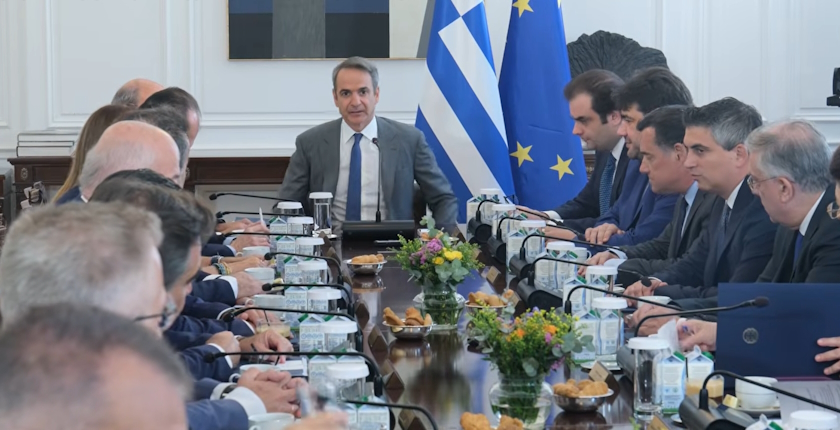
The Greek Cabinet approved the establishment, composition and operation of the Government Committee for Nuclear Energy on 30 July 2026, following a presentation by Minister of Environment and Energy Stavros Papastavrou and Deputy Minister Nikos Tsafos.
The decision gives institutional form to the policy review announced by Prime Minister Kyriakos Mitsotakis at the second Nuclear Energy Summit in Paris on 10 March.
At the summit, Mitsotakis said Greece would establish a high-level ministerial committee to determine whether nuclear power and SMRs could contribute to the Greek energy system. He nevertheless acknowledged that whether nuclear energy would ultimately be adopted remained undecided.
The new committee is expected to organise the initial scientific, technical, economic and institutional assessment required before the government decides whether Greece should launch a commercial nuclear power programme.
From Political Discussion to Institutional Review
Greece has no commercial nuclear power plants. The country’s only nuclear installation is the research reactor at the National Centre for Scientific Research “Demokritos,” according to the Hellenic Atomic Energy Commission.
Nuclear power was considered during the 1960s and 1970s, but Greece did not proceed with a commercial programme. The country instead relied heavily on lignite before expanding wind and solar generation over the past two decades.
The establishment of the committee therefore marks the beginning of an organised national review rather than the revival of an existing power-reactor programme. Its immediate responsibility should be to answer a foundational question:
Would introducing nuclear power serve Greece’s long-term national interest more effectively than the available alternatives?
Answering that question will require more than comparing the advertised generating costs of different reactor technologies.
The committee will need to examine:
- future electricity-demand scenarios;
- the performance and stability of the national grid;
- renewable-energy and storage expansion;
- dependence on imported fuels;
- possible reactor sizes and applications;
- nuclear legislation and institutional responsibilities;
- regulatory capacity;
- financing and ownership structures;
- workforce and supply-chain requirements;
- site suitability;
- radioactive-waste and spent-fuel arrangements;
- emergency preparedness;
- safeguards and nuclear security;
- public acceptance; and
- possible international partnerships.
These issues should be considered together because the introduction of nuclear power is a national infrastructure programme, not simply a technology purchase.
Greece Enters the IAEA’s First Phase
The Greek government has explicitly connected the committee’s work to the International Atomic Energy Agency’s Milestones Approach for countries considering their first nuclear power plant.
The approach divides the development of a nuclear power programme into three phases.
Phase 1: Consider the nuclear option
The country examines whether nuclear energy is appropriate and prepares to make a knowledgeable national commitment.
The first milestone is reached when the government has sufficient evidence and institutional understanding to decide whether to proceed.
Phase 2: Prepare for procurement
After a positive policy decision, the country develops the infrastructure required to invite bids or negotiate a contract for its first nuclear power plant.
Phase 3: Implement the project
The country conducts the activities required to construct, commission and prepare to operate the first plant.
The IAEA framework identifies 19 infrastructure issues that must be addressed, including national position, nuclear safety, management, financing, legal and regulatory frameworks, safeguards, human resources, stakeholder involvement, site selection, environmental protection, emergency planning, nuclear security, the fuel cycle, radioactive waste and procurement.
Greece is therefore at the beginning of Phase 1.
It has created a mechanism to study the nuclear option, but it has not yet made the informed national commitment represented by Milestone 1.
An Initial Feasibility Exercise
The US Department of Commerce’s International Trade Administration has described the Greek process as an initial feasibility study examining whether nuclear energy, particularly SMRs, could enter the electricity mix after approximately 2030–2035.
It expects the assessment to consider changes to the regulatory framework and possible strategic partnerships. The US assessment suggests that the feasibility work could be completed during 2026–2027 and that technology and supplier selection would follow only if the government makes a positive decision.
This sequencing is important.
Technology selection should follow the definition of national requirements—not determine them.
Before discussing vendors, Greece must establish what problem nuclear power would be expected to solve.
Possible objectives might include:
- reducing exposure to imported natural gas;
- providing firm low-carbon electricity;
- supporting an increasingly electrified economy;
- complementing variable renewable generation;
- supplying data centres and industrial facilities;
- improving long-term energy security; or
- developing nuclear-powered maritime applications.
Each objective could produce a different technology assessment.
A reactor considered suitable for a large interconnected electricity system may not be appropriate for an island, industrial facility or shipping application.
Why SMRs Are Attracting Greek Interest
Greece has significantly expanded wind and solar electricity and intends to continue investing in renewable generation, batteries and pumped-storage hydropower.
The government nevertheless expects electricity demand to grow and argues that additional sources of predictable power may eventually be required.
SMRs are attracting interest because individual units would generally be smaller than conventional large reactors. Their promoters argue that they could require less capital per unit, be constructed progressively and provide firm electricity alongside renewables.
Some designs are also proposed for industrial heat, hydrogen production, desalination, remote electricity systems and maritime applications.
These possibilities remain technology- and project-specific.
The term “SMR” covers a wide range of reactor designs with different:
- power outputs;
- coolants and moderators;
- fuel types;
- operating temperatures;
- refuelling intervals;
- safety approaches;
- waste characteristics; and
- levels of technological maturity.
Greece should therefore avoid treating all SMRs as one commercially established technology category.
Commercial Evidence Remains Limited
Most SMR designs being promoted internationally remain under development, regulatory review, demonstration or early construction.
Projected benefits from modular construction and factory production depend on manufacturers securing sufficiently large order books to establish repeat production.
First-of-a-kind projects may not achieve the costs or schedules expected from later fleet deployment.
Greece will therefore need to distinguish carefully between:
- a conceptual design;
- a vendor feasibility study;
- a design undergoing regulatory review;
- a licensed design;
- a demonstration reactor;
- a first commercial project; and
- a reactor with substantial operating experience.
Vendor projections can contribute to the assessment, but they should not be treated as independent proof of performance.
The committee should require evidence on licensing status, reference-plant construction, supply-chain readiness, fuel availability, expected capacity factors, staffing, waste production, decommissioning and complete lifetime costs.
The Existing Regulator Must Remain Independent
Greece already has a national nuclear and radiological regulator.
The Hellenic Atomic Energy Commission, or EEAE, is responsible for regulatory control and supervision in nuclear technology, radiation protection and radiological and nuclear safety. It describes itself as administratively and financially autonomous in performing its regulatory functions.
However, regulating radiation applications and a research reactor is not the same as licensing and supervising a commercial nuclear power programme.
If Greece proceeds, EEAE would require sufficient authority, staffing, financing and specialist competence to assess areas such as:
- commercial reactor design;
- probabilistic safety assessment;
- thermal hydraulics;
- severe accidents;
- digital instrumentation and control;
- civil engineering;
- advanced fuels;
- manufacturing quality;
- human factors;
- cybersecurity;
- physical protection;
- emergency planning;
- environmental impacts;
- spent-fuel management; and
- decommissioning.
The government committee can identify these needs and recommend reforms.
It must not make licensing decisions on behalf of EEAE.
The regulator must remain institutionally separate from organisations responsible for promoting, financing, owning or operating a future nuclear power plant.
The Committee Is Not Automatically a NEPIO
The IAEA Milestones Approach normally requires an effective national coordination mechanism, commonly known as a Nuclear Energy Programme Implementing Organization, or NEPIO.
A NEPIO coordinates the work of ministries, regulators, utilities, technical institutions, universities, emergency organisations and other bodies involved in assessing or developing a nuclear power programme.
The Greek committee may perform some early coordination functions associated with a NEPIO.
However, the establishment of a ministerial committee should not automatically be interpreted as the creation of a permanent programme-implementing organisation with a defined technical secretariat, budget, work programme and legal mandate.
Greece will need to determine whether the committee itself will become the national coordinating mechanism or whether a separate technical organisation will be established after the initial review.
The distinction matters because a high-level committee can provide political direction, while detailed infrastructure development requires continuous technical and administrative capacity.
Site Conditions Require Independent Assessment
Greece has not selected a site for a nuclear power plant.
Any future siting process would need to consider the country’s particular geographical and environmental conditions.
These include:
- seismic hazards;
- coastal conditions;
- flooding;
- extreme temperatures;
- wildfire risks;
- cooling-water availability;
- population distribution;
- transport access;
- grid connections; and
- emergency-response capability.
A design approved in another country cannot simply be assumed to be suitable for a Greek location.
The regulator would need to assess the interaction between the proposed reactor and the specific characteristics of each candidate site.
SMRs may reduce some site requirements compared with large reactors, but they do not eliminate the need for detailed geological, hydrological, meteorological, environmental and security assessments.
Financing Must Cover the Complete Programme
The committee must also examine who would pay for the development of the nuclear infrastructure and any eventual reactor project.
Nuclear expenditure begins long before construction.
Greece would need to finance:
- programme coordination;
- regulatory expansion;
- workforce development;
- site investigations;
- environmental studies;
- legal reform;
- emergency capabilities;
- safeguards and security infrastructure;
- technical-support organisations;
- public engagement; and
- radioactive-waste planning.
These costs must be included when comparing nuclear power with alternatives.
A reactor vendor may present an expected construction cost or electricity price, but the state may still carry substantial programme-level, financial and long-term liability.
The committee should therefore assess public financing, private investment, utility ownership, government guarantees, power-purchase arrangements and possible cost-overrun exposure before recommending a procurement model.
Public Engagement Cannot Be Deferred
Mitsotakis acknowledged in Paris that Greek public opinion remains divided on nuclear power and called for an honest, thoughtful and non-ideological national discussion.
Public engagement should begin during the assessment stage rather than after a preferred technology or site has effectively been selected.
Citizens should receive clear information about:
- why nuclear power is being considered;
- what decisions have and have not been made;
- how alternative energy options will be compared;
- how safety and security will be regulated;
- how sites would be selected;
- how radioactive waste would be managed;
- who would bear financial risks; and
- how the public could participate in decision-making.
Public consultation should not be treated as a campaign to secure predetermined approval.
It should help the government understand public concerns and improve the quality and legitimacy of the final decision.
Lessons for African Nuclear Newcomers
Greece’s approach provides a useful comparison for African countries considering nuclear power.
The most important lesson is that programme coordination should begin before procurement.
A high-level government body can help define the national objectives, organise evidence and assign responsibilities across ministries and public institutions.
But the body’s mandate must be carefully designed.
It should not replace:
- the independent nuclear regulator;
- the future owner-operator;
- the national safeguards authority;
- the radioactive-waste organisation;
- emergency-management agencies; or
- a technically capable NEPIO or programme secretariat.
Its initial responsibility should be to establish whether nuclear power is justified and what infrastructure would be required if the country proceeds.
Begin With the National Need
African governments are frequently approached by reactor vendors before completing an independent assessment of their electricity systems and national development requirements.
This can reverse the correct sequence.
A country may begin discussing a specific reactor and then attempt to construct a national justification around the proposed technology.
The Greek process offers a better starting point:
- identify the long-term energy and development challenge;
- assess all credible energy options;
- determine whether nuclear power could provide additional value;
- evaluate national institutional readiness;
- identify the legal, regulatory and financial gaps;
- conduct transparent public engagement; and
- make a knowledgeable national decision before procurement.
Vendor engagement may provide useful technical information during this process, but it should remain technology-neutral and non-exclusive.
Establish Clear Institutional Boundaries
African countries creating similar committees should define the roles of participating institutions from the beginning.
The ministry responsible for energy may lead policy development, but the regulator must retain authority over safety and licensing.
The future owner-operator should be responsible for project development and plant operation, but it should not regulate itself.
National security institutions may support threat assessment and physical protection, but their responsibilities should be coordinated with the regulator and operator.
Finance ministries should evaluate affordability and contingent liabilities rather than becoming involved only after a vendor agreement has been negotiated.
Universities and technical institutions should support workforce planning, research and independent analysis.
These boundaries become more difficult to establish after commercial negotiations have begun.
Avoid Premature Vendor Commitment
The creation of a nuclear committee can attract immediate attention from supplier governments, reactor companies, consultants and financing institutions.
That engagement should be managed carefully.
Early cooperation agreements should focus on:
- institutional capacity;
- legislation;
- workforce development;
- grid studies;
- site-screening methodologies;
- regulatory training;
- safeguards;
- nuclear security;
- emergency preparedness; and
- independent technology assessment.
They should not create an implicit commitment to purchase a particular reactor.
The government should retain the ability to compare technologies and suppliers after establishing national evaluation criteria.
No Reactor Decision Yet
Greece has not selected a reactor site, vendor, technology, owner-operator or financing model.
It has not issued a tender, signed a reactor-supply contract or made a final investment decision.
The establishment of the Government Committee for Nuclear Energy should therefore not be presented as approval to construct an SMR.
It is the beginning of an organised process for determining whether Greece should proceed at all.
A future nuclear power project would require extensive additional steps, including:
- completion of the national feasibility assessment;
- a formal government decision;
- development or amendment of legislation;
- regulatory capacity expansion;
- designation of a programme-implementing organisation;
- establishment of an owner-operator;
- site screening and characterisation;
- environmental assessment;
- technology evaluation;
- financing arrangements;
- procurement;
- licensing;
- public consultation; and
- construction and commissioning approvals.
The process would extend well beyond the work of the new committee.
Institution Before Procurement
Greece’s decision is significant because it moves the nuclear debate from political statements towards an organised institutional assessment.
The committee can help the government determine whether nuclear power is technically suitable, economically justified and publicly acceptable within the country’s evolving electricity system.
It can also identify the institutions, laws, skills and financial arrangements that would need to be developed before any project could proceed.
The central lesson for African newcomer countries is equally clear. A nuclear programme should begin with national analysis and institutional preparation.
Related

Morocco Nuclear Regulator Says No Radioactive Leak at Maâmora Research Centre
By Nuclear Africa• October 7, 2026
Amazon’s 20-Year Nuclear Deal Shows How Large Corporate Buyers Can Help Finance Nuclear Investment
By Nuclear Africa• October 7, 2026Beyond the Resolutions: GC70 and the Emerging Global Nuclear Order
By Nuclear Africa• October 6, 2026
US Nuclear Regulator’s Workforce Warning Carries a Clear Lesson for African Nuclear Newcomers
By Nuclear Africa• October 5, 2026