
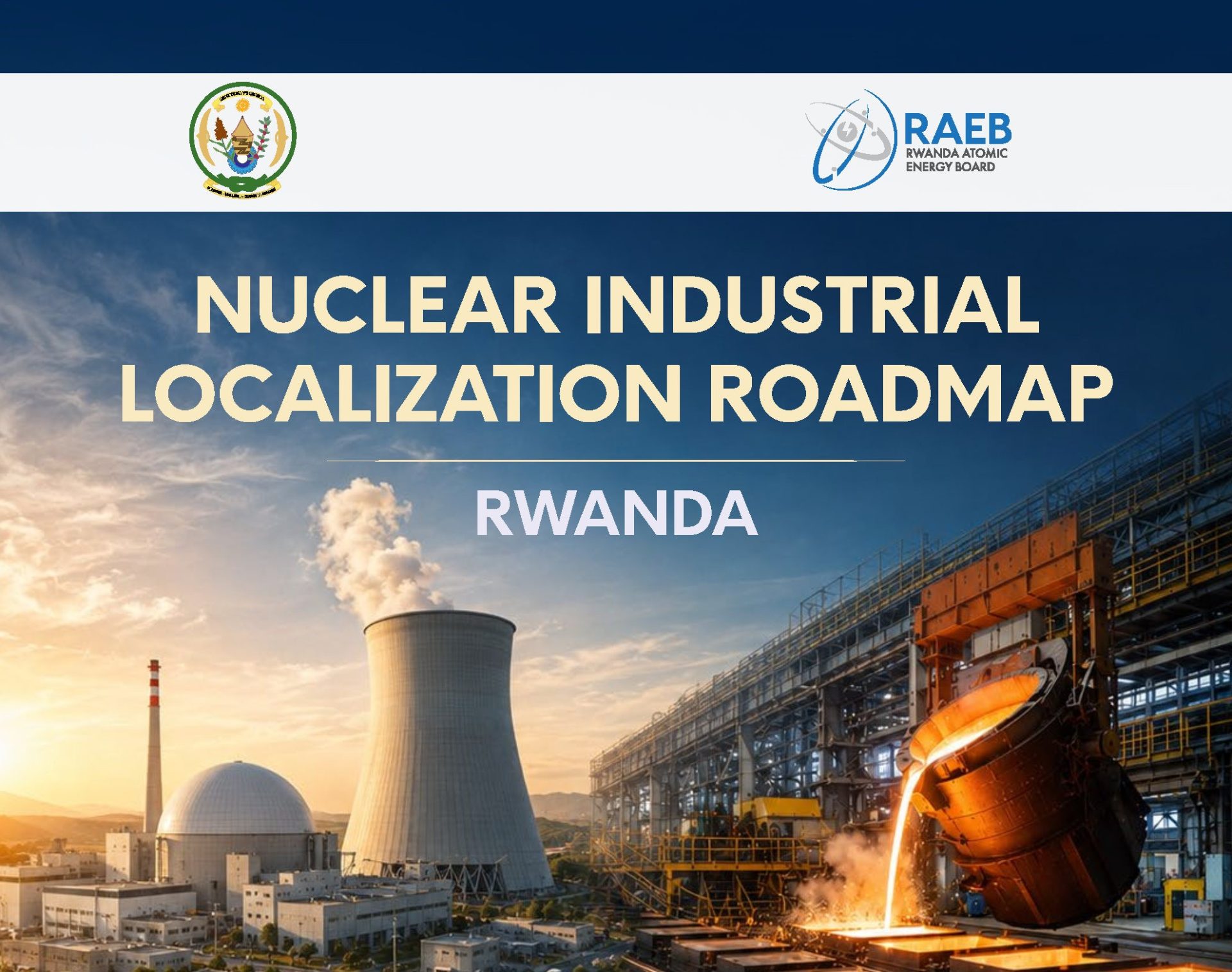
A new Nuclear Industrial Localization Roadmap sets out how Rwandan companies, workers and institutions could participate in the country’s emerging nuclear supply chain. The strategy is notable because it treats nuclear power not simply as an electricity project, but as a potential instrument for industrial development, skills upgrading and technology transfer.
By NuclearAfrica Editorial Desk
5 October 2026
Rwanda has taken an important step towards defining what “local participation” could mean in an African nuclear power programme.
The Rwanda Atomic Energy Board has released a Nuclear Industrial Localization Roadmap developed in coordination with the Ministry of Trade and Industry and with technical support from the United Nations Economic Commission for Africa. The document seeks to identify where Rwandan businesses and workers could realistically participate in a future nuclear supply chain, how existing capabilities would need to be upgraded, and where international partnerships would remain necessary. RAEB’s official resources page lists the roadmap among its September 2026 publications, while the agency subsequently announced its release through its official digital channels.
The roadmap arrives as Rwanda continues preparations for a future nuclear power programme based partly on small modular reactor technologies. In September, Infrastructure Minister Damien Murwanashyaka told senators that Rwanda was targeting about 110 MW of initial nuclear generation between 2030 and 2033, while work continued on the approval of two potential sites.
What makes the localisation roadmap especially relevant to Africa is that Rwanda is trying to answer a question that often comes too late in nuclear programmes:
What will the host country itself actually be able to supply, build, regulate, maintain and learn from the project?
Moving beyond the reactor purchase
Nuclear newcomer programmes are frequently discussed in terms of reactor technology, financing and vendor selection. Those issues are essential, but they represent only part of the economic opportunity.
A nuclear programme also requires:
- civil engineering;
- roads and site preparation;
- concrete and structural materials;
- transport and heavy logistics;
- electrical installation;
- ventilation systems;
- welding and fabrication;
- quality assurance;
- cybersecurity;
- instrumentation;
- inspection;
- maintenance;
- professional services;
- laboratories;
- training; and
- long-term operational support.
Rwanda’s roadmap is significant because it attempts to identify where local firms can begin participating before they are capable of supplying safety-class nuclear components.
The first local beneficiaries of the programme may therefore not be companies that manufacture reactor pressure vessels or nuclear fuel.
They may be construction companies, logistics providers, electrical contractors, engineering consultancies, training institutions and manufacturers supplying conventional systems to nuclear-quality requirements.
Reporting based on the roadmap describes this as a staged approach in which firms begin in sectors where domestic capability already exists before progressively entering more technically demanding areas.
Localisation does not mean making everything locally
This distinction is important.
An effective nuclear localisation strategy should not aim to manufacture every component domestically simply for political visibility.
Nuclear components are subject to exceptionally demanding quality, traceability, inspection and documentation requirements. Developing domestic production where there is insufficient scale or competence can increase costs and potentially introduce safety risks.
The objective should instead be to identify areas where local participation creates genuine economic value without compromising safety or project delivery.
For Rwanda, that may initially mean:
- earthworks and site preparation;
- conventional buildings;
- local transportation;
- selected construction materials;
- non-nuclear electrical equipment;
- selected piping and ventilation work;
- information technology;
- security infrastructure;
- professional services; and
- general maintenance capability.
As domestic firms gain certification, experience and partnerships with established nuclear suppliers, the range of activities could expand.
That is a more credible model than assigning an arbitrary localisation percentage before understanding what local industry can actually deliver.
A three-stage industrial pathway
Reporting on the roadmap indicates that Rwanda intends to pursue industrial participation in stages.
The first stage would concentrate on establishing nuclear-grade quality systems, supplier qualification and participation in civil and preparatory works.
A second stage would seek broader involvement in electromechanical and secondary systems as reactor construction advances.
A later stage would position qualified Rwandan companies for operations, maintenance and potential participation as Tier 2 or Tier 3 suppliers in projects beyond Rwanda.
This progression matters because one nuclear project alone may not provide sufficient demand to sustain a sophisticated domestic nuclear manufacturing industry.
If Rwanda can develop firms that eventually serve projects elsewhere in Africa, localisation could become an export strategy rather than a one-project procurement policy.
That may ultimately be the more valuable objective.
The quality challenge
The central challenge will be qualification.
A company that successfully supplies equipment to conventional power plants, mines or industrial facilities does not automatically qualify to work on nuclear projects.
Depending on the component or service involved, suppliers may need to demonstrate:
- rigorous quality-management systems;
- complete materials traceability;
- documented manufacturing procedures;
- qualified welding procedures and personnel;
- calibrated inspection equipment;
- configuration control;
- cybersecurity controls;
- independent verification;
- corrective-action processes; and
- long-term record retention.
For many African firms, the main barrier to entering the nuclear supply chain will therefore not be basic engineering competence.
It will be demonstrating that competence under nuclear-grade quality assurance.
The roadmap recognises this wider industrial-readiness challenge. Earlier consultations organised by RAEB, the Ministry of Trade and Industry and UNECA focused specifically on assessing domestic industry, identifying gaps and determining what would be required for Rwandan companies to meet international nuclear safety, quality and regulatory standards.
Workforce development is part of localisation
Industrial localisation cannot occur without human capital.
Recent reporting linked to the roadmap says Rwanda aims to develop more than 230 nuclear professionals by 2028, while the country currently has a much smaller pool of specialised personnel. Required expertise spans regulation, licensing, safety, security, reactor operations, maintenance, instrumentation and control, reactor physics, nuclear materials and fuel-cycle disciplines.
The skills requirement extends beyond university graduates.
Nuclear projects also need:
- qualified welders;
- electricians;
- pipefitters;
- boilermakers;
- technicians;
- quality-control inspectors;
- radiation-protection personnel;
- construction supervisors; and
- commissioning specialists.
This is where nuclear development can connect directly with technical and vocational education.
If localisation is designed properly, the nuclear programme could raise standards across sectors far beyond nuclear energy.
A welder trained to nuclear-quality requirements may subsequently be valuable in aviation, advanced manufacturing, oil and gas, pharmaceuticals or precision engineering.
The same applies to quality assurance, nondestructive testing, cybersecurity and industrial instrumentation.
In that sense, the most important economic benefit may not be the number of local components installed in the first reactor.
It may be the upgrading of Rwanda’s wider industrial capability.
The regional opportunity
The roadmap also has implications beyond Rwanda.
African nuclear markets are individually small.
Few newcomer countries are likely to build enough reactors in the near term to justify a fully independent national supply chain.
Regional specialisation may therefore make more economic sense.
One country could develop expertise in: Engineering services; another in specialised fabrication; another in radiation monitoring etc. A regional supply network could then serve programmes across the continent.
This would align with wider African discussions about using the African Continental Free Trade Area to increase the economic scale available for energy and infrastructure investment. At NEISAfrica 2026, Rwandan officials explicitly linked regional integration with the financing and implementation of African nuclear programmes.
Rwanda’s localisation roadmap should therefore not be read solely as a national industrial policy.
It could become an early test of whether African nuclear programmes can generate regional supply-chain opportunities rather than remaining largely import-dependent turnkey projects.
Financing localisation will be difficult
Industrial ambition does not automatically create qualified suppliers.
Companies must finance the transition.
A domestic manufacturer may need to purchase new machinery, establish certified quality systems, recruit specialised engineers, train workers and operate for several years before receiving a major nuclear contract.
That creates a financing gap.
Recent reporting on the roadmap indicates that Rwanda is considering a combination of sovereign support, multilateral development finance and structured public-private arrangements for its wider nuclear programme.
A similar financing question applies to localisation.
If government requires local companies to meet nuclear standards but does not provide access to affordable capital, many firms may be unable to qualify.
Possible policy tools include:
- supplier-development funds;
- concessional loans;
- credit guarantees;
- shared testing facilities;
- tax incentives for qualifying investment;
- training grants;
- joint ventures with international suppliers; and
- long-term framework contracts.
Localisation therefore has to be incorporated into financing negotiations with reactor vendors and export-credit agencies.
It cannot be added after the principal contracts have already been signed.
Vendor partnerships will be decisive
Rwanda is pursuing multiple international nuclear relationships.
In July 2026, RAEB and Russia’s Rosatom signed a roadmap on small modular reactors following the first meeting of their Joint Coordinating Committee on nuclear cooperation. The discussions also covered human resources, infrastructure development and non-power applications.
Rwanda has also engaged other nuclear technology developers.
For localisation to work, future reactor procurement should therefore require bidders to explain precisely:
- which components can realistically be supplied locally;
- which activities can be transferred over time;
- what certification Rwandan companies will require;
- which training programmes the vendor will support;
- whether joint ventures will be established;
- how intellectual property will be managed; and
- whether qualified Rwandan suppliers can enter the vendor’s international supply chain.
These commitments should be measurable.
Promises of “technology transfer” are easy to include in political statements but difficult to evaluate unless contracts identify specific technologies, capabilities, training commitments and timelines.
Regulation must remain separate from industrial promotion
There is also an important institutional boundary.
Government may want to maximise domestic industrial participation.
The nuclear regulator must remain focused on safety.
A regulator should never be pressured to reduce quality requirements simply because a government wants a larger percentage of locally supplied components.
Local firms must qualify on the same safety basis as foreign suppliers.
This is particularly important for Rwanda as its nuclear regulatory infrastructure continues to develop.
The country underwent an IAEA Integrated Nuclear Infrastructure Review mission in March 2026 covering the 19 infrastructure areas associated with the IAEA Milestones Approach, including legal and regulatory frameworks, human resources, safety, security, waste management and stakeholder involvement.
Industrial localisation should advance alongside regulatory capacity, not ahead of it.
The 2030–2033 target should remain conditional
Rwanda’s stated objective of obtaining its first 110 MW of nuclear capacity between 2030 and 2033 is ambitious.
The country is still working through site approval, technology development, regulatory preparation, financing and workforce expansion.
Those are substantial milestones.
The localisation roadmap does not remove these challenges.
Nor should domestic-content objectives create pressure to accelerate a project before national institutions and suppliers are ready.
A nuclear programme should advance according to demonstrated readiness.
If additional time is required to complete licensing, financing, site studies or supplier qualification, adjusting the schedule would be preferable to protecting a political deadline.
Lessons for other African newcomer countries
Rwanda’s approach offers several useful lessons.
First, localisation planning should begin before procurement.
Once the main engineering, procurement and construction agreement is signed, many supply-chain decisions may already be locked in.
Second, localisation must be based on an inventory of actual industrial capability.
Countries need to know what their firms can produce today, what can reasonably be developed within five or ten years and what should continue to be sourced internationally.
Third, workforce development should cover both professional and technical occupations.
Fourth, local-content targets should never override nuclear safety and quality requirements.
Fifth, vendor commitments should be measurable and enforceable.
And finally, countries should look beyond their first reactor.
The real industrial objective should be to develop companies capable of competing in regional and global nuclear markets.
What Ghana, Kenya and other newcomers should consider
Rwanda’s strategy is particularly relevant to Ghana and Kenya, which are also advancing nuclear-power programmes.
Both countries should consider undertaking dedicated nuclear industrial-readiness studies before final vendor selection.
Such assessments should identify:
- existing industrial capabilities;
- potential nuclear suppliers;
- certification gaps;
- training requirements;
- laboratory and testing needs;
- financing constraints;
- realistic localisation timelines; and
- regional export opportunities.
The exercise should not begin with a politically selected percentage of local content.
It should begin with evidence.
For Ghana, this could identify realistic roles for construction, engineering, fabrication, electrical systems, logistics, professional services and eventually operations and maintenance.
For Kenya, a similar approach could connect the proposed nuclear programme with the country’s wider manufacturing and infrastructure ambitions.
Across both countries, supplier development should form part of vendor evaluation rather than being negotiated after technology selection.
Conclusion
Rwanda’s Nuclear Industrial Localization Roadmap represents an important shift in the way African nuclear programmes can be conceived.
It treats nuclear energy not only as a technology to be imported but as a potential platform for developing domestic industry, human capital and technological capability.
That is a worthwhile ambition.
But localisation succeeds only when it is grounded in realism.
Not every component needs to be produced domestically. Not every company will qualify. Nuclear safety requirements cannot be relaxed to satisfy industrial policy, and the economic benefits promised today will materialise only if local companies receive the training, finance, certification and long-term market opportunities needed to compete.
The strength of Rwanda’s approach is that it begins addressing these questions before the proposed reactor is built.
Other African nuclear newcomers should pay attention.
The most valuable nuclear programme may ultimately be one that does more than generate electricity.
It should leave behind stronger institutions, more capable industries, a better-trained workforce and companies capable of competing long after construction of the first reactor is complete.
Related

Amazon’s 20-Year Nuclear Deal Shows How Large Corporate Buyers Can Help Finance Nuclear Investment
By Nuclear Africa• October 5, 2026
US Nuclear Regulator’s Workforce Warning Carries a Clear Lesson for African Nuclear Newcomers
By Nuclear Africa• October 5, 2026
US-South Korea $120 Billion Nuclear Framework Shows the Scale of State-Backed Reactor Finance
By Nuclear Africa• October 5, 2026
Morocco Nuclear Regulator Says No Radioactive Leak at Maâmora Research Centre
By Nuclear Africa• October 5, 2026