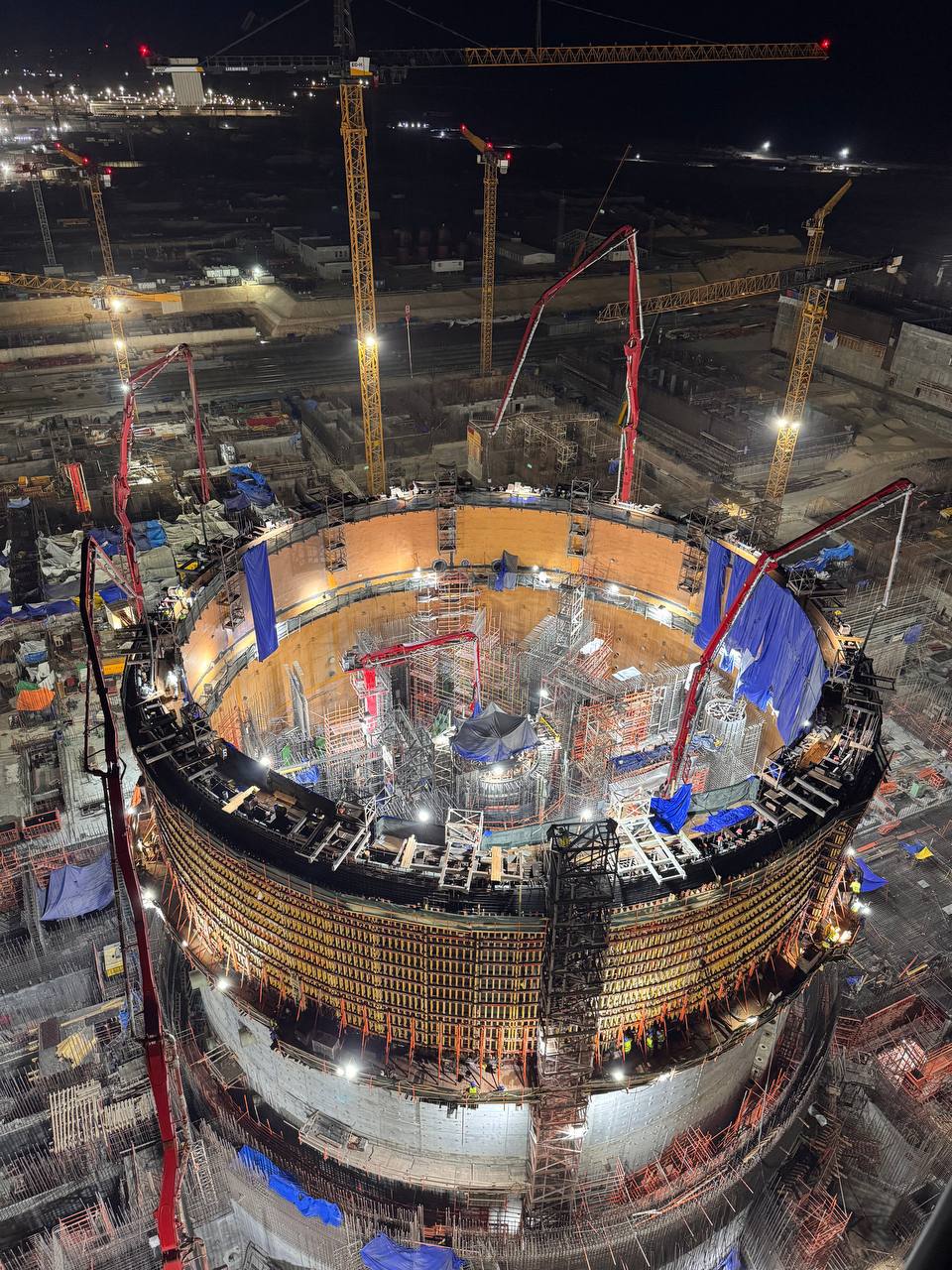
Egypt has signalled plans to discuss the addition of two more nuclear reactors at the El Dabaa Nuclear Power Plant, even as construction continues on the four VVER-1200 units already being built on the Mediterranean coast.
Electricity and Renewable Energy Minister Mahmoud Esmat said the expansion plan has been adopted at the policy level following presidential direction and that Egypt intends to discuss the proposed additional reactors with Russia’s state nuclear corporation Rosatom.
The announcement is significant, but it needs to be interpreted carefully.
Egypt has not yet announced a final investment decision, construction licence, financing package, engineering, procurement and construction contract, or construction start for Units 5 and 6.
For now, the additional reactors should be regarded as a proposed expansion of the El Dabaa programme rather than reactors already ordered for construction.
From First Nuclear Plant to Nuclear Fleet
The existing El Dabaa project consists of four Russian-designed VVER-1200 Generation III+ pressurised-water reactors, each with a gross generating capacity of approximately 1,200 MW.
Together, the four reactors will provide about 4.8 GW of installed nuclear generating capacity.
All four existing units are under construction, making El Dabaa the most advanced commercial nuclear new-build programme anywhere in Africa.
What makes the latest announcement strategically important is that Egypt may already be looking beyond completion of its first nuclear project.
If two additional reactors are eventually approved and are similar in capacity to the existing VVER-1200 units, El Dabaa could ultimately approach approximately 7.2 GW of gross nuclear capacity.
That figure, however, remains illustrative rather than confirmed. Egypt has not formally announced the technology or capacity of the two possible additional reactors.
The more important development is the shift in thinking.
Egypt would no longer simply be asking how to construct its first nuclear plant.
It would be confronting a different question: How does a country move from its first nuclear project to a repeat-build nuclear fleet?
Why Repeat Nuclear Construction Matters
The economics and institutional demands of a first nuclear project are very different from those associated with subsequent units.
A newcomer country must establish or substantially strengthen almost every component of the nuclear programme simultaneously: legislation, regulation, owner-operator capability, workforce development, emergency preparedness, radioactive-waste arrangements, safeguards, nuclear security, supply-chain capacity and specialised infrastructure.
Those investments are considerable.
But once they have been made, subsequent nuclear projects may be able to use institutions, personnel and infrastructure created for the first programme.
That creates the possibility of what the nuclear industry often describes as fleet effects or repeat-build learning.
A country that repeatedly constructs similar reactor technology may gain experience in project management, licensing, construction sequencing, quality assurance, supplier qualification and workforce development.
Workers trained for one unit can move to another.
Domestic companies that initially provide relatively conventional construction services can gradually qualify for more demanding nuclear work.
Regulators also accumulate practical experience reviewing designs, conducting inspections and overseeing construction.
The potential expansion of El Dabaa therefore deserves to be viewed not merely as an increase in generating capacity but as a possible transition toward nuclear programme continuity.
Localisation Could Become More Important
The prospect of two additional reactors could also change the economics of nuclear localisation in Egypt.
Localisation is difficult during a first nuclear project because domestic firms often lack nuclear-qualified experience.
Becoming a nuclear supplier requires more than possessing general industrial capability.
Companies may need specialised quality-management systems, material traceability, qualified welding procedures, inspection systems, configuration control and compliance with nuclear codes and standards.
When only one project is expected, firms may question whether investing in those capabilities is commercially worthwhile.
A multi-unit programme changes that calculation.
If qualified companies can see a longer pipeline of nuclear work, investing in equipment, certification and specialist personnel becomes easier to justify.
Egypt could therefore use repeat construction to deepen domestic participation gradually rather than attempting to maximise local content during the first unit.
This is one reason nuclear localisation should be viewed as an industrial-development trajectory, not simply a percentage in a procurement agreement.
The Workforce Question
Additional reactors would also create a considerably larger long-term workforce requirement.
Nuclear plants require engineers, technicians, reactor operators, maintenance personnel, radiation-protection specialists, chemistry staff, security professionals, emergency planners, safeguards specialists and regulatory inspectors throughout decades of operation.
El Dabaa is already creating substantial demand for Egyptian nuclear personnel.
A six-unit programme would increase that requirement and would make workforce continuity even more important.
Instead of training personnel for a single construction cycle, Egypt could potentially develop a permanent nuclear profession supporting construction, commissioning, operation, maintenance and eventual decommissioning over generations.
For Africa, this may become one of El Dabaa’s most important contributions.
The project could demonstrate what happens when nuclear workforce development moves from an academic exercise into a sustained industrial requirement.
But Six Reactors at One Site Also Create New Questions
Expansion would not produce benefits without additional challenges.
A larger nuclear site would place greater demands on transmission infrastructure.
Grid planners would need to accommodate several large generating units while ensuring that the loss of one reactor—or potentially more than one unit under common external conditions—does not destabilise the electricity system.
Cooling requirements would also need to be assessed for the expanded site.
El Dabaa is located on Egypt’s Mediterranean coast, giving the plant access to seawater for heat rejection. But additional reactors would still require detailed environmental and engineering assessment of cooling-water intake and discharge arrangements.
Emergency preparedness, physical protection, spent-fuel management and radioactive-waste infrastructure would similarly need to account for the larger inventory and operating footprint.
Fleet development therefore creates economies of scale, but it can also create concentration risk.
That balance should form part of any eventual Egyptian decision.
Financing Will Be Crucial
The existing El Dabaa project benefits from an interstate financing arrangement between Egypt and Russia.
Any fifth and sixth units would require their own financing structure or an extension of existing arrangements.
This is likely to become one of the decisive questions.
Nuclear projects involve very large upfront capital expenditure and long development periods before electricity revenue begins.
Even when repeat construction lowers execution risk, governments must still decide how capital costs, exchange-rate risk, construction risk and electricity-market exposure will be allocated.
Until Egypt announces a financing agreement for additional units, the expansion should therefore remain classified as a strategic government plan rather than a committed construction project.
What This Means for Other African Nuclear Newcomers
The development has implications well beyond Egypt.
Much of Africa’s nuclear debate still revolves around whether individual countries should build their first reactor.
Ghana is developing its nuclear power infrastructure.
Kenya continues preparations for a possible future programme.
Nigeria has long-standing nuclear-energy ambitions.
Other countries are assessing large reactors, SMRs or research reactors as possible components of their future energy systems.
Egypt introduces another level of discussion.
If the existing four-unit programme progresses successfully and the additional reactors ultimately proceed, African policymakers will have a functioning continental example of the difference between a nuclear project and a nuclear programme.
The distinction matters.
A single project may produce electricity.
A sustained programme can potentially create institutions, industries, professions and supply chains that survive beyond the original construction cycle.
Why This Matters for Africa
Africa’s nuclear future will not ultimately be determined by how many reactor memoranda of understanding governments sign.
It will be determined by whether countries can create durable nuclear institutions and reproduce successful projects.
That requires continuity in regulation, financing, human resources, industrial capability and political commitment.
Egypt’s possible El Dabaa expansion may therefore become an important test.
If the two additional reactors proceed, the question will no longer simply be whether an African country can successfully construct a modern nuclear power station.
It will become: Can an African country convert its first nuclear project into a sustainable nuclear fleet?
That could be a much more important milestone for the continent than another reactor announcement.
NuclearAfrica Editorial Note
The proposed fifth and sixth reactors have not yet reached final investment decision, licensing, contracting or construction. They should therefore be described as a proposed expansion or government plan, not as reactors already ordered or under construction. Ahram Online reported that Minister Mahmoud Esmat said Egypt and Rosatom would discuss adding the reactors and that he gave no timetable or confirmation of a final construction decision.
Related

Morocco Nuclear Regulator Says No Radioactive Leak at Maâmora Research Centre
By Nuclear Africa• October 7, 2026
Amazon’s 20-Year Nuclear Deal Shows How Large Corporate Buyers Can Help Finance Nuclear Investment
By Nuclear Africa• October 7, 2026Beyond the Resolutions: GC70 and the Emerging Global Nuclear Order
By Nuclear Africa• October 6, 2026
US Nuclear Regulator’s Workforce Warning Carries a Clear Lesson for African Nuclear Newcomers
By Nuclear Africa• October 5, 2026