World Nuclear Association says Ghana has built a credible foundation for nuclear power, including a programme organisation, regulator, prospective owner-operator structure, identified sites and international partnerships. But financing, detailed site work, licensing and final project decisions remain sufficiently unresolved for the Association to judge the country’s approximately 1,000 MW target for 2034 as unlikely to be achieved on the present trajectory.
By NuclearAfrica Editorial Desk
12 October 2026
Ghana’s long-running nuclear power programme has received an important external assessment that is both encouraging about the foundations already established and cautionary about how much remains to be completed before the country can realistically begin generating nuclear electricity.
The World Nuclear Association, in the Ghana country assessment included in its newly updated World Nuclear Outlook Report 2026, classifies Ghana as a nuclear newcomer that has made meaningful progress towards introducing nuclear power. At the same time, the Association rates Ghana “Low-Moderate” across all four dimensions of its readiness assessment: policy framework readiness, institutional and infrastructure readiness, programme and project development, and target achievability.
Most significantly, the Association concludes that Ghana’s target of approximately 1,000 MWe of nuclear capacity by 2034 is unlikely to be achieved unless the programme moves considerably further on financing, project definition, licensing and implementation.
That conclusion should not be interpreted as a judgement that Ghana is unprepared for nuclear power or that its programme lacks credibility. The same assessment acknowledges Ghana’s sustained political commitment, established programme organisation, dedicated nuclear regulator, research capability, preferred and alternative sites, international training and multiple technology partnerships.
Rather, the assessment draws attention to the widening distinction between being institutionally committed to nuclear power and having a specific nuclear project that is sufficiently developed, financed and licensed to meet a particular commissioning date.
For Ghana, that distinction is becoming increasingly important.
Ghana has moved well beyond the stage of merely considering nuclear power
Ghana is not a country that has simply announced an interest in nuclear energy.
The country has been developing nuclear capabilities for decades and is currently implementing its programme using the International Atomic Energy Agency’s Milestones Approach. The Ministry responsible for energy confirms that Ghana has completed Phase One and moved into Phase Two, during which a newcomer country is expected to strengthen the institutions, regulatory arrangements, human resources, financing structures and other infrastructure necessary before committing to construction.
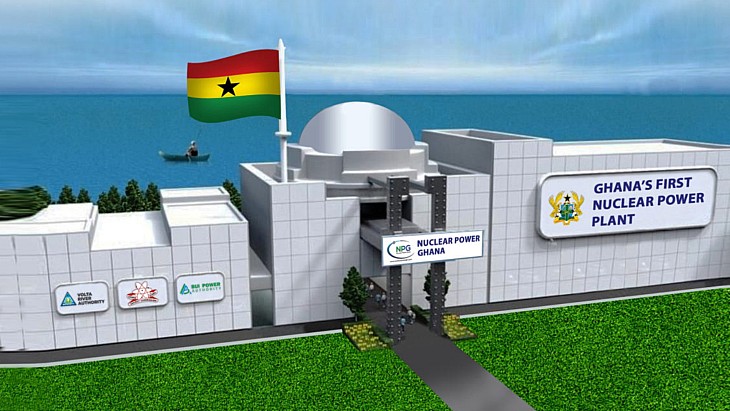
Nuclear Power Ghana has also identified Nsuban in the Western Region as the preferred site for the first nuclear power plant, with Obotan in the Central Region retained as an alternative. Ghana’s site-selection process was subsequently reviewed by an IAEA Site and External Events Design mission, which found that the process had been conducted in accordance with relevant IAEA safety standards.
These are substantive achievements.
Ghana has also developed a domestic nuclear education and research base, including the School of Nuclear and Allied Sciences, and maintains longstanding experience with the Ghana Research Reactor-1 at the Ghana Atomic Energy Commission. International cooperation has expanded considerably, particularly with the United States, China, the IAEA and other nuclear partners.
The country therefore has significantly more nuclear infrastructure than many states that periodically announce an ambition to build reactors.
The question confronting Ghana in 2026 is no longer primarily whether it wants nuclear power.
It is whether the country can convert more than a decade of infrastructure development into a bankable, licensable and executable first nuclear project.
The World Nuclear Association sees a credible programme, but not yet a mature project
This distinction is reflected clearly in the World Nuclear Association’s assessment.
On policy framework readiness, Ghana receives a Low-Moderate rating. The Association recognises durable political commitment, the approximately 1,000 MW objective, an owner-operator structure, site development and vendor relationships. However, it identifies the absence of final financing and project decisions as significant remaining weaknesses.
The same Low-Moderate rating is applied to institutional and infrastructure readiness. Ghana’s independent regulatory body, nuclear research experience and participation in international training provide what the Association describes as a sound base. But the country has not yet regulated the construction and operation of a commercial nuclear power reactor, and its project-delivery institutions have not yet been tested through an actual nuclear build.
The programme receives the same assessment for project and programme development. Ghana has identifiable sites and technology tracks, but the World Nuclear Association points specifically to funding constraints that have prevented the programme from progressing into final contracting, financing and licensing stages.
This is where the assessment becomes particularly relevant to current policy discussions in Ghana.
Much of the programme’s visible progress has involved creating the institutional conditions that make a nuclear project possible. The next phase requires decisions that commit substantial amounts of money and begin transforming those institutions into an actual project.
That transition is considerably more difficult.
The immediate constraint is not nuclear technology
Ghana does not lack potential reactor suppliers.
It has engaged internationally with both large-reactor and small modular reactor technologies. Nuclear Power Ghana entered a framework arrangement with China National Nuclear Corporation concerning the HPR1000 and signed a commercial agreement with US-based Regnum Technology Group related to deployment of a NuScale VOYGR SMR plant.
But those arrangements need to be described carefully.
They represent significant technology and commercial relationships, but they should not be confused with final engineering, procurement and construction contracts, completed financing packages or authorisations to begin reactor construction.
Reporting in 2025 explicitly noted that although framework agreements had been reached, no formal construction contract had yet been signed, while environmental and site work remained under development.
That distinction matters because nuclear programmes can appear much further advanced when technology announcements, framework agreements and project-development relationships are treated as though they were equivalent to final investment decisions.
They are not.
A credible reactor technology is only one component of a credible nuclear project.
Ghana’s own project officials have already identified the funding problem
The World Nuclear Association’s concern about project maturity is consistent with warnings coming from within Ghana’s programme itself.
In March 2026, Nuclear Power Ghana Executive Director Dr Stephen Yamoah said that essential technical activities required to move the programme beyond Phase Two were being delayed because dedicated funding had not been secured.
He identified detailed site characterisation and the environmental impact assessment among the most urgent requirements. Nuclear Power Ghana also needed environmental monitoring, oceanographic and marine equipment to generate the site-specific data required for plant design and licensing.
The significance of this funding gap should not be underestimated.
A preferred site is not the same thing as a characterised site.
Selecting Nsuban means Ghana has identified a location that appears suitable after comparative assessment. Detailed characterisation requires much deeper investigation of the conditions that will affect the eventual reactor design and its safety case.
That includes geology, seismic conditions, hydrology, meteorology, coastal processes, flooding hazards, population characteristics and other external events relevant to the plant.
Until those studies are sufficiently advanced, neither the regulator nor a reactor supplier can treat the site as completely defined.
This also limits the precision of project costing.
Progress has nevertheless continued during 2026
The programme has not remained static.
In September, Ghana reported at the IAEA General Conference that meteorological monitoring systems had been installed at the preferred and alternative nuclear sites and that GIS-based verification supported by aeromagnetic survey information was improving knowledge of subsurface conditions. Government also reported progress on land acquisition.
These developments indicate that Ghana is continuing to build the evidence base required for more detailed site assessment.
They also demonstrate why the World Nuclear Association assessment should not be read as a declaration that the programme has stalled.
Ghana is advancing.
The question is whether the pace of advancement is consistent with commissioning approximately 1,000 MW by 2034.
Those are two different questions.
The 2034 deadline is becoming increasingly demanding
The remaining timeframe is now particularly important.
A reactor expected to enter commercial operation around 2034 must first pass through project structuring, detailed site work, environmental assessment, grid studies, regulatory review, financing, detailed engineering, procurement, construction, commissioning and fuel loading.
Many of these activities overlap, but they cannot all be compressed indefinitely.
Nuclear construction itself may require several years even when a mature reactor design is used and the project proceeds without major disruption.
Before construction begins, however, the country must establish a sufficiently mature technical and financial basis for committing billions of dollars.
This means the period immediately ahead may be more consequential to Ghana’s 2034 ambition than many of the years already spent developing the programme.
Every year in which final financing, site characterisation and project definition remain unresolved reduces the schedule available for licensing and construction.
This appears to be central to the World Nuclear Association’s conclusion that nuclear deployment in Ghana remains credible while the specific 2034 target is becoming difficult to achieve.
Missing a target date would not necessarily mean programme failure
This distinction is also important for how Ghana evaluates success.
Nuclear infrastructure development should not be accelerated simply to protect a politically announced commissioning date.
Safety, site suitability, environmental assessment, regulatory independence and sound financing should take precedence over maintaining a particular year on a project schedule.
If Ghana concludes that the first plant should begin operation later than 2034 because additional time is required to complete the programme properly, that would not by itself constitute failure.
A poorly structured project delivered against an artificial deadline could be substantially more damaging than a properly developed reactor entering service several years later.
Nuclear projects create obligations that can last for a century when construction, operation, spent-fuel management and decommissioning are considered together.
A few additional years during project preparation may therefore be justified if they produce better financing, stronger regulation or a more defensible technology decision.
The real concern would be continued slippage without resolving the underlying causes.
Financing is now becoming the decisive issue
Ghana’s nuclear programme has spent many years developing human resources, regulatory infrastructure and international partnerships.
The next major constraint is likely to be financial.
A nuclear power plant requires large upfront investment before it produces its first kilowatt-hour of electricity. A newcomer country must therefore determine who will provide equity, who will lend, what interest rates will apply, which party bears construction risk and whether government guarantees will be required.
Foreign-exchange exposure is also significant because much of the project cost will almost certainly be denominated in international currencies while electricity revenues will largely be collected in Ghana cedis.
The financing structure must therefore be evaluated not only according to the headline construction price but according to its full lifecycle implications for electricity consumers and the public finances.
This is where Ghana’s technology and vendor discussions eventually have to converge with fiscal policy.
The country is not selecting a reactor in isolation.
It is selecting a reactor, financing structure, strategic partner, fuel relationship, long-term service arrangement and risk allocation model.
Those decisions cannot realistically be separated.
A project-preparation mechanism could become critical
One lesson from Ghana’s current funding difficulties is that government does not need to wait until reactor construction to establish a dedicated nuclear financing mechanism.
Project-preparation activities themselves require predictable funding.
Detailed site studies, environmental assessments, financial modelling, legal advisory work, grid studies, owner-operator development and regulatory capacity can collectively require substantial resources long before the main construction loan is arranged.
If those activities depend on irregular annual allocations, the programme risks repeating a cycle in which technical work is delayed even while high-level political commitment remains strong.
Ghana therefore needs to distinguish clearly between financing the preparation of a nuclear project and financing construction of the nuclear plant itself.
The first is a comparatively modest commitment but is necessary to make the second possible.
A well-designed nuclear project-preparation mechanism could provide multi-year funding for the specific activities required to complete Phase Two and produce an investment-ready project.
Without such preparation, even an attractive foreign financing offer may be difficult to evaluate properly.
The regulator must advance at the same pace as the project
The World Nuclear Association assessment also notes that Ghana’s nuclear regulatory foundation is credible but that commercial reactor licensing remains untested.
This is normal for a newcomer.
Every established nuclear regulator once licensed its first power reactor.
But it means the Nuclear Regulatory Authority must continue building specialist capability before a technology-specific licensing application reaches it.
A regulator may have substantial experience overseeing radioactive sources, research reactors and radiation protection while still requiring additional expertise for commercial power reactor licensing.
The eventual application will involve complex assessments of reactor physics, thermal hydraulics, structural engineering, severe accidents, instrumentation and control, cybersecurity, emergency preparedness, environmental protection, quality assurance and many other areas.
The regulatory institution must be ready before the applicant is.
This is another reason programme schedules should reflect institutional readiness rather than political ambition alone.
Grid readiness will also influence the choice of technology
Ghana’s nuclear decision cannot be separated from the characteristics of its electricity system.
Nuclear Power Ghana said earlier this year that a detailed grid impact study was required to determine transmission upgrades, substations and safety arrangements necessary to accommodate a nuclear plant.
This becomes particularly important when comparing a large reactor with an SMR configuration.
A single reactor in the range of 1,000 to 1,200 MW represents a significant generating unit relative to Ghana’s overall grid. The electricity system must be capable of managing the sudden loss of that unit without compromising grid stability.
An SMR project distributes capacity differently, although its economics may depend on deploying multiple modules.
The technology decision should therefore emerge partly from rigorous power-system analysis rather than being driven primarily by vendor preference or international partnership.
The eventual solution has to work in Ghana’s grid, not merely in the vendor’s reference market.
The owner-operator must also become a project delivery organisation
Another important transition concerns Nuclear Power Ghana itself.
An organisation established to develop a nuclear programme eventually has to become capable of procuring, owning, overseeing construction of and operating an extremely complex infrastructure asset.
That requires a different scale of capability.
The future owner-operator must develop expertise in project management, engineering, procurement, contract management, quality assurance, construction oversight, configuration management, operations preparation, maintenance planning and nuclear safety culture.
It must also become what international lenders and reactor vendors regard as a credible contractual counterparty.
The World Nuclear Association’s reference to an emerging owner-operator structure therefore highlights both progress and unfinished work.
Establishing an institution is the first step.
Transforming it into an organisation capable of delivering a multi-billion-dollar nuclear project is the larger challenge.
Ghana should treat the assessment as an early warning rather than a verdict
The World Nuclear Association is an industry body whose stated mission includes enabling growth of the global nuclear sector. Its assessment should therefore be understood for what it is: an industry-based evaluation rather than an IAEA readiness determination or a decision by Ghana’s government or nuclear regulator.
That does not make the findings unimportant.
If anything, a nuclear industry organisation supportive of expanded global deployment concludes that Ghana’s target is difficult to achieve on the present trajectory, policymakers should examine the reasons carefully.
The Association’s methodology evaluates whether countries have translated policy commitments into the financing frameworks, institutions, supply chains, skills and identifiable projects required for delivery.
Ghana’s Low-Moderate rating therefore does not challenge the strategic case for nuclear energy.
It challenges the maturity of the pathway between Ghana’s ambition and the commissioning date.
There is still a considerable foundation to build on
Ghana should also avoid losing sight of what has already been accomplished.
Government publicly reaffirmed in August that the country intends to pursue nuclear power and remains in Phase Two of the IAEA infrastructure process. Officials reported that site studies, institutional development, stakeholder engagement and discussions with technology suppliers were progressing.
The programme has survived political transitions and has continued to develop over many years.
That continuity matters enormously in nuclear development.
A nuclear programme extends well beyond a single electoral term. Maintaining a stable national policy direction while improving project governance is therefore one of Ghana’s genuine strengths.
The task now is to convert that continuity into decisions.
2027 may become a decisive year
The next year is likely to reveal much about whether the 2034 target remains realistically recoverable.
The strongest evidence would not be another memorandum of understanding or another declaration of political support.
It would be measurable movement on detailed site characterisation, environmental assessment, grid studies, financing, owner-operator capability and the commercial structure of the first project.
Progress towards a clearly defined technology and financing pathway would substantially strengthen confidence in the programme.
Continued ambiguity would make the schedule progressively more difficult.
This is the point at which Ghana’s nuclear programme needs fewer aspirational milestones and more executable ones.
Conclusion
The World Nuclear Association’s new assessment presents a balanced picture of Ghana.
The country has genuine nuclear capability, an established programme structure, a dedicated regulator, identified sites, an expanding workforce and significant international partnerships.
Ghana is therefore considerably further along than many countries that are only beginning to discuss nuclear power.
But the Association also identifies the central challenge now facing the programme: the institutional groundwork has not yet been converted into a sufficiently mature financed and licensed project.
Its conclusion that approximately 1,000 MW by 2034 is unlikely should therefore be taken seriously, but not fatalistically.
Targets can change.
The more important objective is to deliver a nuclear project that Ghana can finance, regulate, operate and sustain safely for decades.
The next phase of the programme must therefore be defined by disciplined project preparation.
Detailed site characterisation has to be funded and completed. Environmental and grid studies have to mature. The owner-operator has to develop into a genuine project-delivery organisation. The regulator must continue building commercial-reactor licensing competence. Technology arrangements must progress beyond frameworks towards final contractual structures. Above all, government must determine how the first plant will actually be financed.
Ghana has already demonstrated that it is serious about nuclear power.
The question raised by the World Nuclear Outlook Report 2026 is whether the country is now ready to move from being serious about nuclear power to being ready to deliver a nuclear power project.
That distinction will determine whether 2034 remains achievable, slips into the later 2030s, or becomes another date in Ghana’s long nuclear history rather than the beginning of nuclear electricity generation.
Related

Morocco Nuclear Regulator Says No Radioactive Leak at Maâmora Research Centre
By Nuclear Africa• October 7, 2026
Amazon’s 20-Year Nuclear Deal Shows How Large Corporate Buyers Can Help Finance Nuclear Investment
By Nuclear Africa• October 7, 2026Beyond the Resolutions: GC70 and the Emerging Global Nuclear Order
By Nuclear Africa• October 6, 2026
US Nuclear Regulator’s Workforce Warning Carries a Clear Lesson for African Nuclear Newcomers
By Nuclear Africa• October 5, 2026