A nuclear power simulator installed at the Ghana Atomic Energy Commission is beginning to serve a wider regional role, with participants from Nigeria and Kenya among those already trained using the facility.
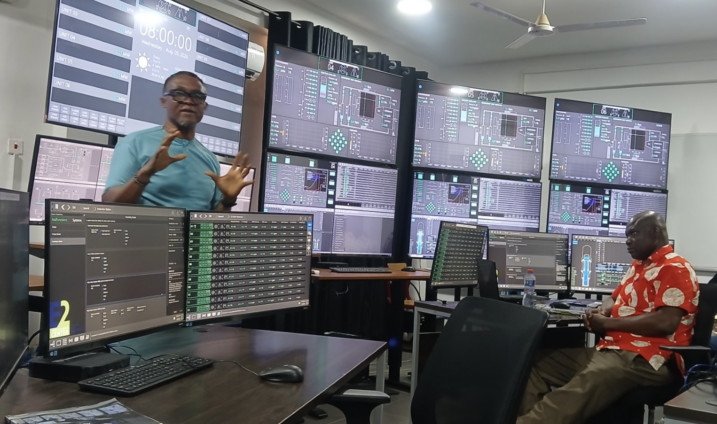
The NuScale Energy Exploration Centre, located at GAEC’s Atomic-Kwabenya enclave, reproduces aspects of an SMR control-room environment and allows trainees to practise plant operations and procedures without operating an actual reactor.
During an August media tour organised by Nuclear Power Ghana, Nuclear Power Institute official George Kofi Appiah said the centre had already supported Ghanaian personnel as well as participants from Nigeria and Kenya.
It is a simulator, not a reactor
This distinction is essential.
The E2 Centre does not contain nuclear fuel and does not generate electricity.
It is a computer-based simulation and training system.
Its importance lies in giving engineers, students, regulators and other professionals exposure to reactor operations, control-room behaviour and nuclear decision-making before Ghana operates a commercial nuclear power plant.
The centre was inaugurated in 2025 under the US Foundational Infrastructure for Responsible Use of Small Modular Reactor Technology programme. It was designed from the beginning to support wider African workforce development.
A regional model is emerging
Africa’s nuclear workforce challenge is substantial.
Newcomer countries need regulators, nuclear engineers, radiation-protection professionals, quality specialists, project managers, operators, emergency planners and technicians.
Replicating every specialised training facility immediately in every country may be inefficient.
Ghana’s simulator suggests another model.
Some expensive capabilities can function as regional assets while national programmes build their own essential institutional competence.
That could eventually include simulator facilities, specialist laboratories, nuclear security centres, safeguards training, emergency-preparedness facilities and regulatory courses.
Technology-specific training needs careful interpretation
The simulator is based on NuScale technology.
That provides useful operational and educational exposure, but training on the simulator should not be confused with a national technology-selection decision.
A newcomer country needs broad, technology-neutral nuclear competence even when individual training facilities use a particular vendor platform.
The same principle applies to Ghana.
Using the E2 Centre strengthens human capacity, but it does not by itself constitute a reactor licence, final investment decision or construction commitment.
Why this matters for Africa
A nuclear programme ultimately depends on people.
Countries can import reactor technology, but they cannot permanently outsource responsibility for nuclear safety.
Regulators must understand the systems they supervise.
Owners must retain enough knowledge to act as intelligent customers.
Operators must be capable of managing normal, abnormal and emergency conditions.
Regional training infrastructure can help Africa accelerate this capability development.
Ghana’s simulator is therefore becoming valuable not because it resembles a future control room, but because it demonstrates how one country’s nuclear investment can serve a wider continental workforce.
Related

Morocco Nuclear Regulator Says No Radioactive Leak at Maâmora Research Centre
By Nuclear Africa• October 7, 2026
Amazon’s 20-Year Nuclear Deal Shows How Large Corporate Buyers Can Help Finance Nuclear Investment
By Nuclear Africa• October 7, 2026Beyond the Resolutions: GC70 and the Emerging Global Nuclear Order
By Nuclear Africa• October 6, 2026
US Nuclear Regulator’s Workforce Warning Carries a Clear Lesson for African Nuclear Newcomers
By Nuclear Africa• October 5, 2026