Ghana has spent years building the institutional and legal foundations required for a nuclear power programme. But as the country moves deeper into the development of its first nuclear power project, an important part of that framework remains unfinished.
Seven Legislative Instruments under the Nuclear Regulatory Authority were still pending in Parliament at the end of Parliament’s Second Meeting of 2026, according to a legislative-status review published by the Ghana News Agency on 13 August.
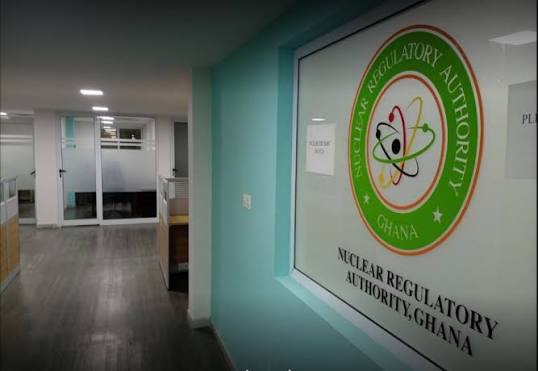
The distinction is important. Ghana does not lack a nuclear regulator or a primary nuclear regulatory law. The country established the Nuclear Regulatory Authority under the Nuclear Regulatory Authority Act, 2015 (Act 895).
What remains at issue is the completion of subsidiary regulations that translate the broad powers and obligations contained in the Act into detailed requirements that can be applied to nuclear facilities and activities.
As Ghana progresses towards decisions on technology, siting, procurement and ultimately licensing and construction, those detailed rules are becoming increasingly important.
Seven Nuclear Regulations Still Pending
Parliament concluded its Second Meeting of the First Session on 31 July 2026.
A Ghana News Agency review of Parliament’s legislative activity subsequently reported that 18 Legislative Instruments remained pending, including seven instruments under the Nuclear Regulatory Authority.
The development is particularly significant because Ghana’s nuclear programme is progressing through a stage in which regulatory requirements will increasingly intersect with commercial and technical project decisions.
The Nuclear Regulatory Authority has already developed a wider body of draft regulations under powers provided by Act 895.
The Authority’s published draft-regulation programme covers important areas including nuclear-installation licensing, site evaluation, design, construction and commissioning, operation of nuclear installations, emergency preparedness and response, nuclear security, integrated management systems and radiation protection.
These are not peripheral administrative matters.
They establish many of the detailed requirements against which a future nuclear power project will eventually be assessed.
Having a Nuclear Law Is Not the Same as Having the Complete Regulatory Architecture
The distinction between legislation and subsidiary regulation can sometimes disappear in public discussions about nuclear readiness.
Primary legislation establishes the fundamental legal framework.
In Ghana’s case, Act 895 established the Nuclear Regulatory Authority and provides the statutory foundation for regulating nuclear and radiation-related activities.
But an Act of Parliament cannot practically contain every technical requirement governing the lifecycle of a nuclear power plant.
That is where subsidiary regulations become important.
The regulatory pathway can be understood broadly as: Primary legislation → subsidiary regulations → regulatory guidance → licence application → technical assessment → regulatory decision → inspection and enforcement. Each stage supports the next.
A country may therefore have an established nuclear regulator and comprehensive primary legislation while still needing to complete detailed regulations before some aspects of a nuclear power programme can be regulated with the level of clarity required for an actual project.
That appears to be the issue Ghana now needs to address.
Why the Timing Matters
Ghana’s nuclear ambitions are gradually moving beyond broad policy discussions.
The country has undertaken extensive work under the International Atomic Energy Agency’s Milestones Approach and is progressing through the activities associated with Phase 2 — the stage preceding a decision to contract for a nuclear power plant.
At this point, questions about siting, technology selection, financing, ownership arrangements, grid integration, environmental assessment and vendor engagement become progressively more concrete.
Regulatory readiness must advance alongside them.
A prospective nuclear project developer needs to understand the regulatory requirements it will have to satisfy.
Potential vendors need clarity about the standards against which their technologies will be evaluated.
Investors and financing institutions need confidence that the regulatory system is predictable and sufficiently independent.
And the regulator itself needs a detailed framework through which it can assess applications, impose licence conditions, inspect facilities and enforce compliance.
The seven pending instruments should therefore be viewed within the wider question of whether Ghana’s regulatory development is keeping pace with the development of the nuclear project itself.
From Siting to Construction
The significance becomes clearer when the subjects covered by Ghana’s developing regulatory framework are considered.
Site evaluation determines the conditions under which a proposed nuclear site must be assessed for natural and human-induced hazards.
Design regulations establish expectations concerning nuclear safety before construction.
Construction and commissioning requirements govern how an approved design is translated into an operating facility.
Operational regulations determine how the plant must subsequently be managed.
Emergency preparedness requirements establish arrangements for responding to credible nuclear or radiological emergencies.
Nuclear-security regulations address the protection of nuclear material, facilities and associated activities against malicious acts.
These regulatory areas collectively cover much of the lifecycle of a nuclear power plant.
Completing the framework before major irreversible project decisions are taken can consequently reduce uncertainty for both the regulator and the future owner-operator.
Regulation Must Keep Pace With Procurement
One of the most important lessons for nuclear newcomer countries is that the commercial and regulatory tracks of a nuclear programme cannot develop independently.
Selecting a reactor vendor is not the same as licensing a reactor.
A government’s preferred technology does not automatically become an acceptable technology from the regulator’s perspective.
The future owner-operator will eventually have to demonstrate that the selected technology, proposed site, organisational arrangements and safety case satisfy Ghanaian regulatory requirements.
The Nuclear Regulatory Authority must make those determinations independently within the country’s legal framework.
That separation is fundamental to credible nuclear governance.
It also means that the detailed regulatory framework should ideally be sufficiently mature before the programme reaches stages where large contractual commitments are made.
Otherwise, there is a risk that commercial decisions begin establishing expectations before regulatory requirements have been fully settled.
The Issue Is Not Whether Ghana Has a Regulator
This distinction deserves emphasis. The pending Legislative Instruments should not be interpreted as meaning that Ghana has no nuclear regulatory system. It does.
The Nuclear Regulatory Authority is established by law and already regulates nuclear and radiation-related activities within the country.
The issue is more specific: the subsidiary regulatory architecture required to give detailed technical effect to parts of Act 895 remains under development and parliamentary consideration.
That is an important difference.
NuclearAfrica also cautions against interpreting the number of pending instruments as evidence that Ghana’s nuclear programme has stalled. Legislative and regulatory development is itself part of building the infrastructure necessary for a nuclear programme.
The relevant policy question is instead whether completion of these instruments is progressing at a pace consistent with Ghana’s wider nuclear timetable.
A Test of Institutional Sequencing
Nuclear programmes are sometimes discussed as though construction of the reactor were the principal measure of progress.
For newcomer countries, some of the most consequential work happens long before concrete is poured.
Legislation must be enacted.
The regulator must be independent and adequately resourced.
Regulations must be established.
Technical competence must be developed.
Sites must be characterised.
Environmental assessments must be undertaken.
Emergency arrangements must be prepared.
The electricity grid must be assessed.
Financing and ownership structures must be established.
Only when these elements mature together does a nuclear programme move from political ambition towards an implementable project.
Ghana’s pending regulations are therefore part of a much larger institutional sequencing challenge.
Why This Matters for Africa
Ghana’s experience offers an important lesson for the growing number of African countries exploring nuclear energy.
There is increasing interest across the continent in both conventional large reactors and small modular reactors. Governments are signing cooperation agreements, conducting feasibility studies, developing nuclear-energy policies and engaging potential technology vendors.
Those developments frequently attract the greatest public attention.
But regulatory infrastructure is just as important as reactor technology.
A nuclear programme cannot ultimately be sustained by political commitments, vendor agreements or technology announcements alone. It requires an independent regulator operating under clear legislation, detailed regulations, competent technical staff and transparent licensing processes.
African newcomer countries should therefore avoid a situation in which technology procurement substantially outruns regulatory development.
The two processes need to advance together.
Ghana is comparatively advanced among Africa’s nuclear newcomers precisely because it has already established many of these institutions. Completing the remaining subsidiary regulatory framework would further strengthen that foundation.
What Happens Next?
The immediate issue to watch is Parliament.
The seven Nuclear Regulatory Authority Legislative Instruments were reported as pending when Parliament ended its Second Meeting on 31 July.
Their status could change as the legislative process continues.
Attention should therefore focus not simply on whether the regulations are laid or adopted, but also on what they contain and how closely they align with international nuclear safety, security and regulatory standards.
Implementation will be equally important.
Regulations on paper require competent personnel, inspection capabilities, technical support, enforcement mechanisms and adequate regulatory financing to become effective.
Passing the instruments will consequently represent another milestone rather than the end of Ghana’s regulatory-readiness process.
The Bigger Nuclear Readiness Question
Ghana’s nuclear programme is approaching a period when decisions taken across different institutions will increasingly converge.
Technology choices will affect licensing.
Site characteristics will affect reactor design.
Grid capabilities will influence reactor size.
Financing arrangements will affect project structure.
And all of those decisions will ultimately intersect with the regulatory framework.
That makes completion of the subsidiary regulations more than a parliamentary housekeeping exercise.
It is part of establishing the rules under which Ghana’s first nuclear power plant could eventually be approved, constructed, commissioned and operated.
For Ghana — and for other African nuclear newcomers watching its progress — the lesson is straightforward:
Building the institutions and rules that govern a nuclear power plant is as important as choosing the reactor that will eventually be built.
Related

Morocco Nuclear Regulator Says No Radioactive Leak at Maâmora Research Centre
By Nuclear Africa• October 7, 2026
Amazon’s 20-Year Nuclear Deal Shows How Large Corporate Buyers Can Help Finance Nuclear Investment
By Nuclear Africa• October 7, 2026Beyond the Resolutions: GC70 and the Emerging Global Nuclear Order
By Nuclear Africa• October 6, 2026
US Nuclear Regulator’s Workforce Warning Carries a Clear Lesson for African Nuclear Newcomers
By Nuclear Africa• October 5, 2026