New European and US market data show Namibia becoming an increasingly important supplier of uranium to major Western nuclear fleets. But the numbers also expose a deeper African challenge: the continent remains concentrated at the mining end of a fuel chain whose most valuable strategic stages are still performed elsewhere.
Namibia supplied 842 tonnes of uranium to European Union utilities in 2025, accounting for 5.74% of all natural uranium delivered to the EU, according to the latest Euratom Supply Agency market data.
That represented an extraordinary 476.33% increase in delivered quantities compared with 2024, making Namibia by far the largest African supplier to the European nuclear market during the year.
Namibian uranium is also reaching another of the world’s largest nuclear markets.
The latest US Energy Information Administration Uranium Marketing Annual Report shows that uranium of Namibian origin accounted for 4% of uranium deliveries to US civilian nuclear power reactor owners and operators in 2025.
Taken together, the figures demonstrate something strategically important for Africa.
Namibia is not merely sitting on uranium resources.
Its uranium is already contributing directly to the fuel security of nuclear reactors operating across Europe and the United States.
But that success raises another question:
How much of the nuclear fuel value chain is Africa actually capturing?
Namibia Emerges as a Major European Supplier
European utilities purchased 14,678 tonnes of natural uranium in 2025 through 147 deliveries under long-term and spot contracts.
Canada was the EU’s largest source, supplying 36.68%, followed by Kazakhstan at 20.31%, Russia at 15.98%, Uzbekistan at 10.37% and Australia at 9.39%.
Namibia followed those major producers with 5.74% of total EU deliveries.
Its 842 tonnes placed it far ahead of every other African source recorded in the Euratom statistics.
Niger supplied 33 tonnes, Malawi 28 tonnes and South Africa 26 tonnes.
The contrast with Niger is particularly striking.
Niger’s deliveries to EU utilities fell by 97.14% compared with 2024, while Namibia’s rose more than fivefold.
Those figures should not be interpreted simply as corresponding changes in national uranium production.
Uranium deliveries reflect contracts, inventories, logistics, mine performance and commercial arrangements, and uranium delivered during a particular year does not necessarily have to have been mined during that same year.
Nevertheless, the data show a clear change in the European market flow.
Namibia has become one of Europe’s more significant individual uranium sources.
Namibia Is Also Supplying US Reactors
The American data tell a similar story.
US civilian nuclear plant owners and operators purchased 46.9 million pounds of U3O8 equivalent in 2025, according to the EIA.
Canada supplied 32% of those deliveries, Kazakhstan 28%, Australia 15%, Uzbekistan 7% and Namibia 4%. Uranium originating within the United States itself represented only 7% of deliveries.
That means Namibia supplied a measurable share of the uranium supporting the world’s largest national nuclear generating fleet.
The broader US figures also show why fuel security has become such an important international issue.
Of the uranium feed delivered by US reactor operators to enrichers during 2025, 63% went to foreign enrichment suppliers. Foreign-origin enrichment services accounted for 77% of enrichment services purchased by US civilian reactor operators.
The lesson is straightforward: uranium resources and nuclear fuel security are not the same thing.
From Mine to Reactor Core
Uranium mined in Namibia does not leave the mine ready to be inserted into a commercial light-water reactor.
The material must move through several technically distinct stages before becoming finished reactor fuel.
The sequence is broadly: uranium mining and milling → conversion → enrichment → fuel fabrication → reactor loading.
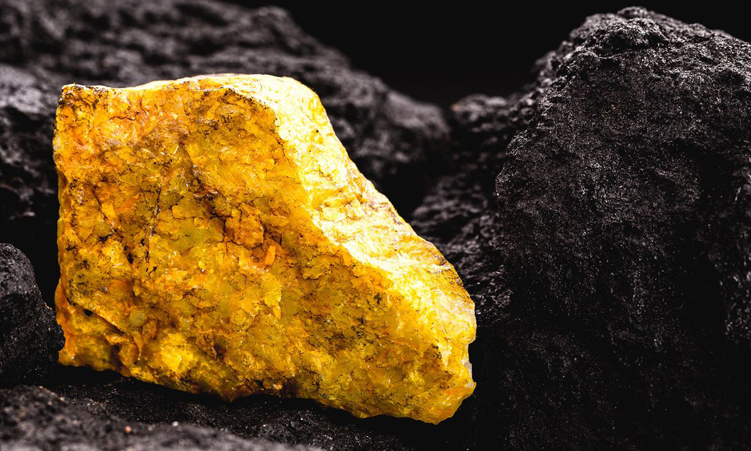
At the mine, uranium ore is processed into uranium concentrate, commonly referred to as yellowcake.
The uranium then normally undergoes conversion into a chemical form suitable for enrichment.
Enrichment increases the concentration of uranium-235 to the level required by most commercial power reactors.
The enriched uranium is subsequently converted into fuel material, fabricated into pellets and assembled into engineered fuel assemblies appropriate to a particular reactor design.
Africa participates strongly in the first part of that chain.
Its role diminishes sharply after that.
Europe’s Own Data Show Where the Strategic Value Lies
The Euratom figures reveal the importance of this distinction particularly clearly.
Although Russia supplied 15.98% of the natural uranium delivered to EU utilities in 2025, Russian providers accounted for 22.55% of enrichment services supplied to EU utilities.
Rosatom also provided 24.40% of separately contracted uranium conversion services.
Those numbers explain why Europe’s effort to diversify away from Russian nuclear supply is considerably more complicated than finding alternative uranium mines.
A utility can source uranium from Namibia, Canada, Australia or Kazakhstan and still depend on a completely different country for conversion, enrichment or fuel fabrication.
The strategic bottleneck therefore often sits downstream from the mine.
That is precisely where the African industrial-policy opportunity becomes interesting.
Namibia Already Has the Mining Scale
Namibia is not a marginal uranium producer.
World Nuclear Association data indicate that the country accounted for approximately 12% of global mined uranium production in 2024, placing it among the world’s leading uranium-producing jurisdictions.
Its mining ecosystem includes some of the most important uranium operations globally.
Husab is among the world’s largest uranium mines. Rössing remains a major producer, while Langer Heinrich has returned to production following a period on care and maintenance.
The Namibia Uranium Association reports that Husab produced more than 5,200 tonnes of U3O8 in 2024, while Langer Heinrich resumed commercial production and produced 814 tonnes of U3O8 during that calendar year as it continued its ramp-up.
The country therefore already possesses considerable experience in uranium extraction, processing, environmental monitoring, mining regulation and the technical services associated with a substantial uranium industry.
The policy question is whether some of that expertise can become the foundation for wider participation in the international nuclear economy.
Downstream Value Does Not Have to Begin With Enrichment
Calls for African value addition sometimes jump immediately from uranium mining to uranium enrichment.
That risks oversimplifying the challenge.
Commercial enrichment requires highly specialised technology, very substantial capital investment, large and predictable markets, strong nuclear regulation, international safeguards and carefully managed non-proliferation obligations.
It is therefore not an obvious first step for every uranium-producing country.
There are many other parts of the nuclear fuel economy where African capability could potentially expand earlier.
Countries can deepen expertise in uranium chemistry, nuclear-material laboratories, transport and logistics, environmental monitoring, safeguards, material accountancy, radiation protection, mining technology, engineering services and radioactive-waste management.
Technical universities and research institutions can also develop expertise around the nuclear fuel cycle even where commercial conversion or enrichment is not immediately justified.
The strategic objective should not be to replicate every stage of the global fuel cycle domestically.
It should be to identify where Africa can realistically capture more technical and economic value.
A Lesson From the Critical-Minerals Debate
The issue has parallels with Africa’s wider critical-minerals debate.
African countries have increasingly questioned a development model in which mineral resources are extracted locally but most refining, advanced manufacturing and technology development occur elsewhere.
Uranium deserves the same examination.
The difference is that nuclear materials operate within a far more demanding international safety, safeguards and non-proliferation architecture.
Any downstream strategy would therefore have to be built around those obligations from the beginning.
That need not be viewed simply as a constraint.
Strong safeguards, regulatory capability and nuclear-material control can themselves become sources of institutional competence.
Niger Shows Why Reliability Matters
The sharp reduction in Niger-origin deliveries to Europe provides another lesson.
Niger remains one of Africa’s historically important uranium jurisdictions, but recent political, commercial and operational disruptions have complicated its uranium sector.
The dramatic fall in deliveries does not mean Niger has lost its geological uranium resources.
It demonstrates something different:
uranium security depends on more than geology.
Political stability, predictable regulation, mining performance, infrastructure, transport routes and commercial relationships all influence whether uranium actually reaches reactor customers.
For African producers seeking long-term international markets, reliability therefore becomes part of the value proposition.
Africa Should Follow the Fuel, Not Just the Ore
Namibia’s latest market position should encourage African policymakers to look beyond headline uranium production statistics.
The more revealing questions are:
Where is the uranium converted?
Where is it enriched?
Where is the fuel fabricated?
Who finances those activities?
Who owns the intellectual property?
Where are the skilled jobs?
And which countries capture the higher-margin services surrounding those activities?
Those questions are increasingly important as countries seek to strengthen nuclear fuel security.
Why This Matters for Africa
Global nuclear expansion could create one of the most important uranium-market opportunities in decades.
Namibia is already positioned to benefit.
Its uranium is flowing into both European and American nuclear fleets, and the country maintains a substantial mining base capable of supplying international customers.
But Africa should measure success by more than export volumes.
The deeper strategic objective should be to convert natural-resource participation into technical capability, specialised employment, stronger nuclear institutions and progressively higher-value industrial participation.
Namibia’s 842 tonnes of uranium delivered to the European Union in 2025 demonstrate that Africa already has a seat at the nuclear fuel table.
The next question is how much further along that table the continent wants to move.
NuclearAfrica Editorial Note
The 476.33% increase refers to uranium delivered from Namibia to EU utilities between 2024 and 2025. It should not be reported as a 476% increase in Namibia’s national uranium mine production.
Likewise, Niger’s 97.14% fall concerns EU deliveries during the year and does not represent a corresponding reduction in uranium reserves or long-term resource potential.
Movement into downstream fuel-cycle activities would also require substantially different investment, technology, regulatory arrangements and safeguards obligations from uranium mining.
Related

Morocco Nuclear Regulator Says No Radioactive Leak at Maâmora Research Centre
By Nuclear Africa• October 7, 2026
Amazon’s 20-Year Nuclear Deal Shows How Large Corporate Buyers Can Help Finance Nuclear Investment
By Nuclear Africa• October 7, 2026Beyond the Resolutions: GC70 and the Emerging Global Nuclear Order
By Nuclear Africa• October 6, 2026
US Nuclear Regulator’s Workforce Warning Carries a Clear Lesson for African Nuclear Newcomers
By Nuclear Africa• October 5, 2026